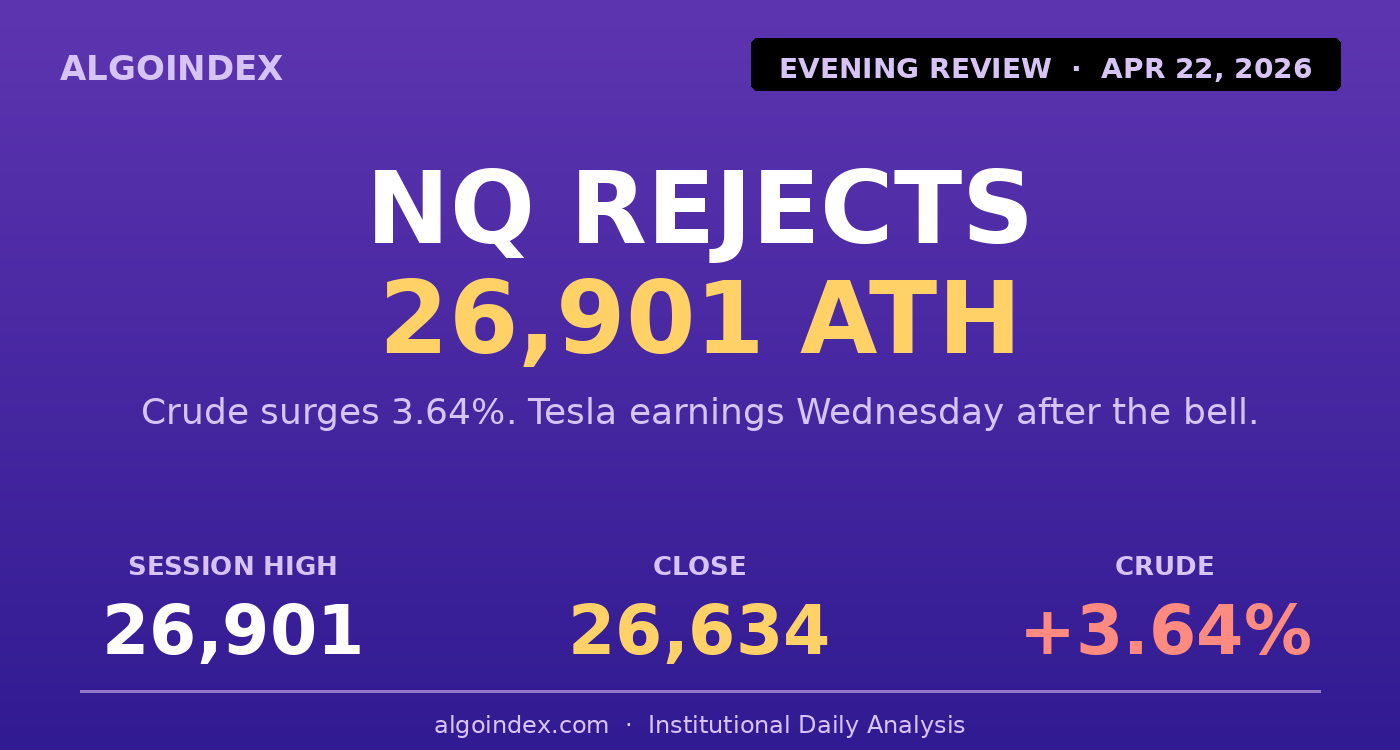
On Tuesday morning, NQ printed a new all-time high of 26,901.75 within the first hour of the cash open, the latest line in an April melt-up that has pulled the Nasdaq-100 more than ten percent off its 20-day moving average. By 15:30 ET the bid was gone. A 350-point session range had already carved its low at 26,551.75, VIX was quietly climbing 3.34 percent to 19.49, and crude oil had surged 3.64 percent to 92.79 on a second consecutive draw in US inventories and renewed Iran-Hormuz headline pressure. NQ settled at 26,634.75, lower by 114 points, and the daily candle finished as a reversal bar that tagged the all-time high and then left the upper 100 points untraded into the close.
The mechanical story is simple. Every major moving average sits below price, short-term momentum is stretched to the kind of reading that historically invites mean-reversion, and Wednesday after the bell brings the single most volatile print of the Magnificent Seven. Tesla reports at 16:05 ET, Texas Instruments at 16:30 ET. Add UK CPI overnight, EIA crude inventories at 10:30 ET, and a twenty-year Treasury auction at 13:00 ET, and Wednesday becomes a session that does not reward passive positioning. What follows is the structure the Wednesday open inherits, the crude-driven mechanism that tilted Tuesday into distribution, and the two NQ setups that sit inside the technical and dealer-positioning map.
A Record High That Was Rejected With Pace
The rejection was not subtle. NQ traded 26,901.75 within the first hour of the open, a fresh all-time high by more than fifteen points over Monday’s mark. The distribution began around 11:00 ET, accelerated into the New York afternoon, and the low at 26,551.75 arrived inside three hours. On higher timeframes the uptrend remains intact and the technical composite still reads 56 percent buy, but shorter-window momentum is deeply overbought. The 9-day relative strength index prints 80.51, the 14-day reads 72.45, and stochastic K and D come in at 96.21 and 97.42. Those readings do not require a rejection, but when one arrives at the exact all-time high on a session where volatility is expanding, the read is that the net-long book has tagged its upper boundary.
The dealer-positioning map reinforces the Tuesday close as a pivot rather than a new impulse. QQQ, which tracks the Nasdaq-100, references 646 with the primary upside call concentration at 655, downside put concentration at 600, and the dealer gamma flip level at 640. Mapped to NQ futures, the confluence stacks at 26,760 for the upside call zone, 26,720 for the volatility inflection level, 26,703 for the computed pivot, and a downside gamma flip zone at 26,560. Price is holding inside positive-gamma territory for now. A break below 26,560 steps price into a less-supportive dealer environment and opens room toward the S2 standard-deviation level at 26,411. The mechanics of how dealer gamma positioning shapes price remain the interpretive key: inside positive gamma, dealers are stabilizing; outside it, they are amplifying.
Crude Was the Mechanism, Not a Sideshow
Tuesday’s 3.64 percent move in WTI crude to 92.79 was not a rates-neutral rotation. Two things happened in sequence. The American Petroleum Institute reported an overnight crude draw of 4.47 million barrels, roughly four and a half times the consensus one-million draw. The Trump administration then extended its Iran ceasefire while keeping the military blockade intact, and Iran’s Parliament Speaker and Military signaled that continued US pressure would be grounds to move on the Strait of Hormuz. For a rate-sensitive index where much of the Mag7 cash flow is discounted against back-end yields, an oil move of that magnitude imports two simultaneous headwinds: it lifts the near-term inflation prior, widening the valuation haircut on long-duration growth, and it reintroduces a geopolitical risk premium that rotates capital from technology toward energy and defensive exposure.
The mechanism shows up in the breadth read. The Nasdaq outperformed the S&P 500 cash by twenty-five basis points on the downside measure, a small divergence that masked a weaker sector internal with semiconductors and consumer discretionary leading the fade. The concurrent broader S&P read from the same session documented the same reversal on ES, where the 7,183 supply zone was tagged to the penny and rejected on the identical Iran-cascade sequence. Two different index structures, one macro driver. The consistency across instruments matters because Wednesday’s open is not inheriting a single-index technical problem; it is inheriting a cross-asset repricing.
Wednesday’s Catalyst Stack Is Dense and Binary
The event calendar places the Nasdaq directly in the line of fire. Overnight, UK headline and core CPI print at 02:00 ET, where consensus sees headline cooling to 3.0 percent from 3.3 percent and core holding at 3.2 percent. A downside surprise lifts global duration and supports a Nasdaq bid toward the 26,703 pivot; an upside surprise pressures yields higher and accelerates NQ toward 26,580. Midday brings Boeing and AT&T earnings before the bell, EIA weekly crude inventories at 10:30 ET where a second consecutive draw compounds Tuesday’s crude-inflation dynamic, and a US twenty-year bond auction at 13:00 ET where a soft tail reignites duration concerns.
The decisive catalyst arrives after the bell. Tesla reports at 16:05 ET with consensus of 0.36 per share and revenue near 22.3 billion; the single most volatile Magnificent Seven name closed 388.11 into the release. Texas Instruments reports at 16:30 ET, a critical read on the semiconductor cycle. IBM follows at 17:10 ET. The Tesla print is the most likely driver of a gap event on Thursday’s open, and implied volatility on Nasdaq ETF options is likely to expand ten to fifteen percent into 15:30 ET on position-reduction flows. The post-market Nvidia headline, a partnership investing up to ten billion dollars in Anthropic with workloads on Microsoft Azure using Grace and Vera Rubin chips, landed muted with NVDA off 1.08 percent. That muted response is profit-taking into the record print, not a fundamental repricing, and it reinforces the read that the Tuesday fade was positioning rather than thesis.
The Two Setups for the Wednesday Open
The structural backdrop matches what Monday’s NQ coil under the record outlined, where the setup was a coiled range beneath the all-time high with a binary resolution queued for the following session. Tuesday was that resolution, and it came on the upside first and the downside second. The broader read, consistent with the broader correction-risk framework, is that the uptrend remains intact but the short-term momentum is working off extension. Wednesday’s catalyst stack is the most likely mechanism for that reset. Sizing should reflect the after-close Tesla and Texas Instruments risk; any position held into 16:05 ET is a position held over a single-stock gap.
A record high was printed and then rejected on the same session, and the Wednesday after-close clock starts the moment the opening bell rings.
Update: the Wednesday session fully reversed Tuesday’s rejection, printing a fresh all-time high at 27,136 into settlement. Read the follow-on in our Thursday NQ review covering the 27,136 ATH, Tesla earnings reaction, and the 09:45 ET Flash PMI setup.
Join the Discussion
Connect with other ES futures and SPY options traders. Share setups, discuss levels, and get real-time market insights from our community.
Join AlgoIndex Trading CommunityFoundational guides
New to Nasdaq 100 futures? Start with What Are NQ Futures, the ES, NQ, MES & MNQ point value and contract specs, QQQ gamma exposure (GEX), and market internals: TICK, ADD, VOLD and VIX.