image
undefined

Frequently Asked Questions

What is options flow analysis for ES futures?

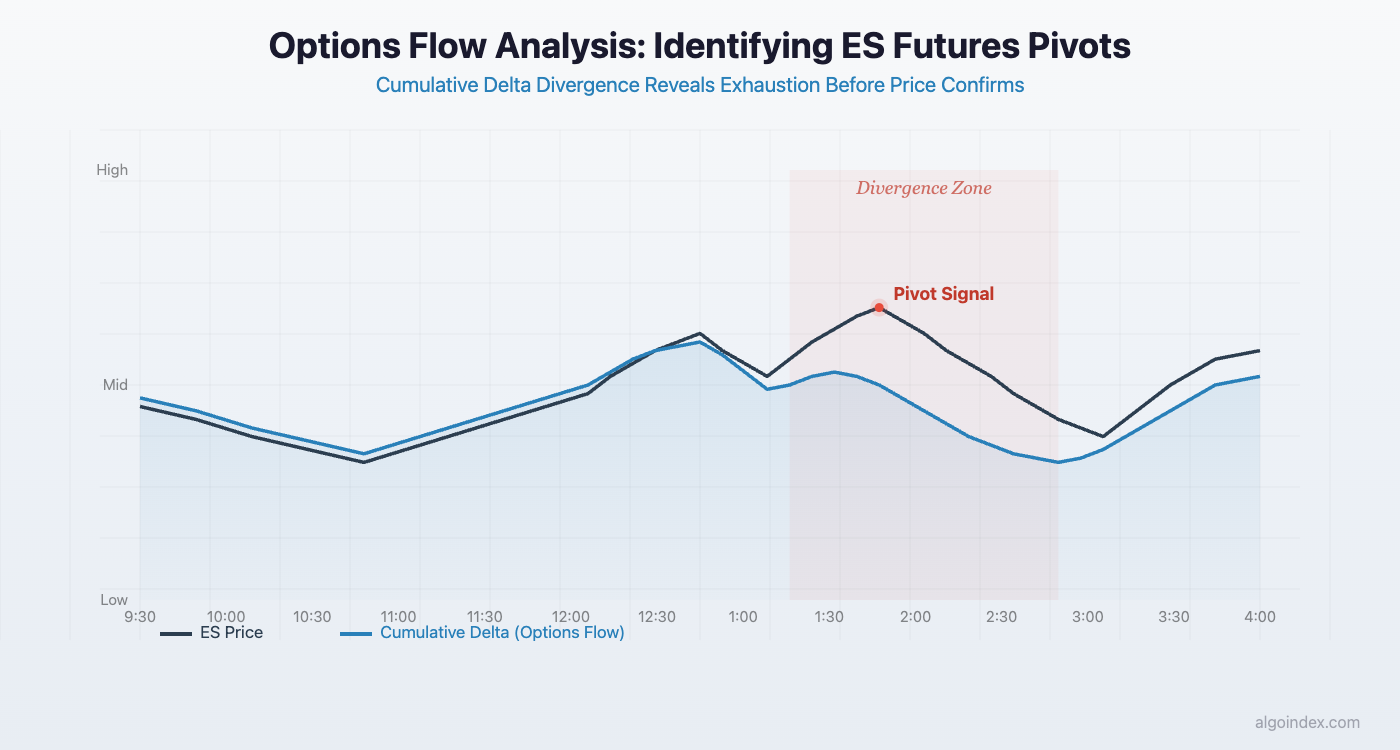
Options flow analysis tracks institutional buying and selling of options contracts in real-time. For ES futures traders, monitoring SPX options flow reveals where large participants are placing directional bets, hedging risk, or building positions – often signaling price pivots before they show up on the futures chart.

How does HIRO help identify ES futures pivot points?

HIRO (Hedging Impact Real-time Overlay) tracks cumulative customer delta from options trades during regular trading hours. When HIRO diverges from price action – for example, HIRO flattening while ES keeps rising – it signals that options flow is exhausting, and a reversal is likely forming. This divergence at key gamma levels provides the highest-conviction pivot signals.

What is the difference between 0DTE and longer-dated options flow?

0DTE (zero days to expiration) flow represents same-day options trades that are highly reactive and short-term – these generate large immediate dealer hedging impacts but are prone to reversal. Longer-dated flow (weekly, monthly expirations) represents more deliberate institutional positioning with higher conviction and more stable price effects.

When is options flow data most reliable for ES futures trading?

Options flow is most reliable during the New York AM session (9:30-11:30 ET) when institutional volume peaks, and during power hour (3:00-4:00 ET) when end-of-day positioning accelerates. Flow signals are less reliable during lunch hours (12:00-1:30 ET) due to lower volume, and should not be used outside regular trading hours.


Day 23 of Conflict | Hormuz Blocked 3 Weeks | 200-DMA Broken

Iranian ballistic missiles struck near Israel’s nuclear facility Saturday. Interceptors failed. WTI touched $100. ES closed 112 points below the 200-DMA for the first time since October 2025, and OPEX wiped $93.9 billion in gamma from the dealer book. The IEA chief called this “worse than the two oil crises of the 1970s combined.”

Saturday’s Iranian ballistic missiles struck Dimona and Arad, wounding 180 people near Israel’s Shimon Peres Negev Nuclear Research Center. Israeli interceptors launched and failed. Two warheads weighing hundreds of kilograms made direct impact, collapsing a building in Dimona. The IAEA confirmed no damage to the nuclear facility itself and no abnormal radiation readings. But the military and psychological impact of ballistic missiles landing near a nuclear research site, with interceptors failing to stop them, changes the calculus for every risk desk recalculating exposure Monday morning.

This is now Day 23 of the US-Israel military conflict with Iran. The Strait of Hormuz has been effectively blocked since February 28, shutting off approximately 20 million barrels per day, roughly 20% of global seaborne oil trade, for three consecutive weeks. WTI crude touched $100.22 intraday Friday and is heading for its fifth straight weekly gain. Brent is trading between $106 and $113. Gold hit $4,645. Money market funds reached a record $7.856 trillion. And on Friday, ES closed 112 points below the 200-day moving average at 6,619, the first close below that level since October 2025.

IEA Chief Birol, Sunday Evening

“The situation is worse than the two oil crises of the 1970s combined.” The “global economy faces a major threat today.” Fuel shortages are “an increasing problem in Asia.” Japan is spending 800 billion yen from budget reserves to curb gasoline prices. Malaysia’s fuel subsidy bill jumped to $811 million. The UK Prime Minister called an emergency economic meeting.

What $93.9 Billion in Expired Gamma Means for Monday

Triple witching destroyed the options positioning that had been anchoring dealer behavior for weeks. Roughly $93.9 billion in gamma exposure rolled off when Friday’s $4.7 trillion options expiration cleared, and that gamma was not neutral. It was concentrated at strikes between 6,600 and 6,700 SPX, the same zone where price spent most of the past two weeks. Dealers who had been hedging those positions were providing structural support, buying dips and selling rallies in a way that compressed volatility around those strikes. That structural support is gone.

The gamma index closed Friday at -4.097, the deepest negative reading of the entire March selloff. Negative gamma notional stood at -$1.189 billion. The stability meter dropped to 11% into the close, with negative gamma concentrated heavily at the 6,700 and 6,600 strikes. But here is the critical distinction: with OPEX clearing the book, Monday’s gamma environment resets. The 0DTE gamma exposure that dominated Friday vanishes, and Monday’s dealer positioning will be determined entirely by whatever new positions get opened this week.

This reset creates a two-sided dynamic. Moves will be less mechanically amplified than they were Thursday and Friday. A morning short-covering bounce has a better chance of holding for 30 to 45 minutes before sellers reload. But the structural support that kept price from falling through 6,600 SPX two weeks ago no longer exists. The gravitational anchors are gone, and the combo strikes that remain, at 6,600, 6,547, 6,507, 6,501, 6,474, 6,448, 6,402, and 6,303, all sit below Friday’s close.

The War Has Become the Single Variable That Matters

Every other input, the Fed’s hawkish hold at 3.75%, hot PPI at 0.7% monthly, broken moving averages, is secondary to what happens between Washington, Tehran, and the Strait of Hormuz.

Trump issued a 48-hour ultimatum to Iran: reopen the Strait or the US will “obliterate” Iran’s power plants. When pressed on the timeline, he responded: “You’re gonna find out soon. It’s gonna be very good. Total decimation of Iran.” Treasury Secretary Bessent stated the US “may need to escalate to de-escalate.” US officials told Israeli counterparts that America may have no alternative but to launch a ground operation to seize Kharg Island, the facility that handles 90% of Iran’s oil exports. Israel is “interested in wide-scale attacks on Iran’s energy facilities and backs the 48-hour ultimatum.”

Iran’s response has been equally escalatory. The IRGC declared that if energy facilities are targeted, “energy facilities in countries that host US bases will be lawful targets,” directly threatening Saudi Arabian, Emirati, Qatari, and Bahraini oil infrastructure. Iran’s Parliament Speaker Ghalibaf went further: “US Treasury bonds are soaked in Iranians’ blood. Purchase them, and you purchase a strike on your HQ and assets.” Late Sunday evening, explosions were reported in several parts of Tehran itself, signaling that active military operations are continuing and expanding in real time.

Positive Headline

Ceasefire, diplomatic channel, or Hormuz reopening signal triggers a 50-100 point short squeeze within minutes. Temporary reaction within the broader downtrend.

Negative Headline

Kharg Island seizure, Gulf energy strikes, or nuclear escalation accelerates selloff toward 6,475 and potentially beyond. VIX above 28 confirms acceleration.

The intelligence picture is shifting. Netanyahu reportedly relied on Mossad’s optimism about an uprising in Iran to convince Trump that a change of government was realistic. US intelligence now suggests hardliners will remain in power. The IDF chief stated the fight with Hezbollah has “only just begun,” confirming a multi-front war. Saudi Aramco’s CEO canceled his CERAWeek trip due to the conflict.

The 6,475 Expiration Problem

The JPMorgan quarterly collar put strike at 6,475 SPX has acted as a gravitational center for the past two weeks. Price bounced off it on Friday when SPX tagged the level exactly. Dealer hedging flows associated with that position provided measurable support every time SPX approached it. Institutional flow analysis confirmed desks were adding put butterflies at the 6,500 to 6,475 zone, betting on continued weakness into month-end.

That collar expires on March 31, eight trading days from Monday. When it expires, the hedging support it provides vanishes the same way OPEX cleared $93.9 billion in gamma. The 6,475 level goes from structural support to a number on a chart.

Seventy thousand VIX April 40 calls traded last week, creating a feedback loop that accelerates any selloff. VIX rises, those calls gain delta, dealers hedge by buying VIX futures, which pushes VIX higher, which makes the calls gain more delta. Meanwhile, 78,000 SPY put spreads targeting 625, roughly SPX 6,250, with a March 27 expiration represent a deep-pockets directional bet on 250 more points of downside within five trading days. RSI at 29.88 is technically oversold, but ADX at 34.57 with -DI dominating at 40.56 confirms a strong directional trend, not a mean-reversion setup. The Dow just posted its first four-week losing streak since 2023.

Friday Close and Key Levels

ES Settle

6,553

-1.51%

SPX Close

6,507

-1.51%

VIX

26.77

+11%

WTI Crude

$98.48

touched $100.22

Gold

$4,645

+0.87%

Money Markets

$7.856T

record

LevelSignificance
6,690-6,710Thursday’s Globex high zone. Not expected under current conditions.
6,643-6,655Friday’s OPEX high, computed pivot R2. Would require a significant positive headline.
6,620-6,631Computed pivot R1 and 200-DMA zone. Upper bound of any realistic Monday bounce.
6,580-6,596Value area high from Friday. First bounce target and short entry zone.
6,540-6,545Value area low. Sunday Globex testing here. Immediate support.
6,521-6,530JPM collar equivalent zone. Most important structural level in the market. Has held twice.
6,494-6,5014H extension target aligned with computed pivot S1.
6,470Computed pivot S2. Deep support, 4H discount zone.
6,419Computed pivot S3. Extreme downside, major escalation scenario only.

Primary Setup

Short from 6,580-6,600 (ES) | Stop 6,643 | Targets: 6,540 / 6,521 / 6,494

The post-OPEX gamma reset should allow enough of a short-covering bounce to provide the entry window between 9:45 and 10:30 AM before institutional sellers use that bounce to reload. Wait for real-time hedging flow confirmation of the morning bounce exhaustion before entry.

Based on historical backtesting, post-OPEX short setups from the value area high with defined stops above the session high have a favorable risk-reward profile.

March 31 is circled on every institutional calendar, and the eight days between now and then will determine whether the safety net holds or whether the market discovers what exists beneath it.

Past results are not indicative of future performance. This content is for informational and educational purposes only and does not constitute financial advice or a recommendation to buy or sell any security or futures contract. For our full performance disclosure, visit algoindex.com/performance-statement.

AlgoIndex Research · algoindex.com · Start your free trial

AlgoIndex Research | March 18, 2026

FOMC Day: What $2.2 Billion in Institutional Delta Shift and VIX Expiration Tell You About the Two-Phase Setup in ES Futures

The Setup in 30 Seconds

ES closed March 17 at 6,773 after a +0.68% session. But institutional hedging flow collapsed from -$81M to -$2.2B in cumulative delta during the final 2 hours, driven by 0DTE call selling and put buying. With VIX expiration removing 40% of open interest on March 18 morning and FOMC at 2:00 PM, expect a two-phase session:

  • Phase 1 (Morning): Vanna/vega driven rally toward 6,800 as vol compresses
  • Phase 2 (Afternoon): FOMC-driven directional move, likely toward 6,690-6,710 support (base case, 65% probability)

The Three Numbers That Define March 18

Options Flow Close (March 17)

-$2.2B

Cumulative delta driven by 0DTE call selling with additional put positioning. Institutions reduced upside exposure aggressively while adding downside hedges. Suggests hedging, not panic.

Gamma Stability

2%

Near the lowest reading possible. The market is compressed like a spring. Conditions are set for an amplified directional move larger than average.

Zero Gamma (ES)

6,797

Price closed 24 points below this threshold. Dealers remain in amplification mode, meaning the FOMC move will be larger than normal.

Summary: Institutions are hedged for a large move, the market is compressed for amplified price action, and dealer mechanics will magnify the FOMC reaction in whichever direction it goes.

Why This FOMC Is Different

The Federal Reserve announces its rate decision at 2:00 PM ET on Wednesday, March 18, and unlike the last several meetings where the outcome felt predetermined, this one carries genuine uncertainty about the forward path. The rate itself stays at 3.75% with 99% conviction. What matters is the dot plot, the updated economic projections, and how Jerome Powell characterizes inflation risk in a world where Iran just set a UAE gas field on fire and oil is back above $95.

The Bank of America Fund Manager Survey released on March 17 quantified the institutional mood shift. The numbers are striking: 45% of fund managers now expect higher CPI over the next 12 months, up from just 9% a month ago. Rate cut expectations collapsed from 46% to 17%. And 35% now expect rate hikes, up from 9%. This survey was conducted March 10-14, before the overnight Iran escalation heading into March 18. The actual institutional sentiment heading into FOMC is likely more bearish than these numbers suggest.

Key Point: The dot plot will either confirm or deny what fund managers already believe: that the rate-cutting cycle everyone was counting on has been postponed indefinitely. If Powell validates the “higher for longer” narrative, equities have to reprice. If he surprises to the dovish side, the $2.2 billion in institutional hedging unwinds violently and ES squeezes higher.

The Morning Counterweight: VIX Expiration and Vanna/Vega Dynamics

Important: Before jumping to the bearish conclusion, there’s a critical mechanical force that could push prices HIGHER into the FOMC decision.

March 18 is VIX expiration day, and approximately 40% of total VIX open interest expires at 9:30 AM. The 3.4 million March VIX call contracts that provided hedging demand all week will decay and close, removing a significant source of selling pressure on equities.

Gamma exposure analysis notes that the massive vol premium (+10 points) combined with VIX expiry, FOMC, and Friday’s OPEX creates conditions for a vanna/vega driven rally back toward 6,800 SPX. The mechanism: as VIX drops on expiration, dealers who were short vega buy back their hedges, creating upward pressure on equities. Fixed strike implied volatility already declined 1-2 vol points on March 17, and if that compression continues into the morning, SPX could rally toward the 6,800 Volatility Threshold level before FOMC begins.

This doesn’t invalidate the bearish positioning. It means the session likely has two phases: a morning lift from mechanical vol compression, followed by the FOMC directional resolution in the afternoon. Traders who only see the institutional hedging are missing half the picture.

What the March 17 Session Actually Revealed

The headline number, ES +0.68% to close at 6,773, masked a far more revealing intraday story.

From the open through 2:00 PM on March 17, the session looked like a continuation of the March 16 relief bounce. German ZEW Economic Sentiment printed at -0.5 versus 39.2 expected, one of the worst misses on record for European confidence, but the market shrugged it off completely. Traders were fixated on FOMC positioning, not European data.

The real signal came after 2:00 PM. Options flow data showed cumulative customer delta at -$81 million at 2:00 PM, essentially flat. By 4:00 PM, it had cratered to -$2.2 billion. That’s $2.119 billion of net negative delta in 120 minutes, driven by 0DTE call selling alongside put spread positioning. The put spreads being opened at the close, specifically at the 6,650/6,600 SPX strikes, are institutional-sized positions with defined risk parameters. These are portfolio hedgers and tactical funds reducing upside exposure while adding downside protection into the FOMC event.

Market internals confirmed the deterioration beneath the surface. While price rose 0.68%, breadth told a different story: NYSE Advance-Decline at 937 (-78, -7.68%), showing more stocks declining than advancing even as the index finished green. Volume conviction via VOLD dropped 17.08% to 469,181. VIX at 22.36 only fell 4.93% despite a positive session, an unusually small decline that signals the options market wasn’t buying the rally either.

Translation: The March 17 session was one where the index went up but the underlying market went down. The divergence between price and flow is the signal.

The Iran Factor: Escalation With a New Dimension

Developments overnight heading into March 18 added a layer of geopolitical risk that the market hasn’t fully priced in. Israel killed Iran’s security chief Ali Larijani in a targeted strike. Tehran responded by setting a UAE natural gas field on fire and threatening Kharg Island, Iran’s primary oil export terminal. Russia expanded its support for Iran with satellite imagery and drone assistance, per the Wall Street Journal.

This is a qualitative escalation, not just another exchange of missiles. Targeting a nation’s security chief is a decapitation strategy that changes the calculus on both sides. The threat to Kharg Island is particularly significant: approximately 90% of Iran’s oil exports flow through that terminal. Any disruption there would send crude materially higher and reset the energy risk premium that partially unwound on March 16.

Oil’s response was muted on the day, with WTI at $95.04, down slightly. That tells you the energy market has already priced in a base level of conflict, and any escalation from here needs to be genuinely new to move the needle. But the API Crude build of +6.556 million barrels (versus -0.6M expected) introduced a demand-side concern: either refineries are pulling back throughput or end-user demand is softening. Neither is bullish for the broader economy.

For the March 18 session, the geopolitical backdrop creates an asymmetry: dovish FOMC news gets partially offset by war premium, while hawkish FOMC news gets amplified by it.

Dealer Mechanics: Negative Gamma, Compressed Stability, Gravitational Pull

Negative Gamma Persists

Net gamma exposure on SPX remains negative, meaning dealer hedging amplifies moves in both directions. When dealers are short gamma, they sell as price falls and buy as price rises, creating a feedback loop that makes every move bigger than it would be in a positive gamma environment. This is why the March 16 Baghdad rocket attack produced a 30-point flush in two minutes, and it’s why the March 18 FOMC reaction will overshoot in whichever direction it goes.

The Stability Meter Is at 2%

This forward-looking metric from gamma exposure analysis measures how compressed the market’s positioning has become. At 2%, it’s near the absolute lowest reading, indicating that conditions are set for an amplified directional move. This isn’t a prediction of when or which direction, it’s a statement that the magnitude of the next significant move will be larger than average.

Gamma Concentration at 6,700-6,720 SPX

The delta pressure analysis shows all-pink (negative) readings below current price, indicating dealer downward hedging pressure. If price breaks below 6,720 SPX (approximately 6,773 ES), dealers will be forced to sell additional futures to maintain their hedges, accelerating the decline. This creates a gravitational pull toward the Put Concentration Level.

The Put Concentration Level at 6,690 SPX

The options-implied 1-day move low sits at 6,690, exactly where the Put Concentration Level and institutional put spread positioning concentrate. This is the level where selling pressure should exhaust, at least temporarily. Put spreads opened on March 17 at 6,650/6,600 tell you institutions expect a controlled pullback to the Put Concentration Level, not a crash through it.

PPI Preview: The Morning Catalyst

Producer Price Index data hits at 8:30 AM, 90 minutes before the cash market opens. The consensus expects year-over-year PPI at 3.0% (prior 2.9%), month-over-month at 0.3% (prior 0.5%), and core year-over-year at 3.7% (prior 3.6%).

A hot reading (above expectations) would reinforce the inflation persistence narrative right before Powell speaks, making a hawkish message easier to deliver. A cool reading (below expectations) would give Powell room to sound more balanced, potentially opening the door for the dovish surprise scenario.

The energy dimension is critical here. With Asia experiencing fuel price spikes across 12 countries (Vietnam gasoline +44%, Bangladesh rationing diesel, China suspending refined fuel exports), the pipeline pressure on producer prices is real. Oil back above $95 after the brief dip below on March 16 creates a cost-push dynamic that shows up directly in PPI. The odds favor an in-line to slightly hot reading, which would support the bearish base case for the FOMC reaction.

Technical Structure: Below Every Major Moving Average

Price at 6,773 ES sits in a clear distribution pattern between short-term support and intermediate resistance.

Moving Average Positioning

ES is above only the 9-day MA (6,741) and the 200-day MA (6,608). Every intermediate moving average, including the 18-day at 6,815, the 40-day at 6,866, and the 100-day at 6,841, sits overhead as resistance. This configuration, where price is sandwiched between a rising short-term MA and falling intermediate MAs, is characteristic of a relief rally within a downtrend, not the beginning of a reversal.

The 4-Hour Timeframe

Maintains a clear lower-high, lower-low sequence from the March 10 high at 6,950. Multiple break-of-structure events to the downside confirm the trend. The 4-hour oscillator is rolling over in the 54-62 range, meaning momentum from the March 17 bounce is already fading.

Stochastic Readings Are Deeply Oversold

The 14-day raw stochastic sits at 28.51%, with %K at 18.00% and %D at 16.55%, both firmly in the oversold zone below 20. RSI at 41.71 is approaching but hasn’t reached oversold territory. These readings historically precede bounces, not continuation selloffs. Combined with the vanna/vega rally thesis from VIX expiration, this supports a morning bounce before FOMC determines the afternoon direction.

Composite Technical Indicators

Read 8% Sell with minimum strength. The multi-week degradation pattern is telling: from 56% Buy a month ago to 24% Buy last week to 8% Sell now. This steady erosion matches the fund manager survey’s institutional rotation from optimism to caution. ADX at 28.03 confirms the market is trending, not chopping, and the directional indicators show -DI at 31.77 leading +DI at 10.66, nearly a 3-to-1 ratio favoring the downtrend.

Three Scenarios for March 18

Scenario 1: Neutral to Hawkish

65% Probability – Base Case

The Setup: Powell reiterates “higher for longer.” The dot plot shows 2 rate cuts in 2026 instead of the 3 projected three months ago. He acknowledges inflation risks from geopolitical disruption without signaling urgency to cut.

Market Reaction: ES sells off 50-80 points from the morning high toward the 6,690-6,710 support zone. VIX spikes to 25-27. The institutional hedging proves correct and provides a base near the Put Concentration Level. Close in the 6,690-6,720 range.

Probability: Highest likelihood given fund manager positioning and inflation persistence narrative.

Scenario 2: Dovish Surprise

25% Probability

The Setup: Powell hints that cuts are coming in 2026, acknowledges growth risks, and sounds more concerned about economic slowdown than inflation persistence. The dot plot holds at 3 cuts.

Market Reaction: Violent short squeeze as $2.2 billion in institutional hedging unwinds simultaneously. ES rallies 40-60 points toward 6,815-6,830 (the 18-day MA zone). VIX drops to 20-21. The move would be fast, concentrated in the 2:30-3:00 PM window.

Risk: This is where the cost of being positioned with the crowd materializes if the crowd is wrong.

Scenario 3: Aggressively Hawkish

10% Probability

The Setup: Powell signals potential for rate hikes if inflation accelerates. The dot plot shows only 1 cut or none. He explicitly cites oil and supply disruptions as inflation risks.

Market Reaction: ES breaks through the Put Concentration Level toward 6,650-6,660. VIX spikes above 27. This scenario would trigger the cascade dynamics from negative gamma positioning, with dealers selling into the decline and amplifying the move beyond what fundamentals alone would justify.

Context: Least likely given current inflation trends, but possible given Iran escalation and energy risks.

Key Levels for March 18

Resistance

6,853-6,839

Volatility Threshold & Fib 38.2%

Trend reversal territory. Only reachable on a dovish FOMC surprise.

6,825-6,815

18/100-day MA Convergence

Strong structural resistance. Would require clear directional catalyst to break.

6,803-6,797

Zero Gamma & R3 Pivot

The critical dealer inflection. Above this, hedging behavior shifts from amplifying to dampening.

6,790-6,780

March 17 High & 4H CoC

Immediate overhead. Likely tested during morning vanna/vega lift.

Support

6,715-6,710

March 16 Swing Low & 9-day MA

First support on any post-FOMC decline. Expected to hold initially.

6,700-6,693

Pivot Point & Dealer Concentration

Major confluence from three independent sources. Critical test zone.

6,690-6,680

Put Concentration Level & Implied 1d Move Low

THE level. Institutional put spreads are defending here. Break below triggers acceleration toward 6,650.

6,660-6,650

S2/S3 Pivot & Weekly Low

Strong demand zone. Where cascading selling should find buyers.

March 18 Session Forecast

Overnight into March 18

ES rallied in after-hours trading to 6,787, consistent with the vanna/vega thesis as overnight vol compression lifts prices ahead of VIX expiration. Overnight range likely holds 6,775-6,800 with potential to test the Zero Gamma level near 6,797 by the Asian session.

Pre-Market / PPI (8:30 AM)

PPI sets the morning tone. Hot PPI = opens flat to slightly lower. Weak PPI = modest gap up. Either way, the opening range (9:30-9:45) provides the first 15 minutes of direction before any new entries are considered.

Morning Session (9:30 AM – 1:00 PM)

The VIX expiry effect should provide early support, potentially lifting ES toward 6,800-6,815 as 40% of VIX open interest expires and vol compresses. Expect consolidation in the 6,790-6,815 range rather than an immediate selloff. Bank of Canada rate decision at 9:45 AM and Factory Orders at 10:00 AM provide minor catalysts. The key level to watch is 6,800 SPX (Volatility Threshold): if price reaches that level and stalls, it confirms the rally was mechanical, not structural.

FOMC Window (2:00 – 3:00 PM)

The main event. Decision at 2:00, Powell speaks at 2:30. The largest 30-minute price move of the day will occur in the 15 minutes after Powell finishes. Do not chase the initial 2:00 PM reaction; wait for the full picture from the press conference.

Power Hour (3:00 – 4:00 PM)

Direction follows Powell. Base case: drift toward 6,690-6,710 support. If support holds with buying interest, close firms near 6,710-6,730. If support breaks with momentum, close near 6,670-6,680.

Expected Range

6,690 to 6,830

140 points, with the morning likely testing 6,800-6,815 before FOMC determines whether the close is near 6,690-6,720 (hawkish) or 6,800+ (dovish).

Most Likely Path

Open around 6,790-6,800 on VIX expiry tailwind. Morning consolidation in the 6,790-6,815 band as vanna/vega mechanics provide support. FOMC at 2:00 triggers the directional move. Powell’s commentary drives ES toward 6,710-6,690 support by 3:00 PM in the base case. Modest bounce off support into the close, settling near 6,710.

VIX Expiration – Critical Context

Institutions also positioned 20,570 VIX 28 calls expiring March 18 and 30,000 VIX April 25/30 call spreads, signaling they expect volatility expansion from FOMC, which aligns with a post-FOMC directional move rather than a morning selloff. This hedging structure confirms the two-phase session thesis: mechanical vol compression in the morning, then directional move in the afternoon as institutions rotate from hedges into directional positioning.

March 18 Economic Calendar

08:30
PPI YoY
3.0%
2.9%
08:30
Core PPI YoY
3.7%
3.6%
08:30
PPI MoM
0.3%
0.5%
09:45
Bank of Canada Rate Decision

10:00
Factory Orders

14:00
FOMC Rate Decision + SEP + Dot Plot
Hold 3.75%
3.75%
14:30
Powell Press Conference

16:00
MU (Micron) Earnings
EPS $8.50
Rev $18.97B
Pre
BABA (Alibaba) Earnings
EPS $1.73
Rev $41.26B
AH
FDX (FedEx) Earnings
EPS $4.11
Rev $26.46B

Note: March 20 (Friday) is Triple Witching / March OPEX, which will create additional volume and vol dynamics heading into the weekend.

Our Read: A Two-Phase Session

The institutional positioning is real but more nuanced than a simple directional bet. The $2.2 billion delta shift was driven by call selling alongside put positioning, not pure directional conviction. Combined with VIX expiration mechanics that favor an early session rally, deeply oversold stochastics, and IV compression acting as a tailwind, the March 18 session is better understood as a two-act play.

Act 1: Morning (9:30 AM – 2:00 PM)

Vanna/vega driven lift toward 6,800 SPX as VIX expires and vol compresses. This is the mechanical trade driven by the removal of 40% of VIX open interest. Expect consolidation and potential upside testing before FOMC.

Act 2: Afternoon (2:00 PM – 4:00 PM)

FOMC determines the real direction. A hawkish Powell activates the negative gamma and institutional hedging for a move toward 6,690-6,700. A dovish Powell triggers a violent hedging unwind and squeeze to 6,815-6,830.

The base case remains a test of the 6,690-6,700 support zone after FOMC (65% probability), but the path to get there likely includes a morning rally first, making the timing of the short entry critical.

Important Risk: The 25% dovish surprise scenario represents the cost of being positioned with the crowd. If Powell sounds more concerned about growth than inflation, the hedging unwind would be fast and violent. When the crowd is wrong, the reversal hurts. The upside stop at 6,825 is where this trade gets invalidated.

High-Probability Execution Approach

For the March 18 session specifically, the high-probability approach is patience. Let VIX expiry and PPI set the morning tone. Let FOMC provide direction. Wait 30-45 minutes after Powell finishes speaking. Then follow the flow. The directional move will be clearer after the initial FOMC shock reactions settle, and the institutional flow (options and futures) will show which direction has conviction.

PRIMARY SETUP

Direction

SHORT

Entry Zone

6,790-6,800

Stop Loss

6,825

Target 1 / Target 2

6,730 / 6,690-6,680

Entry Condition: Post-FOMC only, after 2:45-3:00 PM, with options flow divergence confirmation at resistance. If FOMC is dovish, setup is invalidated and the stop is the max loss.

Past results are not indicative of future performance. This content is for informational and educational purposes only and does not constitute financial advice or a recommendation to buy or sell any security or futures contract. Trading and investing involve substantial risk of loss. Always conduct your own due diligence and consult with a qualified financial advisor before making investment decisions.