
image
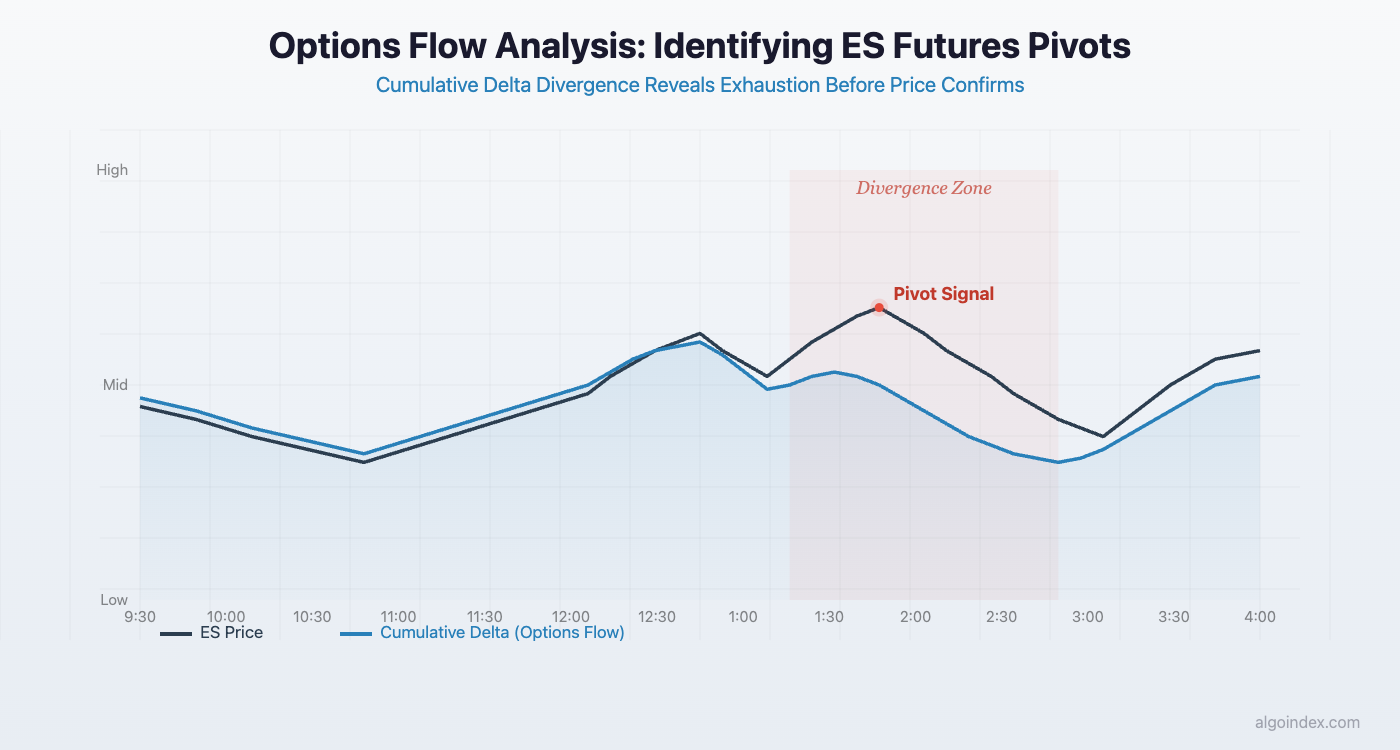
Options flow analysis chart showing cumulative delta divergence on SPX futures

How Options Flow Analysis Helps ES Futures Traders Find Pivots

Categories: Market Outlook
March 28, 2026 by AlgoIndex
undefined

Frequently Asked Questions

What is options flow analysis for ES futures?

Options flow analysis tracks institutional buying and selling of options contracts in real-time. For ES futures traders, monitoring SPX options flow reveals where large participants are placing directional bets, hedging risk, or building positions – often signaling price pivots before they show up on the futures chart.

How does HIRO help identify ES futures pivot points?

HIRO (Hedging Impact Real-time Overlay) tracks cumulative customer delta from options trades during regular trading hours. When HIRO diverges from price action – for example, HIRO flattening while ES keeps rising – it signals that options flow is exhausting, and a reversal is likely forming. This divergence at key gamma levels provides the highest-conviction pivot signals.

What is the difference between 0DTE and longer-dated options flow?

0DTE (zero days to expiration) flow represents same-day options trades that are highly reactive and short-term – these generate large immediate dealer hedging impacts but are prone to reversal. Longer-dated flow (weekly, monthly expirations) represents more deliberate institutional positioning with higher conviction and more stable price effects.

When is options flow data most reliable for ES futures trading?

Options flow is most reliable during the New York AM session (9:30-11:30 ET) when institutional volume peaks, and during power hour (3:00-4:00 ET) when end-of-day positioning accelerates. Flow signals are less reliable during lunch hours (12:00-1:30 ET) due to lower volume, and should not be used outside regular trading hours.

Join the Discussion

Connect with other ES futures and SPY options traders. Share setups, discuss levels, and get real-time market insights from our community.

Join AlgoIndex Trading Community

Related Articles

Monthly OPEX trading guide showing six mechanical forces behind options expiration

Monthly OPEX Trading Guide: The Six Forces Behind Options Expiration

Evergreen Guide Monthly OPEX produces $12B+ in mechanical flow, removes ~35% of options exposure, and follows the same six-force sequence twelve times a year. This guide breaks down each force, the three-phase trading framework for expiration day, and the mistakes that cost traders the most. Every third Friday, roughly $12 billion in mechanical selling and […]

Read More
Market maker hedging mechanics showing how dealers move ES futures through gamma exposure and delta hedging

How Market Makers Hedge: The Invisible Force Behind ES Futures Levels

Net Hedging Flow +$15B Single session Strike Breached 7,000 15,000 0DTE calls Point Squeeze +26 pts Near-vertical line Duration 2 hrs No catalyst At 1:03 PM on Wednesday, ES futures punched through the 7,000 strike where 15,000 zero-day-to-expiry call contracts were sitting. Over the next two hours, price squeezed from 7,000 to 7,026 in a […]

Read More
ES ATH Squeeze - dealer gamma removal Friday with SPX 7026 and VIX 18.05

ES ATH Squeeze Into OPEX: The Anatomy of a $15B Mechanical Rally

Article Brief · OPEX Eve SPX closed at a new all-time high of 7,026.04 on Wednesday after a $15 billion options positioning squeeze through the 7,000 strike. The rally was mechanical, driven by 0DTE gamma forcing short call covering, not conviction buying. With OPEX Friday and overbought oscillators at the extremes (RSI 70.27, Stochastic 99.71%), […]

Read More