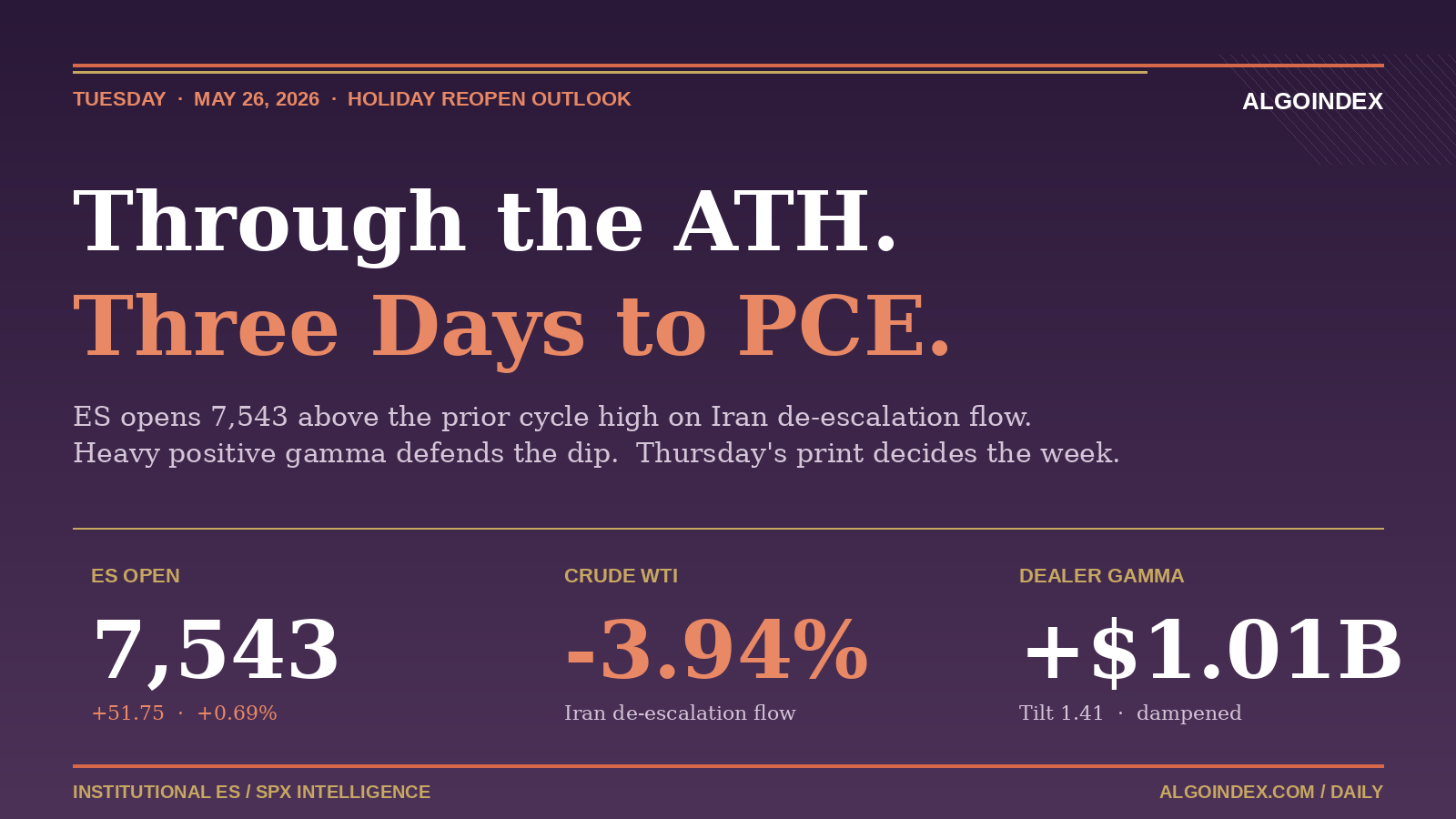
By 9:15 ET on Tuesday, ES had already done what the long weekend's risk premium said it shouldn't. Fifteen minutes before the post-Memorial Day open, the June contract was 51.75 points above Friday's close, oil had collapsed nearly 4 percent overnight, and the structural 52-week high from the prior cycle was sitting underneath the price like a level the session had already passed through in the dark.
Three forces are pushing the index higher this morning, and they are arriving inside a calendar that asks them to wait. Iran de-escalation rhetoric is unwinding a weekend of geopolitical hedging. Broad participation is showing up across small caps and tech, with NQ up 1.22 percent and RTY up 1.12 percent on the open. And dealer gamma is heavy and positive at the major strikes between SPX 7,475 and 7,500, providing a structural support shelf for any dip-buyer who shows up. The complicating factor is what happens Thursday at 8:30 ET, when Core PCE prints and the entire week's positioning resolves into a single number. The session in front of us is the calm before that print. The question is whether the structural ATH break holds long enough to matter.
The Iran De-escalation Reset
The overnight rally has one clean explanation. At 03:03 ET, Iran's Supreme Leader Khamenei delivered escalation rhetoric without an escalation move, and markets read the absence of action as confirmation that the recent strikes were a one-off. Crude futures fell 3.94 percent to 92.79, a $3.81 collapse that wiped out the entire risk premium accumulated over the long weekend. Ten-year yields dropped 1.86 percent to 4.488, with bonds and stocks both bid in tandem, a combination that points to a peace-trade rotation rather than reflation-driven buying.
What's interesting is what didn't happen. Gold was almost unchanged at 4,517. The dollar barely moved at 99.131. Bitcoin added 1.60 percent and ETH added 2.86 percent, both confirming the risk-on read. There was no flight-to-safety footprint anywhere across the cross-asset matrix. The only mild divergence sits with VIX, up 0.84 percent to 16.74 even with stocks higher, a signal that some institutional hedging is being put on into Thursday's print.
The Structural ATH Break
The session opens above the most-watched technical level on the chart. SPX cash will gap above the 7,517.12 mark that has anchored every weekly close since the prior cycle peak, sitting at the 52-week high, the 13-week high, and the one-month high simultaneously. On the basis-adjusted view, ES at 7,542 corresponds to SPX 7,525, putting the index into pure price discovery above the prior swing peak for the first time in this cycle.
The trend composite confirms what the price action shows. The composite trend signal reads 100 percent BUY across short, medium, and long timeframes, with 13 of 13 component indicators aligned bullish. Compare that with a month ago, when the same composite was reading 56 percent BUY at the four-week look, and the breadth of the change becomes obvious. The 14-day average daily range sits at 1.00 percent or roughly 75 points, the directional-strength reading is 30.96 with the positive directional indicator at 36.51 versus the negative at 18.03, and every major moving average from the 5-day through the 200-day is ascending in a bull stack with the index 17.88 percent above the 200-day.
The vulnerability is structural. The 14-day relative-strength index is at 68.30, high but not yet stretched above 70. The 14-day stochastic is at 79.71, into overbought territory. The breakout is happening on holiday-thinned liquidity into a binary catalyst three days away, which is the geometry that has historically produced failed-breakout reversals. Above current price sits the Call Wall at SPX 7,600 or ES 7,617, the next mechanical ceiling that dealer-hedging behavior makes structurally hard to break through without a catalyst.
The Institutional Hedge Against the 0DTE Chase
The most important signal from the institutional positioning data is that two different audiences are doing two opposite things at the same time. Net delta across index ETFs sits at minus $4.05 billion, in the 77th percentile of bearish positioning, with net gamma at minus $1.03 billion in the 88th percentile. The hedging is concentrated in IWM, with 31,025 IWM 269 puts and 26,445 IWM 271 puts both bought-to-open for June 18 expiry, a four-week downside hedge that says institutions are protecting the small-cap exposure through the next options-expiration. SPY put-buying matches the pattern, with bought-to-open size at 705, 715, and 724 strikes for May 29 expiry running 17,000 to 27,000 contracts per strike.
At the same time, today's 0DTE flow shows 18,984 SPX 7,630 calls bought-to-open at the May 26 expiry. That strike sits above the Call Wall and is a speculative upside chase, not a defensive position. The combination, defensive hedges below current price plus lottery-ticket optionality above, is the typical pre-binary-catalyst structure. It tells us institutions are not predicting which way PCE breaks, only that they want exposure to both sides.
Bond positioning carries its own warning. TLT vega registered at the 100th percentile, the highest possible reading, indicating heightened anticipation of bond-market volatility into Thursday. Semiconductor exposure shows the same pattern, with SMH gamma and vega both at the 100th percentile and negative delta in the 2nd percentile, all three pointing to size conviction in a specific direction the chip sector is about to move.
What Thursday Underwrites
The calendar matters this week more than it matters most weeks. The first real catalyst lands today at 10:00 ET with Consumer Confidence, fifteen minutes after the post-holiday open establishes the morning range. A soft print below the 87 to 88 consensus likely fades into the SPX 7,500 magnet, which sits at the 99.76 percent combo-magnet probability, by far the highest concentration on the gamma surface. A strong print extends upside toward SPX 7,548, which prints at 98.47 percent magnet probability and sits at the upper end of the morning range.
Wednesday brings a 5-year auction and Fed speakers Cook, Goolsbee, and Lane, with a BoJ voice from Himino overnight. Thursday is the day everyone is waiting for. Core PCE prints at 8:30 ET alongside GDP second estimate, Personal Income and Spending, Durable Goods, and Initial Jobless Claims, then three Fed speakers (Williams, Musalem, Barkin) stretch across the day with EIA crude inventory at 10:30 and a 7-year auction at 13:00. The asymmetry is straightforward. Hot Core PCE above 0.3 percent month-over-month or above 2.9 percent year-over-year unwinds the rate-cut bet and likely sends the index toward SPX 7,400, which lines up with both the Pivot S3 and the major gamma support strike. Cool Core PCE below 0.2 percent month-over-month or below 2.7 percent year-over-year repriced the cut bet higher and likely sends the index toward the Call Wall at 7,600.
13:00 2Y auction
20:20 Kashkari (V)
15:55 Cook (V)
20:00 Lane, Himino
GDP, Claims, DG
3 Fed speakers, EIA
Sat: China NBS PMI
(weekend overhang)
The Primary Setup
The setup the data supports is a long entry on a pullback into the ES 7,494 to 7,500 zone, with the SPX 7,503 combo magnet at 99.76 percent probability and the gamma support shelf one strike below. Stop sits at ES 7,481, below the daily pivot point of 7,481.36, with the first target at ES 7,519 for the SPX 7,500 mechanical magnet test, second target at ES 7,535 for the ATH structural level, and a third target at ES 7,547 for the extension beyond ATH if the Call Wall breaks.
13 points · $650/ES · $65/MES
No entries pre-9:45 ET · Force-flat 4:00 ET · Half size pre-PCE
Position size is halved against normal for three reasons. The PCE binary on Thursday produces tail risk that does not show up in the daily range. The holiday-thinned liquidity all week reduces conviction across every signal. The 10:00 ET Consumer Confidence print sits inside the first 30 minutes of the session, which collides with the standing session rule of no entries before 9:45 ET. The alternative short setup only activates if ES rejects the 7,565 to 7,575 zone with a bearish divergence on the intraday oscillators, crude rebounding against the Iran de-escalation flow, and VIX popping above 17.50. Outside of those three conditions converging together, the path of least resistance is the gamma-supported dip-buy.
The session that comes before a binary print is rarely the session that decides anything. It is the session that sets the level the binary print breaks from.
Foundational guides
New to S&P 500 futures? Start with What Are ES Futures, the ES, NQ, MES & MNQ point value and contract specs, gamma exposure (GEX) explained, and market internals: TICK, ADD, VOLD and VIX.