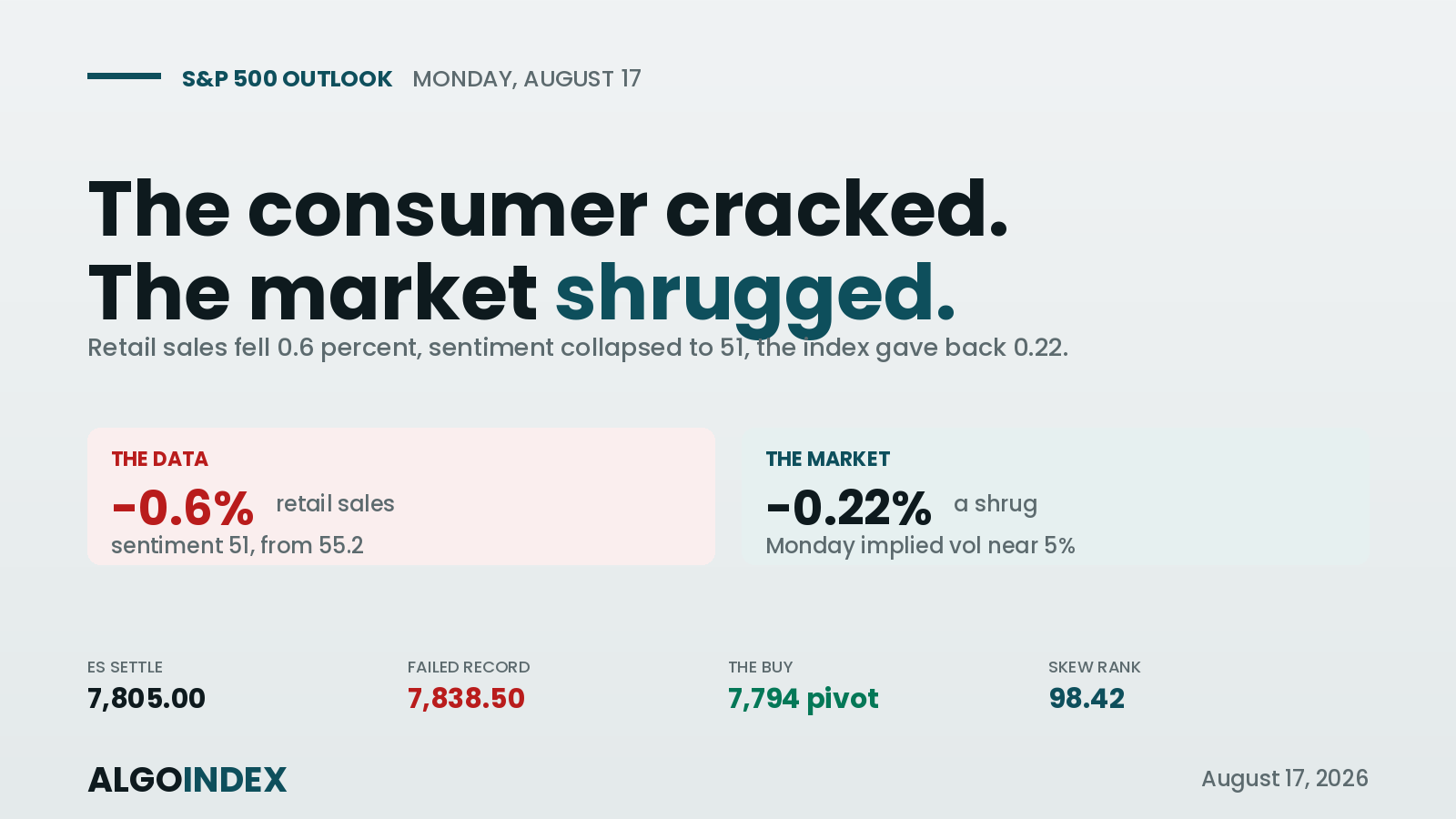
ES is the E-mini S&P 500 futures contract, the most-traded way to trade the S&P 500 index. One point is worth $50 per contract and one tick, which is 0.25 points, is worth $12.50. It trades nearly 23 hours a day with leverage, so a smaller account can control a large notional position. Its micro version, MES (Micro E-mini S&P 500), is worth $5 per point and suits smaller accounts.
What This Guide Covers
ES contract specs, why futures lead equity markets, trading sessions, margin mechanics, institutional usage, key technical levels, and the broader market ecosystem.
At 9:29 AM on any given weekday, roughly $30 billion in notional value changes hands before most Americans have finished their coffee. The instrument responsible is the E-mini S&P 500 futures contract, known simply as “ES,” and it is the single most liquid equity futures product in the world.
Whether you trade equities, options, or nothing at all, ES futures are setting the price of your portfolio in real time. The overnight session, the pre-market gap, the last-hour ramp or selloff, every one of these events runs through the ES pit first, then radiates outward into ETFs, options, and individual stocks. Understanding this instrument is not optional for anyone serious about equity markets. It is prerequisite knowledge.
This guide covers everything from the basic contract specifications to the mechanics that professional traders use to read ES price action in the context of gamma exposure, institutional positioning, and macro catalysts.
What ES Futures Actually Represent
An ES futures contract is a standardized agreement to buy or sell the S&P 500 index at a specified price on a future date. It trades on the Chicago Mercantile Exchange (CME) under the ticker ES, and each contract represents $50 multiplied by the current S&P 500 index level.
At an index level of 5,500, one ES contract controls $275,000 in notional exposure. A one-point move equals $50 per contract. A ten-point move is $500. This is real leverage, and it is the reason both institutional hedgers and speculative traders gravitate toward the product.
At an index level of 5,500, one ES contract controls $275,000 in notional exposure. A one-point move equals $50 per contract. This is real leverage, and it is the reason both institutional hedgers and speculative traders gravitate toward the product.
The contract settles quarterly (March, June, September, December), though the front-month contract carries virtually all the volume. Most traders never hold to settlement. They enter and exit positions intraday or over short multi-day windows, rolling to the next contract before expiration.
A smaller variant, the Micro E-mini (MES), controls $5 per index point, one-tenth the size of ES. It trades on the same exchange and follows the same price, making it accessible for traders with smaller accounts who still want direct S&P 500 exposure without the capital requirements of a full-size contract.
Why ES Futures Matter More Than You Think
The S&P 500 cash index is a calculation. It exists as a number. You cannot buy or sell the S&P 500 index directly. What you can buy is SPY (the ETF), options on SPX (the cash-settled index), or ES futures. Among these three, ES futures are the price discovery vehicle. They lead, and everything else follows.
This is not a theoretical claim. Academic research and market microstructure data consistently show that during periods of stress, ES futures move first, and equity markets adjust afterward. The October 2023 rally, the August 2024 VIX spike, the March 2025 tariff selloff, in every case the ES contract priced the move before SPY, before SPX options, and well before individual stocks reflected the shift.
ES futures are the price discovery vehicle. They lead, and everything else follows. Academic research and market microstructure data consistently show that during periods of stress, ES futures move first, and equity markets adjust afterward.
There is a simple reason for this: futures markets operate nearly 23 hours per day, five days per week. ES trades from 6:00 PM Eastern on Sunday through 5:00 PM Eastern on Friday, with a brief 15-minute daily maintenance halt. When news breaks at 2:00 AM, when a central bank surprises at 3:00 AM European time, when geopolitical risk escalates over a weekend, ES is the instrument that absorbs the shock immediately. By the time the equity market opens at 9:30 AM, the gap in ES has already set the tone.
For equity and options traders, ignoring ES futures means you are always reacting to a price that was established somewhere else. The gap-up you see on SPY at the open was decided in the ES overnight session hours earlier.
The Trading Sessions: Globex, Pre-Market, and RTH
ES trades across three distinct sessions, each with different characteristics.
The Globex overnight session runs from 6:00 PM to 9:30 AM Eastern. Liquidity is thinnest during the Asian and early European hours (roughly 8:00 PM to 3:00 AM), when spreads widen and moves can be exaggerated on low volume. The European open (3:00 AM Eastern) typically brings the first meaningful liquidity injection, and price discovery accelerates. Institutional desks in London and Frankfurt begin hedging, rolling, and positioning.
The pre-market session (roughly 8:00 to 9:30 AM Eastern) is when most economic data releases occur. Non-Farm Payrolls at 8:30, CPI at 8:30, PCE at 8:30, these prints produce some of the most violent moves of the day, on the thinnest pre-market liquidity. Professional traders often avoid positioning ahead of these releases and wait for the initial reaction to stabilize before engaging.
Regular Trading Hours (RTH), 9:30 AM to 4:00 PM Eastern, is where the vast majority of volume concentrates. The first 15 minutes establish the opening range. The last hour (3:00 to 4:00 PM) often sees the day’s highest volume as institutions execute MOC (Market on Close) imbalances and portfolio hedgers adjust their delta into the close.
The character of each session matters. A breakout during Globex thin hours often reverses at the RTH open. A move during the last hour of RTH, backed by heavy volume, tends to carry conviction into the next session. Learning to distinguish real moves from liquidity-driven noise is one of the essential skills in ES trading.
Margin, Leverage, and Position Sizing
Futures use margin, not full cash payment. The CME sets minimum initial margin requirements, which vary based on volatility but typically run between $12,000 and $16,000 per ES contract. Day trading margin at most brokers is substantially lower, often around $500 to $2,000 per contract for intraday positions.
This leverage is a double-edged mechanism. A $500 margin on a contract controlling $275,000 in notional value means a 0.2% move against your position wipes out the margin entirely. It is the reason position sizing discipline separates traders who survive from those who blow out their accounts in a single session.
A $500 margin on a contract controlling $275,000 in notional value means a 0.2% move against your position wipes out the margin entirely. It is the reason position sizing discipline separates traders who survive from those who blow out their accounts in a single session.
Professional traders typically risk 1-2% of their total account on any single trade. On a $50,000 account, that means a maximum loss of $500-$1,000 per trade. With ES moving $50 per point, a 10-point stop loss on one contract represents $500 in risk, which fits the framework. Two contracts with a 10-point stop is $1,000, also within bounds. Three contracts with a 20-point stop is $3,000, which for a $50,000 account represents 6% risk per trade, and that is how accounts implode.
Position Sizing Example: On a $50,000 account, risk 1-2% per trade = $500-$1,000 max loss. With ES at $50 per point, a 10-point stop on one contract = $500 risk. Two contracts with a 10-point stop = $1,000. Three contracts with a 20-point stop = $3,000 (6% risk per trade), which is how accounts implode.
The math is straightforward. The discipline to follow it under pressure is the hard part.
How Institutional Traders Use ES Futures
Retail traders tend to think of ES as a directional bet: long if you think the market goes up, short if you think it goes down. Institutional traders use the product very differently.
Portfolio hedging is the dominant institutional use case. A fund holding $500 million in equities can sell 1,818 ES contracts to fully hedge its market exposure ($500M / $275K per contract). More commonly, funds execute partial hedges, selling enough contracts to reduce beta from 1.0 to 0.5 or 0.3, protecting against a drawdown while maintaining some upside participation.
Basis trading exploits the spread between ES futures and the cash SPX index. Futures typically trade at a slight premium to cash (reflecting the cost of carry minus expected dividends). When this basis widens or narrows beyond fair value, arbitrage desks simultaneously buy one and sell the other. This activity, largely automated, keeps ES and SPX in tight alignment and provides continuous liquidity.
Options dealer hedging creates some of the most important ES dynamics for day traders. When dealers are short gamma (the most common state), they must buy ES when price rises and sell ES when price falls, amplifying moves in both directions. When dealers hold long gamma, they do the opposite, buying dips and selling rips, which dampens volatility and creates mean-reverting range days.
Understanding whether dealers are long or short gamma on a given day, and where the key gamma levels sit (gamma flip level, the volatility inflection level, hedge walls) transforms how you read ES price action. A rally into a large negative gamma zone behaves very differently than a rally into concentrated positive gamma. The former tends to accelerate. The latter tends to stall and reverse.
Key Levels and Technical Structure in ES
ES futures create their own technical structure that feeds back into SPX and SPY. The levels most watched by professional ES traders include session-based references and broader structural levels.
Session levels reset daily and include the previous day’s high (PDH), low (PDL), close, and the overnight high and low (ONH, ONL). These levels act as intraday magnets and rejection points. A move above the overnight high during RTH signals that the session is expanding beyond the overnight range. A failure to hold the previous day’s low suggests downside continuation.
Value Area levels come from volume profile analysis: the Value Area High (VAH), Point of Control (POC), and Value Area Low (VAL). The POC represents the price where the most volume traded, a natural gravitational level. Price outside the value area tends to get pulled back toward it. Price that breaks away from the value area with strong volume suggests a genuine trend move rather than a rotation.
Structural levels include the 200-day moving average (the most widely watched trend identifier), Fibonacci extensions from major swings, and weekly/monthly open levels. When ES breaks below the 200-DMA, the character of the market changes. Algorithmic trend-following systems flip short, and institutional managers reduce exposure. It becomes a different instrument than the one that was trading above it.
The convergence of multiple levels at a single price zone creates what professional traders call confluence. An area where PDH, a Fibonacci level, and the 50-DMA all converge within a 10-point range will generate much stronger reactions than any single level on its own. Identifying these confluences in advance, before the session opens, is the core of preparation for ES day trading.
ES Futures and the Broader Market Ecosystem
ES does not trade in isolation. It sits at the center of a web of interconnected instruments, and understanding these relationships deepens your read on price action.
VIX (the CBOE Volatility Index) measures implied volatility on SPX options. In practice, VIX and ES maintain an inverse correlation: when ES sells off, VIX rises as traders bid up protection. When VIX exceeds 25, ES typically enters a higher-volatility state where daily ranges expand significantly. A VIX above 30 signals that options markets are pricing extreme fear, and mean reversion trades in ES carry elevated risk because the distribution of outcomes has fattened tails.
SPY options flow directly impacts ES through dealer hedging. A surge in SPY put buying forces dealers to sell ES futures as a hedge, creating additional selling pressure on top of whatever fundamental catalyst drove the put buying. This feedback loop between options flow and futures is the mechanism behind many of the “waterfall” selloffs that seem to accelerate without clear news catalysts.
Crude oil, Treasury yields, and the dollar each influence ES through sector and macro channels. A crude oil spike pressures consumer discretionary and transports while benefiting energy. Rising 10-year yields compress equity valuations, particularly in growth and technology names that dominate S&P 500 weighting. Dollar strength pressures multinational earnings. None of these relationships are perfectly stable, but they provide context that makes ES price action less random and more readable.
Getting Started: What You Need to Trade ES
Trading ES requires a futures-approved brokerage account. The major brokers serving retail ES traders include NinjaTrader, AMP Futures, Tradovate, and Interactive Brokers, each offering different commission structures and platform capabilities. CME data fees apply on top of commissions (roughly $4-7/month for real-time ES data depending on exchange fee elections).
The minimum practical account size for ES depends on your risk management. For Micro E-mini (MES) contracts at $5/point, a $5,000 account allows reasonable position sizing with proper stops. For full-size ES at $50/point, $25,000 represents a working minimum that allows for normal drawdowns without margin calls forcing premature exits.
Before risking capital, paper trading (simulation) on a platform with real-time ES data lets you develop pattern recognition, practice order execution, and build the muscle memory of managing positions under live market conditions. The difference between simulation and live trading is emotional, not mechanical, but simulation eliminates the execution learning curve so you can focus on the psychological adjustment when you go live.
Where ES Futures Fit in Your Trading
Whether you trade ES directly or use it as a leading indicator for equity and options decisions, this instrument shapes the market you operate in every day. The overnight gap on SPY, the last-hour ramp into the close, the violent reaction to an economic print, each of these events plays out in ES first.
Professional traders who track real-time gamma exposure and dealer positioning alongside ES price action gain a structural edge that pure technical analysis cannot provide. The price chart tells you where ES has been. Gamma levels and institutional flow tell you where the pressure is building.
At AlgoIndex, our daily analysis covers ES futures with institutional-grade data: key support and resistance levels, gamma exposure maps, options flow signals, and the macro catalysts that will drive the next session. The methodology combines multiple data sources into a single, actionable framework for ES traders who want to see the forces moving price before they appear on the chart.
Past results are not indicative of future performance. This content is for informational and educational purposes only and does not constitute financial advice or a recommendation to buy or sell any security or futures contract. For our full performance disclosure, visit algoindex.com/performance-statement.
AlgoIndex Research · algoindex.com · Start your free trial
Continue Learning
- How to Read Gamma Exposure (GEX) for Trading, Understand how dealer gamma creates dynamic support and resistance
- What Is Dealer Gamma Positioning?, How dealer hedging flows drive ES futures price action
- Options Flow Analysis for ES Futures, Using real-time options data to identify pivot points
- Market Internals: TICK, ADD, VOLD, VIX, Breadth and volatility indicators every ES trader should know
- Support & Resistance for ES Futures, How to identify and trade key price zones
Frequently Asked Questions
ES futures (E-mini S&P 500 futures) are standardized contracts traded on the CME that track the S&P 500 index. Each contract represents $50 times the index value. Traders can go long (betting price rises) or short (betting price falls) with built-in leverage, meaning you only need a fraction of the contract value as margin to control the full position.
ES futures trade nearly 24 hours a day, 5 days a week. The electronic session (Globex) runs from Sunday 6:00 PM ET through Friday 5:00 PM ET, with a daily maintenance break from 5:00-6:00 PM ET. Regular Trading Hours (RTH) are 9:30 AM to 4:00 PM ET, which is when the highest volume and most reliable price action occurs.
The initial margin for one ES contract is typically around $12,000-$15,000 depending on your broker, though day trading margins can be as low as $500-$2,000 per contract at some brokers. Most professional traders recommend starting with at least $25,000-$50,000 to properly manage risk and withstand normal drawdowns.
The minimum price movement (tick) for ES futures is 0.25 index points, worth $12.50 per tick per contract. A full point move equals $50 per contract. For example, if ES moves from 5,500.00 to 5,501.00, that one-point move represents a $50 gain or loss per contract.
Join the Discussion
Connect with other ES futures and SPY options traders. Share setups, discuss levels, and get real-time market insights from our community.
Join AlgoIndex Trading CommunityRelated guides
- ES, NQ, MES & MNQ Contract Specs & Point Value. Point value, tick value and margin for every contract.
- What Is Gamma Exposure (GEX)?. How dealer gamma sets the call wall, put wall and gamma flip on ES futures.
- Market Internals: TICK, ADD, VOLD & VIX. Read breadth and the advance/decline line intraday.
- ES vs SPY: Futures or ETF?. Leverage, cost, trading hours and tax compared.