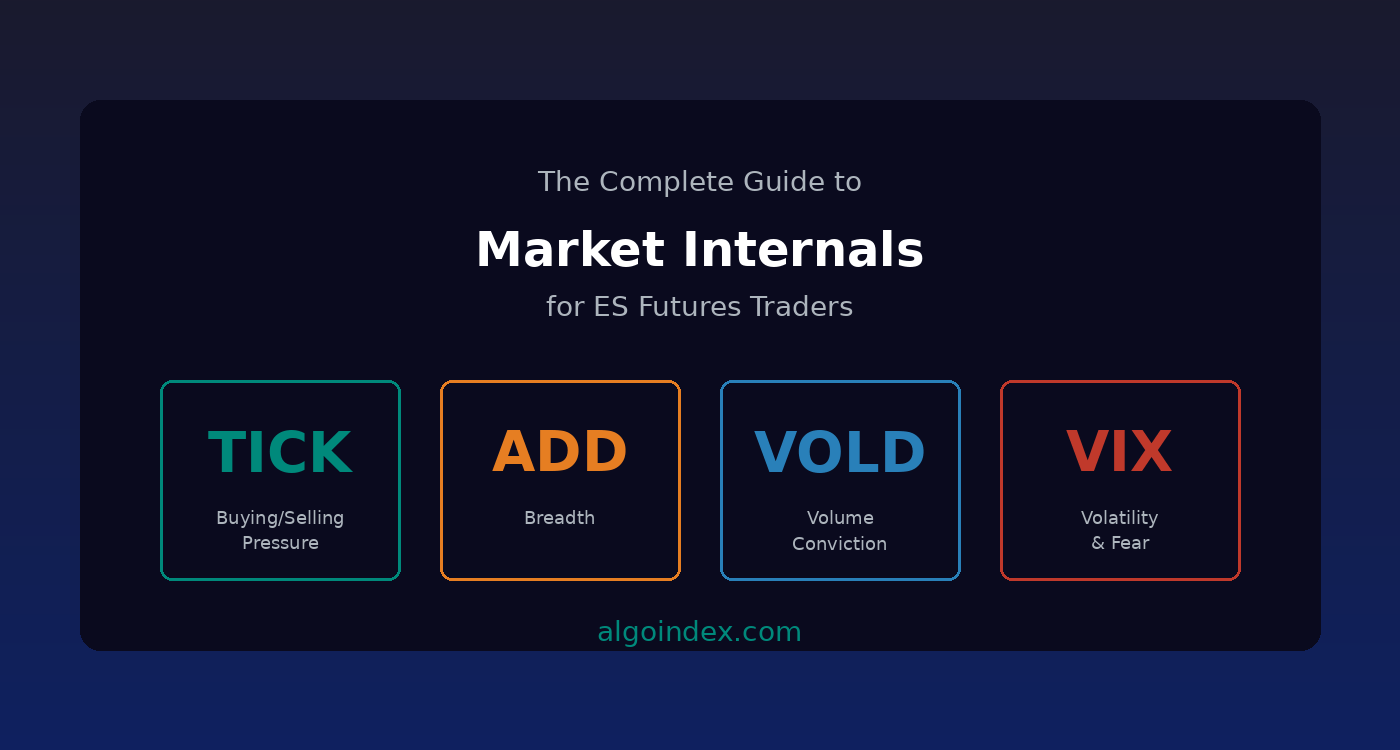
Market internals are real-time breadth and volume indicators that show whether the whole market is participating in a move, not just the index price. The four most important ones for S&P 500 and ES futures traders are TICK (buying versus selling pressure), ADD (advancers minus decliners), VOLD (up volume minus down volume), and VIX (expected volatility). Read together, they tell you whether a price move is broad and real or narrow and likely to fail.
At 2:47 PM on a Tuesday in March 2026, the S&P 500 was grinding higher , up 12 points on the day, reclaiming a key resistance level that had rejected sellers three sessions running. Everything looked bullish on the surface. But underneath, the NYSE TICK had been printing persistently negative readings for two straight hours, the Advance-Decline line was deeply negative, and up-volume had dried to a trickle. Twenty minutes later, ES futures dropped 30 points in a cascade of selling that caught breakout buyers completely off guard.
The index lied. The internals told the truth.
This is why professional futures traders treat market internals as essential context for every trade. Price tells you what happened, internals tell you whether it is real. For ES futures traders, where every tick is worth $12.50 per contract and leverage magnifies both gains and mistakes, understanding the health of the move beneath the surface is not optional. It is the difference between entering a sustainable trend and walking into a trap.
What Are Market Internals and Why Do They Matter?
Market internals are breadth and volume indicators that measure the participation and conviction of the broader stock market. The S&P 500 index is a market-cap weighted composite of 500 stocks, which means a handful of mega-cap names (Apple, Microsoft, NVIDIA, Amazon) can drag the index in one direction even when the majority of stocks are moving the opposite way.
This creates a dangerous illusion for ES futures traders. The index might rally 15 points on three mega-cap earnings beats while 350 of the 500 constituent stocks are actually declining. Without internals, you would see a bullish chart and might enter long, right into what is actually deteriorating breadth that will eventually pull the index back down.
The four core market internals that ES futures traders monitor are TICK, ADD, VOLD, and VIX. Each measures a different dimension of market health, and together they form a composite picture that no single price chart can provide.
The TICK Indicator: Real-Time Buying and Selling Pressure
The NYSE TICK (symbol: USI:TICK) measures the net number of stocks on the New York Stock Exchange that last traded on an uptick minus those that last traded on a downtick, sampled continuously throughout the trading day.
Think of it as a real-time pulse of buying versus selling pressure across the entire exchange. When TICK reads +600, it means 600 more stocks just ticked up than ticked down at that exact moment. When it reads -800, selling pressure is dominating broadly.
Readings between -500 and +500 represent normal market noise with no strong directional signal. Above +800 indicates broad, coordinated buying pressure. Below -800 indicates broad selling pressure. Extreme readings above +1,000 or below -1,000 often mark short-term exhaustion points and potential reversals.
The most actionable TICK signals come at extremes. A TICK reading above +1,000 or below -1,000 often marks a short-term exhaustion point. When you see TICK spike to -1,200 while ES is testing a support level that aligns with a key gamma strike from dealer positioning data, that combination frequently marks an intraday bottom. The logic is straightforward: if nearly every stock on the NYSE is simultaneously ticking down, there is not much incremental selling left in the system.
Persistent TICK readings matter more than individual spikes. If TICK spends the entire morning session oscillating between +200 and +800 without dipping below zero, it confirms strong underlying breadth supporting the rally. Conversely, a day where TICK cannot sustain readings above +300 despite the index pushing higher warns that the rally lacks broad participation.
One practical application: compare TICK behavior at the same price level across multiple tests. If ES revisits a resistance zone and TICK is printing +700 on the first test but only +200 on the second test at the same price, buying pressure is fading. That divergence often precedes a rejection.
ADD: The Advance-Decline Line Tells You About Breadth
The NYSE Advance-Decline indicator (symbol: USI:ADD) counts the number of stocks advancing (trading higher) minus the number declining (trading lower) on the exchange. Unlike TICK, which captures a momentary snapshot, ADD is cumulative throughout the session and builds a picture of breadth over time.
A positive ADD reading means more NYSE-listed stocks are up on the day than down. A negative reading means more are declining. The magnitude matters: an ADD reading of +1,500 means substantially more stocks are participating in the upside than a reading of +200.
The most dangerous market conditions occur when the index is rising but ADD is falling, meaning fewer stocks are participating while a shrinking group of large-cap names carries the index higher. This narrow breadth is inherently unstable and frequently precedes swift reversals.
In practice, ES futures traders use ADD as a filter. On a day when ADD is persistently positive (climbing throughout the session), buying dips on ES has a higher probability of success because broad participation supports the uptrend. On a day when ADD is persistently negative despite occasional index bounces, shorting rallies is the higher-probability approach because the majority of the market is not participating in the upside.
The relationship between ADD and sector rotation provides additional context. Sometimes ADD turns negative because defensive sectors are declining while tech rallies. Other times ADD turns negative broadly across all sectors. The latter is a much stronger bearish signal for ES futures.
VOLD: Volume Conviction Behind the Move
The NYSE Up Volume minus Down Volume indicator (symbol: USI:VOLD) measures the total share volume flowing into advancing stocks minus the total volume flowing into declining stocks. This is the conviction indicator, it tells you whether the money behind the move is real or hollow.
Consider this scenario: ADD shows +800 (more stocks advancing), but VOLD shows -500 million. This means that while more stocks are rising, the heavier volume is concentrated in declining stocks. The advancing stocks are drifting higher on light volume while the declining stocks are getting sold with conviction. This is a bearish divergence that warns the positive breadth reading from ADD is misleading.
The reverse is equally instructive. VOLD at +1.5 billion with ADD at +300 tells you that although the breadth is only modestly positive, the advancing stocks are attracting heavy institutional volume. This is actually a stronger bullish signal than high ADD with low VOLD, because it suggests big buyers are aggressively accumulating even if the breadth count is not extreme.
For ES futures day traders, VOLD helps distinguish between institutional participation and retail noise. Institutional orders move volume dramatically. When VOLD surges in one direction during the first 30 minutes of the session, it often sets the tone for the entire day because early institutional positioning tends to be directional and sticky.
The VOLD-to-ADD relationship also helps identify volume divergences at key levels. If ES is testing the prior day’s high and VOLD is declining even as price pushes higher, the breakout attempt lacks the volume conviction to sustain. This setup frequently leads to a failed breakout and reversal.
VIX: The Fear Gauge and Volatility Context
The CBOE Volatility Index (symbol: CBOE:VIX) measures the market’s expectation of 30-day forward volatility, derived from the prices of S&P 500 options. Unlike the other three internals, VIX is not a breadth indicator, it is a sentiment and volatility gauge that provides essential context for position sizing, target setting, and risk management.
VIX levels define the trading environment. Below 15, the market is complacent and daily ranges tend to be tight (ES might move 20-30 points in a session). Between 15 and 25, conditions are normal with moderate daily ranges. Above 25, fear is elevated and daily ranges expand significantly, with 50 to 80+ point days becoming common. Above 30, the market is in high-fear territory where 100+ point intraday swings are routine.
Rising VIX with falling ES is the strongest risk-off signal. Falling VIX with rising ES confirms a healthy rally. The most dangerous condition is rising VIX with a rising index, which signals the options market is not confirming the price move.
For ES futures traders, VIX serves as a daily range estimator. A quick calculation: take the current VIX level, divide by the square root of 252 (trading days per year), and multiply by the current SPX price. With VIX at 25 and SPX at 5,500: (25 / 15.87) x 5,500 equals approximately 86 points expected daily range. This helps set realistic profit targets and stop-loss distances.
VIX also interacts powerfully with dealer gamma positioning. When VIX is elevated and the index is trading below the gamma flip level, where dealer hedging changes character, both volatility expectations and dealer hedging mechanics align to amplify moves. These are the sessions where ES can move 50+ points in a single hour, and where the highest-conviction setups form when other internals like TICK show exhaustion at key levels. Our own published record grades these levels after every close: the gamma flip level has held about 4 in 5 times it was tested, and the running numbers update daily in the free gamma level accuracy tracker.
Putting It All Together: A Practical Framework
No single internal tells the complete story. The power is in combining them into a composite read. Here is the framework that professional ES futures traders use:
Strong Bullish Confirmation: TICK persistently above +300, ADD climbing through the session, VOLD heavily positive, VIX declining. This is the environment where buying dips works and shorts get squeezed.
Strong Bearish Confirmation: TICK persistently below -300, ADD declining through the session, VOLD deeply negative, VIX rising. This is the environment where selling rallies works and dip-buyers get trapped.
Bull Trap Warning: ES rising, but TICK cannot sustain above +500, ADD is flat or declining, VOLD is negative despite higher prices, VIX is not falling. The rally is narrow and running on fumes.
Bear Trap Warning: ES falling, but TICK stops making new lows, ADD flattens, VOLD shifts from negative to neutral, VIX stops rising. Selling pressure is exhausting. Snap-back rally is likely.
A simple way to apply this intraday: at the open, let the first TICK and VOLD readings set your bias for the session; through the midday lull, watch ADD for whether breadth is confirming or quietly eroding the trend; and into the final hour, lean on TICK extremes and a rising or falling VIX to judge whether a late move is real or a trap. Reading the four in that sequence, rather than glancing at them in isolation, is what turns market internals from noise into a repeatable edge.
The key to using internals effectively is recognizing that they are context tools, not standalone signals. They tell you the quality of the move, not the direction. Pair them with technical structure (support and resistance levels, key gamma exposure zones, session levels like PDH/PDL) and real-time options flow data to build high-conviction setups.
If you are new to ES futures, our beginner’s guide to E-mini S&P 500 trading covers the contract mechanics and margin requirements. For traders already familiar with the basics, integrating market internals into your process is one of the highest-impact improvements you can make, because in a market where algorithms and options mechanics drive increasingly fast moves, knowing whether the move is real before you commit capital is no longer an advantage. It is a necessity.
Disclaimer: This content is for educational purposes only and does not constitute financial advice. Trading futures involves substantial risk of loss. Past performance does not guarantee future results. See our performance statement for details. Ready to see how algorithmic signals work in practice? Explore AlgoIndex plans.
Frequently Asked Questions
Market internals are breadth and volume indicators (TICK, ADD, VOLD, VIX) that measure the underlying health of the broader stock market beyond what the index price alone shows. They reveal whether a move in ES futures is supported by broad participation across all 500 S&P stocks or driven by just a few large-cap names.
The NYSE TICK measures net stocks ticking up minus those ticking down. Readings between -500 and +500 are neutral. Above +800 indicates broad buying pressure. Below -800 signals broad selling. Extreme readings above +1,000 or below -1,000 often mark short-term exhaustion points.
ADD counts advancing stocks minus declining stocks, measuring breadth. VOLD measures volume flowing into advancing versus declining stocks, showing conviction. A divergence where ADD is positive but VOLD is negative is a bearish warning.
VIX measures expected 30-day S&P 500 volatility. Below 15 means tight ranges. Above 25 means 50-80+ point days. Rising VIX with falling ES is the strongest risk-off signal.
Professional traders look for confirmation or divergence across all four internals. Strong bullish conditions show TICK above +300, ADD climbing, VOLD positive, and VIX declining.
Join the Discussion
Connect with other ES futures and SPY options traders. Share setups, discuss levels, and get real-time market insights from our community.
Join AlgoIndex Trading CommunityRelated guides
- What Is Gamma Exposure (GEX)?. How dealer gamma sets the call wall, put wall and gamma flip on ES futures.
- ES, NQ, MES & MNQ Contract Specs & Point Value. Point value, tick value and margin for every contract.
- What Are ES Futures?. The S&P 500 futures contract explained from the ground up.
- ES vs SPY: Futures or ETF?. Leverage, cost, trading hours and tax compared.
- Cumulative Volume Delta (CVD). Read net aggressive order flow against the dealer-positioning levels.
- Value Area and VPOC. The volume-profile levels where the most business traded, forward-tested.
- Futures Market Hours. When ES, NQ and the S&P 500 actually trade.
- Triple Witching Explained. The quarterly expiration sessions and what they do to volume.
If you want to see whether these readings actually helped your own trades, log them in the free AI trading journal and let the coach grade each one. No card required.