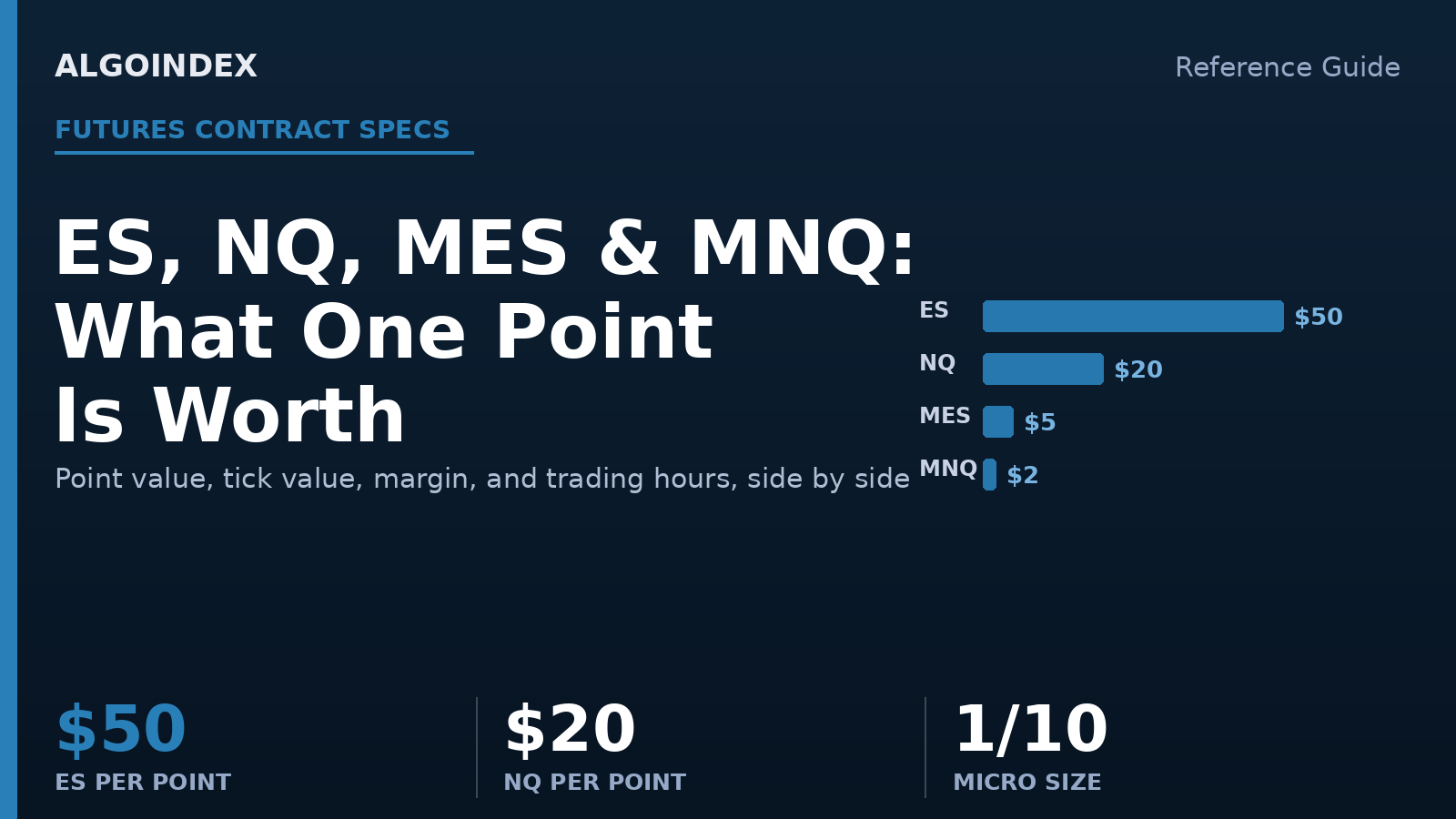
One E-mini S&P 500 (ES) point is worth $50. One Nasdaq 100 (NQ) point is worth $20. Their micro versions, MES and MNQ, are worth exactly one tenth of that, $5 and $2 a point. Those four numbers decide how much every tick adds to or takes from an account, and they are the first thing a futures trader needs to settle before placing a single order.
| Contract | Per point | Per tick (0.25) | Size vs sibling |
|---|---|---|---|
| ES E-mini S&P 500 | $50.00 | $12.50 | 10x MES |
| MES Micro E-mini S&P 500 | $5.00 | $1.25 | 1/10 ES |
| NQ E-mini Nasdaq 100 | $20.00 | $5.00 | 10x MNQ |
| MNQ Micro E-mini Nasdaq 100 | $2.00 | $0.50 | 1/10 NQ |
On the first morning a new trader sells a single MNQ contract, the position feels almost weightless: a fifty point move is a hundred dollars. Switch that one contract to NQ, the full-size E-mini, and the same fifty point move is a thousand dollars. Nothing about the chart changed. Only the multiplier did.
That multiplier is the whole game. Futures are leveraged, and leverage is simply a number working in both directions. The point value of a contract is that number made concrete, the exact dollars that flow in or out for every one point the index travels. Trade a size that does not match the contract and a routine session can do real damage. Match it deliberately and the same contract becomes a precise tool for taking exactly the risk intended. Here is what every point, tick, contract, and margin dollar is actually worth.
Point value and tick value
Every one of these contracts moves in ticks of 0.25 index points. What differs is what that quarter-point is worth. In ES, a single tick is $12.50 and a full point is $50. In NQ, a tick is $5 and a point is $20. The micros divide both by ten: $1.25 a tick in MES, $0.50 a tick in MNQ.
The point that traders new to the Nasdaq miss is that NQ carries a smaller dollar value per point than ES yet often produces the larger dollar swings. The reason is range. The Nasdaq 100 is heavier in a handful of technology names and tends to travel 250 to 400 points in a session where the S&P 500 moves 50 to 80. A lighter point value attached to a wider range frequently nets out to more dollars at risk, not fewer.
Margin, and what it actually means
Margin in futures is not a down payment. It is a good-faith deposit the exchange and broker hold against the position. The exchange sets a minimum that rises and falls with volatility, the broker layers its own requirement on top, and retail accounts carry an additional buffer above the published exchange rate. The figures below are approximate initial-margin levels and should be treated as a starting reference, not a quote.
Two distinctions matter more than the exact dollar figure. The first is initial versus maintenance margin: initial is what an account needs to open the position, maintenance is the lower level it must stay above before a margin call. The second, and the one that surprises newcomers, is day-trade margin. Many brokers require only a small fraction of the exchange overnight margin for positions opened and closed inside the same session, sometimes a few hundred dollars on an ES contract. That intraday allowance is what makes day trading these contracts accessible, and also what makes oversizing so easy.
Trading hours and contract months
All four contracts trade on the same near-continuous schedule, roughly 23 hours a day from Sunday evening to Friday afternoon US Eastern Time, with a short daily maintenance break.
Contracts expire quarterly, in March, June, September, and December, on the third Friday of the expiry month. Liquidity concentrates in the nearest contract, the front month, and rolls to the next about a week and a half before expiration. The timing of that shift is covered in our guide to when to roll ES, NQ, MES and MNQ futures. A trader watching a chart labeled with a continuous symbol is almost always watching the front month, which is where the volume and the tightest spreads live.
Micro or mini: which contract fits
The micros are not a different market. MES and MNQ track the same indexes, trade the same hours, and follow the same charts as their full-size counterparts. They are simply one tenth the size, and that single fact changes who should trade what.
A useful way to feel the size is notional value: the index level multiplied by the point value. With the S&P 500 near 7,400, one ES contract controls roughly $370,000 of exposure, while one MES controls about $37,000. With the Nasdaq 100 near 24,000, one NQ contract carries close to $480,000 of exposure against roughly $48,000 for an MNQ. The micros let a smaller account trade the same idea, scale in and out in tenths rather than whole contracts, and size risk to the dollar instead of rounding up to a position it cannot afford.
For most traders the decision is straightforward. Accounts building a process, testing a strategy, or risking small should start in the micros, where a mistake costs tens of dollars rather than hundreds. Accounts with the capital and the track record to carry full-size risk graduate to the minis for the deeper liquidity and the lower commission per dollar of exposure. The contract specs do not tell anyone how to trade. They tell everyone exactly how much each decision costs.
The chart looks the same in every one of these contracts. The only thing that changes is how much each candle is worth.
Frequently Asked Questions
One ES (E-mini S&P 500) point is worth $50 per contract. One tick is 0.25 points, worth $12.50. The Micro E-mini (MES) is worth $5 per point and $1.25 per tick.
What is the point value of NQ futures?One NQ (E-mini Nasdaq 100) point is worth $20 per contract. One tick is 0.25 points, worth $5. The Micro E-mini (MNQ) is worth $2 per point and $0.50 per tick.
What is the difference between E-mini and Micro E-mini futures?Micro E-minis (MES, MNQ) are one tenth the size of the E-minis (ES, NQ). They track the same index, trade the same hours, and follow the same chart, but each point is worth one tenth as much, which allows finer position sizing for smaller accounts.
How much margin do you need to trade ES or NQ futures?Initial margin is approximately $13,000 for ES and $16,500 for NQ, but exchange minimums change with volatility and brokers set their own requirements. Intraday day-trade margins are often far lower. Always verify the current figure with your broker.
What hours do ES and NQ futures trade?Both trade nearly 23 hours a day, Sunday evening through Friday afternoon US Eastern Time, with a short daily maintenance break from 5:00 to 6:00 PM ET.
Trade these contracts on a system, not a hunch.
AlgoIndex publishes institutional-grade reviews on ES, NQ, GC, and CL, and runs an automated SPY options strategy on the same data. See the performance statement for how the strategy is tracked, then view pricing.
New here? Start with What Are ES Futures, What Are NQ Futures, or ES vs SPY.
Related guides
- What Are ES Futures?. The S&P 500 futures contract explained from the ground up.
- ES vs SPY: Futures or ETF?. Leverage, cost, trading hours and tax compared.
- ES vs SPX vs SPY: Trade the S&P 500. Three ways to trade the S&P 500 compared.
- What Is Gamma Exposure (GEX)?. How dealer gamma sets the call wall, put wall and gamma flip on ES futures.
- Futures Market Hours: When the S&P 500 Trades. When ES, NQ and the S&P 500 actually trade.
- Triple Witching Explained. The quarterly expiration sessions and what they do to volume.