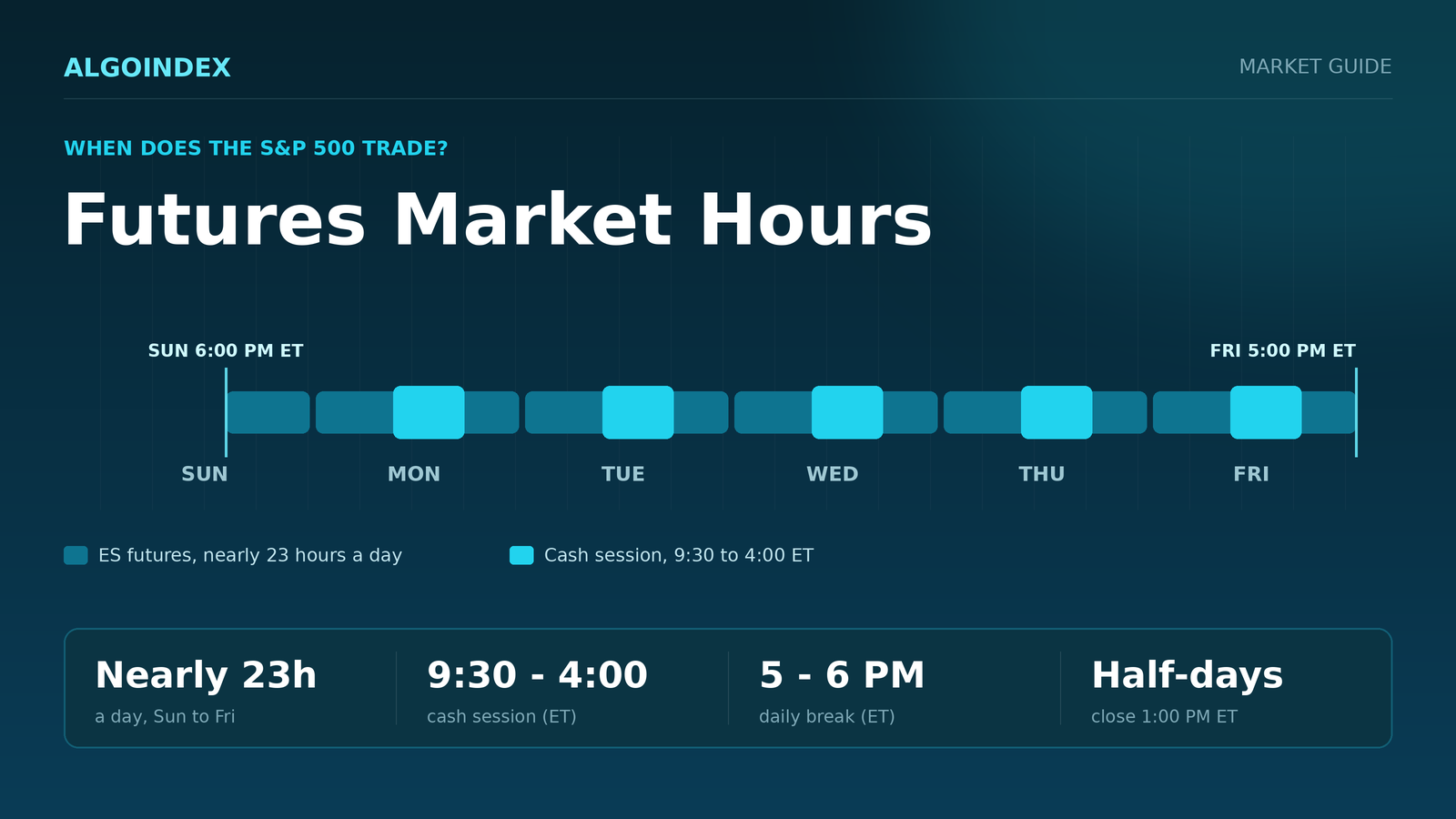
The S&P 500 trades on two different clocks. As a futures contract, the E-mini (ES) runs nearly around the clock, from Sunday evening to Friday evening, with only a short daily break. As a cash market, the index, its underlying stocks, and the SPY fund trade in the regular session, 9:30 a.m. to 4:00 p.m. Eastern. Knowing which clock you are on explains why the S&P can be moving at 3 a.m. and why the real volume only shows up after the opening bell.
A trader new to futures checks a quote at eight in the evening, sees the S&P 500 ticking up and down, and is confused because the stock market closed hours ago. Nothing is broken. What they are watching is the ES futures contract, which keeps trading through the night on news from Asia and Europe long after the New York session has gone home. The cash index is closed; the futures are wide awake.
That distinction is the whole reason hours matter. The overnight futures session sets the tone and the gaps, but it runs on thin liquidity where moves can be exaggerated and quick to reverse. The regular session is where the volume, the institutions, and the cleanest price discovery actually live. Trading the wrong window without knowing the difference is an easy way to get caught in a move that unwinds at the opening bell.
ES futures hours: nearly around the clock
E-mini S&P 500 futures trade on CME Globex from Sunday at 6:00 p.m. Eastern through Friday at 5:00 p.m. Eastern. Each day there is a single one-hour maintenance break from 5:00 p.m. to 6:00 p.m. Eastern, when the exchange resets for the next session. Outside that hour, the contract trades continuously, which works out to roughly 23 hours a day, five days a week.
| Weekly open | Sunday 6:00 p.m. ET |
| Weekly close | Friday 5:00 p.m. ET |
| Daily break | 5:00 p.m. to 6:00 p.m. ET, every day |
| Roughly | 23 hours a day, Sunday evening to Friday evening |
One note on time zones. The exchange publishes its hours in Central Time, one hour behind Eastern, so a schedule that lists a 5:00 p.m. open is the same 6:00 p.m. Eastern open described here. When in doubt, confirm whether a source is quoting Central or Eastern.
The regular session: 9:30 to 4:00
The regular trading hours, often called the cash session or RTH, run 9:30 a.m. to 4:00 p.m. Eastern, Monday through Friday. This is when the New York Stock Exchange and Nasdaq are open, when the 500 stocks in the index actually trade, and when SPX index values and SPY fund liquidity are at their deepest. It is also when the overwhelming majority of daily volume occurs.
Two moments inside that window carry extra weight. The 9:30 open is the day's biggest liquidity event, when overnight news gets repriced and the opening range forms. The 4:00 close brings the closing auction, where large orders settle and the official daily price is set. The hours in between are the cleanest stretch for price discovery, which is why most active S&P traders do their work inside the cash session rather than overnight.
ES, SPX, and SPY: three instruments, three schedules
ES futures give the widest access, trading through almost the entire week. SPY, as an exchange-traded fund, trades during regular hours and also in the pre-market and after-hours windows that most brokers offer, roughly 4:00 a.m. to 9:30 a.m. and 4:00 p.m. to 8:00 p.m. Eastern, though liquidity there is thinner. SPX index options trade during the cash session, with extended sessions available on the listing exchange for traders who need them. For how these three instruments differ in size, settlement, and tax, see our full comparison of ES vs SPX vs SPY and the contract specifications.
Why the hours matter
The overnight futures session is where gaps are born. News from Asia and Europe, earnings released after the close, and geopolitical headlines all move ES while the cash market sleeps, so the S&P can open far from where it settled the day before. That overnight move is real information, but it trades on thin liquidity, where a small order can push price further than it would in the crowded cash session and where moves often fade once New York opens. The disciplined approach is to treat the overnight as context and let the regular session confirm the move, rather than chasing a pre-market spike that may reverse at 9:30. The daily maintenance break is a smaller practical detail: for that one hour each evening, the contract is not trading at all.
Holidays and half-days
Both markets observe the US market holiday calendar. On a full holiday the cash session is closed and the futures schedule is shortened or paused around it. Several times a year the market also runs a half-day, with the cash session closing early at 1:00 p.m. Eastern, often the day after Thanksgiving and ahead of certain holidays. Before trading around a known holiday, it is worth confirming both the cash close and the adjusted futures schedule for that specific date, because the two do not always move in lockstep.
The S&P 500 almost never fully sleeps, but it is only truly awake for six and a half hours a day. Know which clock you are reading, respect the thin hours, and save your best decisions for the session where the volume actually shows up.
Frequently Asked Questions
It depends on the instrument. E-mini S&P 500 (ES) futures trade nearly 23 hours a day, from Sunday 6:00 p.m. to Friday 5:00 p.m. Eastern, with a daily break from 5:00 to 6:00 p.m. The cash session, when the index stocks and SPY trade most actively, runs 9:30 a.m. to 4:00 p.m. Eastern, Monday through Friday.
When do ES futures open on Sunday?E-mini S&P 500 futures open for the new week on Sunday at 6:00 p.m. Eastern (5:00 p.m. Central) and then trade nearly around the clock until Friday at 5:00 p.m. Eastern.
What is the regular or cash session?The regular trading hours, also called the cash session or RTH, are 9:30 a.m. to 4:00 p.m. Eastern. This is when US stock exchanges are open, the index components trade, and the bulk of daily volume occurs, including the opening and closing auctions.
Can you trade the S&P 500 overnight?Yes, through ES futures, which trade almost continuously overnight, and through SPY in broker pre-market and after-hours windows. Overnight liquidity is thinner than the cash session, so moves can be sharper and more prone to reversing at the 9:30 open.
Is the market open on holidays?No. On US market holidays the cash session is closed and the futures schedule is shortened or paused. The market also runs occasional half-days that close early at 1:00 p.m. Eastern. Always confirm both the cash and futures schedule for the specific date.
Session boundaries are tradable information, and we test that claim daily. The levels each session hands to the next, the prior day's high and low, the value area, the highest-volume price, get marked every morning and graded after the close in our free gamma level accuracy tracker. The record so far: the prior session high held 87 percent of tested sessions (13 of 15), the value-area high 88 percent (15 of 17), and the volume point of control 82 percent (14 of 17). The overnight session sets those reference points, and the regular session respects them far more often than not. For how the daily options-implied range behaves, see our expected move break-rate study.
Trade the session, not the noise.
AlgoIndex publishes its read before the cash open and runs an automated SPY options strategy on the regular session. See the performance statement for how it is tracked, then view pricing.
Related: ES vs SPX vs SPY, ES and NQ contract specs, and What Are ES Futures.
If you want to see which session hours actually worked for your own trades, log them in the free AI trading journal and let the coach grade each one. No card required.