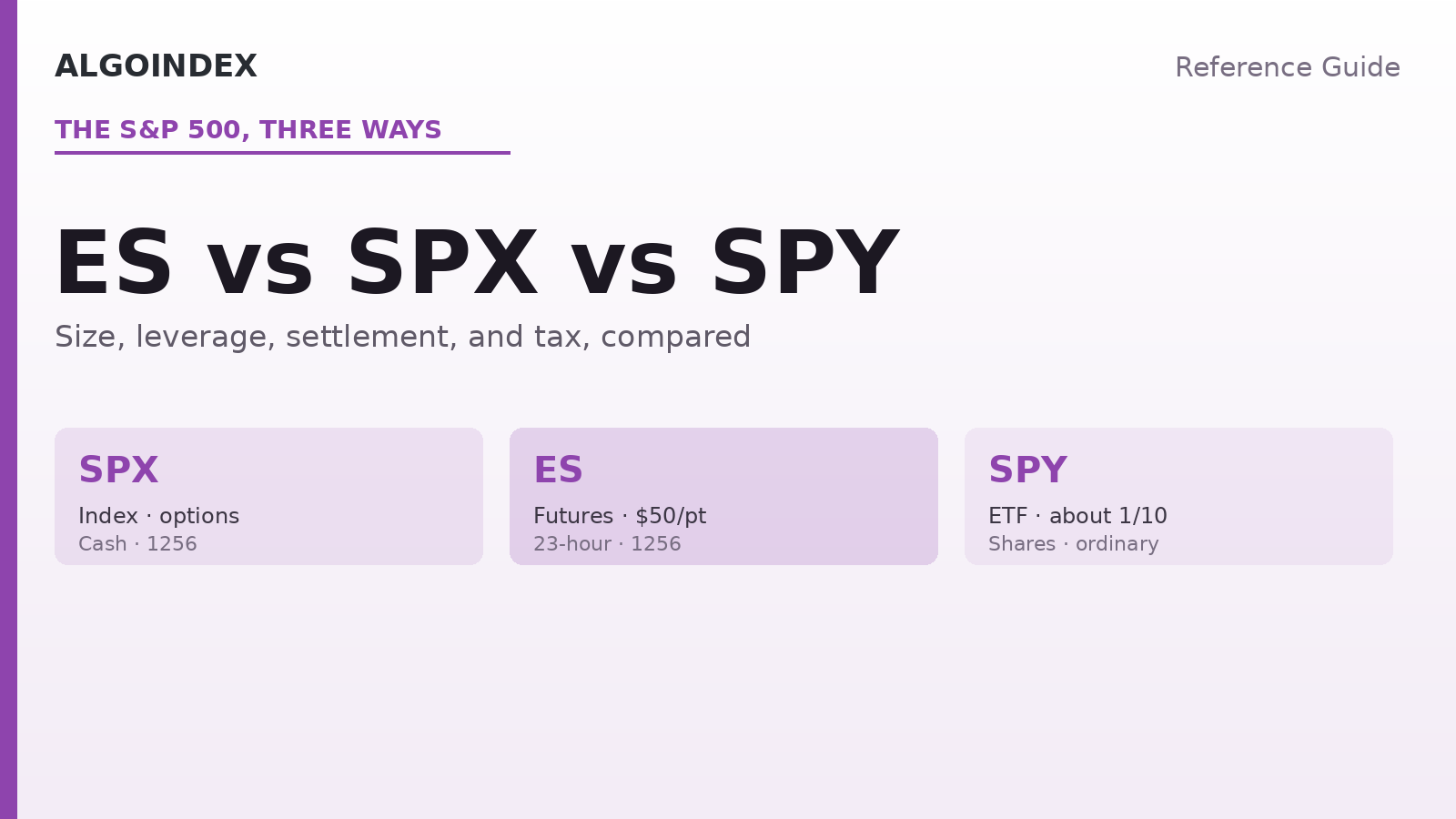
SPX, ES, and SPY all track the same thing, the S&P 500, but they are three different instruments. SPX is the index itself, traded through cash-settled options. ES is the futures contract, worth $50 a point and trading nearly around the clock. SPY is the exchange-traded fund, priced at about one tenth of the index and traded like a stock. Same market, three very different ways in, and the right one depends on account size, time horizon, and tax treatment.
| SPX | ES | SPY | |
|---|---|---|---|
| What it is | The index, traded via options | Futures contract | ETF (a fund you can buy) |
| Price scale | Full index (near 7,400) | Tracks the index, $50 / pt | About 1/10 of the index (near 740) |
| Settlement | Cash, European exercise | Futures, quarterly expiry | Shares, American options |
| Tax class | 1256 (60/40) | 1256 (60/40) | Ordinary security |
| Best for | Defined-risk and 0DTE options traders | Active and overnight directional traders | Smaller accounts and long-term investors |
On a quiet Tuesday a new options trader buys what looks like a cheap S&P 500 call, sees SPX quoted at 7,400, and assumes the contract behaves like the SPY options traded last month. It does not. One SPX contract carries a $100 multiplier on a 7,400 index, roughly $740,000 of notional exposure, settles in cash, and cannot be exercised early. The same dollar idea in SPY would have been one tenth the size and would have delivered actual shares on assignment. The ticker looked familiar. The instrument was not.
That gap is the whole point of choosing deliberately. All three instruments rise and fall with the S&P 500, so the chart is nearly identical across them. What differs is everything around the chart: how much one contract or share controls, whether leverage is built in, when it trades, how it settles, and how the profit is taxed. Picking the wrong vehicle for the account is one of the most common and most avoidable mistakes a new index trader makes.
What each one actually is
SPX is the S&P 500 index, a number, not something an account can hold directly. Traders get exposure to it through SPX options, which are cash-settled and European-style, meaning they can only be exercised at expiration and pay out in cash rather than shares. ES is the E-mini S&P 500 futures contract, a leveraged agreement that tracks the index at $50 a point and expires quarterly. SPY is the oldest and most heavily traded exchange-traded fund in the world, a share that holds the 500 stocks and trades at roughly one tenth of the index level.
The practical consequence is that SPX and SPY are most often used through their options, while ES is most often traded as the underlying futures contract. A trader can hold SPY shares for years; nobody holds an SPX option for years, and a futures position rolls every quarter.
Size and leverage
The single number that reorganizes everything is price scale. SPX is quoted at the full index level. SPY is quoted at about one tenth of it. ES tracks the index at $50 a point.
Scale flows straight into position size. With the index near 7,400, one SPX option controls roughly $740,000 of notional exposure through its $100 multiplier. One ES contract controls about $370,000. One SPY option, covering 100 shares near 740, controls about $74,000, and a single share is around $740. The SPX contract is the heavyweight, SPY the featherweight, ES in between. Futures and options both carry leverage, so a small account can take a large position in any of the three. The contract that fits is the one whose smallest sensible position still respects the account's risk per trade.
Settlement, assignment, and tax
Beyond size, the mechanics diverge in ways that matter at expiration and at tax time.
Two differences carry real weight. The first is assignment. SPX options are European and cash-settled, so a short position cannot be handed shares before expiration, which removes a category of risk that SPY option sellers have to manage. The second is tax. SPX and ES are section 1256 contracts, which means gains are treated as 60 percent long-term and 40 percent short-term no matter how briefly the position was held. SPY shares and options follow the ordinary holding-period rules. For an active trader the difference compounds over a year, though how it applies to any one account is a question for a tax professional, not a blog.
Which one fits
For a defined-risk options trader, especially anyone running same-day expirations, SPX is the natural home: cash settlement, no early assignment, deep liquidity, and the 1256 tax treatment. For an active directional trader who wants leverage and the ability to hold through the overnight session, ES is the instrument, with its near 23-hour access and single deep front-month contract. For a smaller account, a long-term investor, or anyone who would rather trade inside an ordinary brokerage account without futures approval, SPY is the simplest and most flexible, and its options are the most beginner-friendly of the three.
None of this is about which instrument is best. They are the same bet on the same index. The decision is about fit, and the trader who matches the vehicle to the account keeps more of what the chart gives them.
Three tickers, one index. The skill is not picking the market. It is picking the instrument that suits the trade you actually want to make.
Frequently Asked Questions
All three track the S&P 500. SPX is the index itself, traded through cash-settled options. ES is the E-mini futures contract, worth $50 per point and trading nearly 23 hours a day. SPY is an ETF priced at about one tenth of the index that trades like a stock.
Is SPX a future?No. SPX is the S&P 500 cash index, not a futures contract. The S&P 500 future is ES (or the full-size SP). Traders get SPX exposure through SPX options, which are cash-settled and European-style.
Why is SPX about ten times the price of SPY?SPY is designed to trade at roughly one tenth of the S&P 500 index value to keep the share price accessible. If the index is near 7,400, SPX is near 7,400 and SPY is near 740.
Are SPX and ES taxed differently from SPY?SPX and ES are section 1256 contracts, generally taxed 60 percent long-term and 40 percent short-term regardless of holding period. SPY shares and options are taxed as ordinary securities by holding period. Confirm your own situation with a tax professional.
Which should a beginner trade, ES, SPX, or SPY?SPY, or its micro-priced peers, is usually the most beginner-friendly: it trades in an ordinary brokerage account, sizes small, and has the simplest options. ES suits active traders who want leverage and overnight access; SPX suits defined-risk options strategies.
Trade the S&P 500 on a system, not a guess.
AlgoIndex runs an automated SPY options strategy and publishes institutional-grade reviews on ES, NQ, GC, and CL. See the performance statement for how it is tracked, then view pricing.
Related: ES vs SPY in depth, ES and NQ contract specs, and What Are ES Futures.
Related guides
- ES vs SPY: Futures or ETF?. Leverage, cost, trading hours and tax compared.
- ES, NQ, MES & MNQ Contract Specs & Point Value. Point value, tick value and margin for every contract.
- What Is Gamma Exposure (GEX)?. How dealer gamma sets the call wall, put wall and gamma flip on ES futures.
- Trading SPY Signals: S&P 500 Strategies. A complete framework for SPY signals.
- Futures Market Hours: When the S&P 500 Trades. When ES, NQ and the S&P 500 actually trade.