Open any charting app at 9:45 in the morning and the SPDR S&P 500 ETF, ticker SPY, is already flashing a dozen contradictory cues. One indicator says buy, another says sell, a third says wait. The hard part of trading SPY was never finding a signal. It is knowing which signals are complete enough to risk money on, and which are noise dressed up as conviction.
A SPY trading signal is a rule-based instruction to buy or sell the S&P 500 ETF, or its options, at a defined price level with a specific entry trigger, stop-loss, target, and invalidation point. The most reliable signals do not come from a single indicator crossover. They combine a directional bias from trend and dealer-positioning structure with a precise level and a confirmation trigger, then attach predefined risk before the trade is ever placed.
That definition is the whole article in miniature, and it is also where most free guides stop short. The pages that rank for SPY strategies tend to list the same retail indicators, the relative strength index, a couple of moving averages, a momentum oscillator, and call the output a signal. Those tools are useful, but an indicator reading is an input, not a signal. A signal is the finished decision: direction, level, trigger, stop, target, and the condition that proves you wrong. This guide builds that decision from the ground up, then shows where the institutional layer, the part the retail guides skip, actually lives.
What a complete SPY signal actually contains
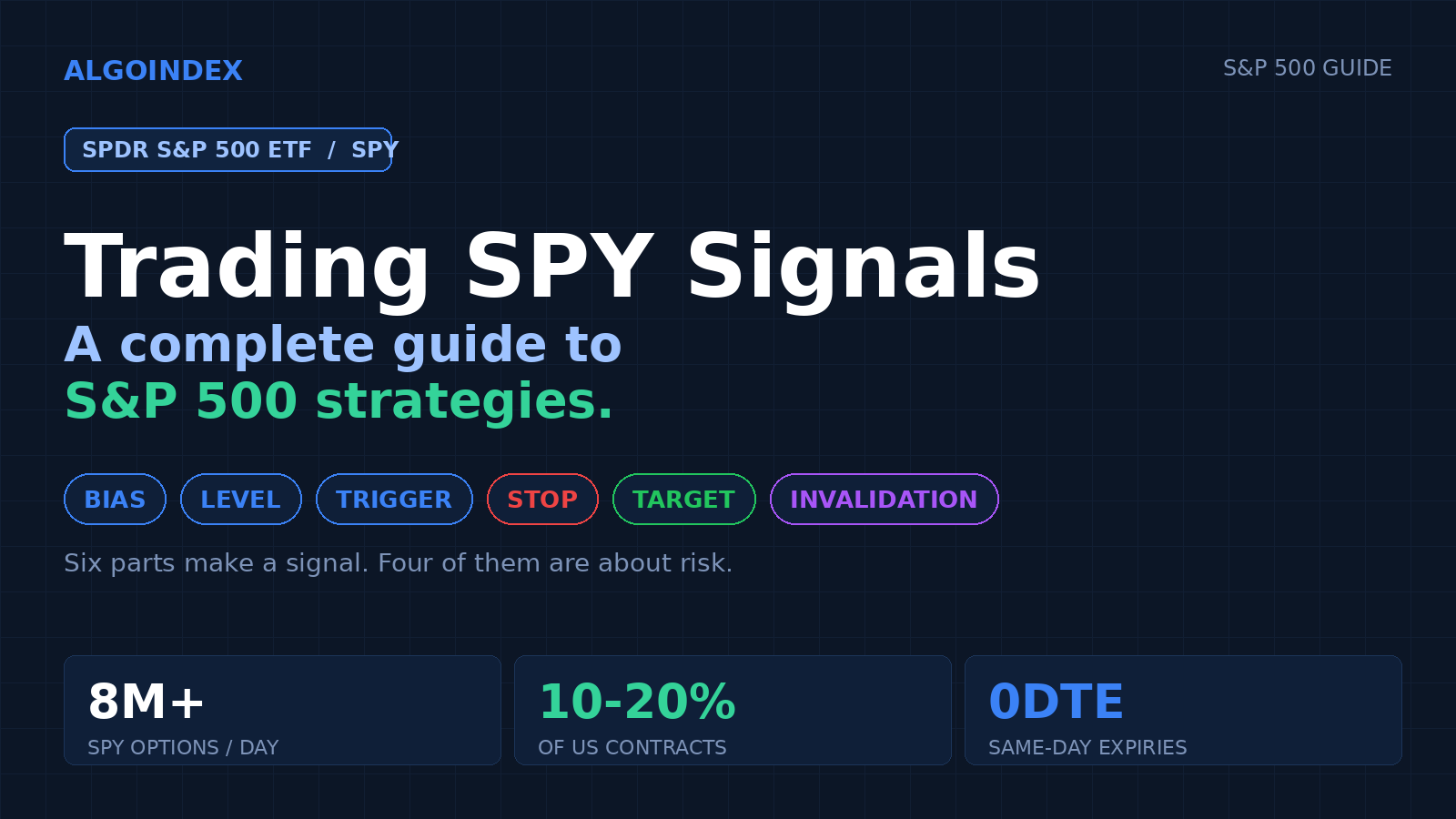
A tradable signal has six parts. Strip any one of them out and you are left with a hunch. The bias answers which direction the odds favor. The level answers where the trade becomes valid. The trigger answers what has to happen at that level before you act. The stop answers where the idea is wrong. The targets answer where you take money off. The invalidation answers what tells you to stand aside entirely before the trigger even fires.
Notice that four of the six parts are about risk and exits, not entry. That ratio is the point. Amateur signals are ninety percent about getting in. Durable signals spend most of their definition on getting out, because the entry is the only part of a trade you fully control and the least correlated with whether you make money.
Why traders signal on SPY specifically
SPY is the most heavily traded security in the world, and that liquidity is the reason it is the default canvas for S&P 500 signals. One ticker carries the weighted behavior of five hundred large American companies, so a trader watching SPY is effectively watching the whole index without juggling five hundred charts. The options market on top of it is enormous, which keeps bid-ask spreads tight and makes entries and exits cheap and fast.
The arrival of options that expire the same day they are listed, often shortened to 0DTE, added a second reason. Same-day contracts let a trader express a precise intraday view with a known, capped maximum loss, the premium paid. That precision is powerful and dangerous in equal measure, which is why a risk-first approach matters more on SPY than almost anywhere else. We cover that mechanics-and-risk balance in depth in the 0DTE SPY options risk-first guide.
The main families of S&P 500 trading strategies
Every SPY signal belongs to a strategy family, and the family decides the timeframe, the holding period, and the kind of risk you are taking. Confusing them is the single most common reason a good signal produces a bad result: a swing entry managed like a scalp gets stopped out of a move that would have worked, and a scalp held like a swing turns a small win into a large loss.
Historically, the longer holding periods have done the heavy lifting. Trend and swing approaches capture the bulk of the index's return because the S&P 500 spends most of its life grinding in one direction, punctuated by sharp corrections. Pure intraday strategies can work, but they fight time decay and transaction friction, and the published long-run records for naive intraday systems are far thinner than for patient ones. The lesson is not that day trading is impossible. It is that the shorter the holding period, the more precise the signal and the risk control have to be.
Retail indicators versus the institutional lens
Most SPY signal guides live entirely in the left column below. The indicators there are real and worth knowing. But they describe price after it has already moved. The right column is where the largest participants actually leave footprints, and it is the layer that separates a generic guide from an informed one.
- Relative strength index, for overbought and oversold
- 50-day and 200-day moving averages, for trend
- Moving-average convergence, for momentum shifts
- Bollinger bands and VWAP, for stretch and fair value
- Dealer-positioning and gamma levels, where hedging flows concentrate
- The ES futures lead-lag, since futures often move first
- Market internals, the breadth and volume tilt under the index
- Expiration mechanics, which cap or amplify ranges
Dealer positioning deserves a plain-English explanation because it is the most useful and least understood input. When market makers sell options to the public, they hedge their exposure by buying and selling the underlying as price moves. In some conditions that hedging absorbs volatility and price pins toward heavily-traded strikes. In others it amplifies volatility and a small move snowballs. Knowing which environment you are in tells you whether to expect a quiet range that fades extremes or a trend that runs. We unpack the mechanism in what dealer gamma positioning is, and we publish a forward-only study of how often those computed levels actually hold in the gamma-level accuracy tracker.
The second institutional input is the lead-lag between the S&P 500 futures, ticker ES, and SPY. The futures trade nearly around the clock and often turn before the ETF opens or reacts, so a level computed in the futures market frequently flags where SPY will pause or reverse. The two instruments are close cousins but not interchangeable, and the differences in hours, settlement, and tax treatment matter; we compare them directly in ES vs SPX vs SPY.
A repeatable framework, not a magic indicator
The traders who last do not chase the perfect signal. They run the same five-step process every session, so the output is consistent even when the market is not. The framework moves from the general to the specific: first read the environment, then mark the levels, then wait for the trigger, then manage by rule, then write it down.
The framework also tells you when not to trade. If the environment is a tight, low-volatility chop with price pinned between two heavy strikes, the highest-probability action is often to stand aside, because the same dealer hedging that compresses the range will fade your breakout. Reading the environment first is what turns a pile of indicators into a decision about whether a signal is even worth taking today.
Timing: not all hours are equal
SPY does not trade with uniform character across the session. The open is fast and prone to false moves as overnight orders clear. The late morning and the final ninety minutes carry the most consistent institutional participation, which is where trends tend to be cleanest. The midday lull is thin and choppy. A signal that works at 10:15 in the morning can be a trap at 12:30 in the afternoon.
Risk management is the actual edge
Here is the uncomfortable truth that the signal-selling industry buries: entry quality contributes a small fraction of long-run results, and position sizing plus exits contribute most of it. A trader with mediocre signals and excellent risk control will outlast a trader with excellent signals and no risk control, every time. Two rules do most of the work. Risk a small, fixed fraction of the account on any one idea, commonly between one half and two percent, so no single loss is consequential. And define the stop before the entry, sized so that the distance to the stop, not a round number of shares or contracts, determines the position.
No signal wins every time, and any source that implies otherwise is selling certainty that does not exist in markets. The goal of a good signal is a positive expectancy across many trades, where the wins are larger than the losses on average, not a perfect record. That is also why the last step of the framework, the journal, matters as much as the first: only a written record tells you whether your signals actually carry an edge or just feel like they do.
How AlgoIndex generates SPY signals
Our own approach puts the institutional layer at the center. We compute the day's dealer-positioning and gamma structure, read the S&P 500 futures for the lead-lag, and only then look for a precise trigger to express the view in SPY or its options. A signal is never a lone indicator crossover; it is the full structured object described at the top of this guide, with the stop and targets attached before entry. We track how those calls perform openly on the performance statement, and you can study the strategies on the pricing page.
The same S&P 500 structure behind our signals is built into the indicators we publish on TradingView, so you can see the levels and plan trades on your own charts. Two are free to everyone:
- AlgoIndex Levels & Setup Planner , map up to twelve key levels and build a complete trade plan with entry, stop, target, and risk-to-reward, the exact six-part signal this guide describes, with optional webhook alerts.
- RTH Levels: VWAP, PDH/PDL, ONH/ONL and Initial Balance , a session-aware, non-repainting levels tool that plots the prior-day and overnight highs and lows, the session VWAP with bands, and the opening range, the reference levels the framework reads first.
And two free tools on our own site:
- The forward-only gamma-level accuracy tracker, a public study of whether these levels actually hold.
- The free AI Trading Journal with an AI coach, to grade every SPY trade against its plan.
Want the full automated system? Our complete intraday engine, the AlgoIndex All Stages strategy, is an invite-only S&P 500 strategy that turns these levels into signals automatically.
Frequently asked questions
SPY trading signals are rule-based buy or sell instructions for the SPDR S&P 500 ETF or its options, each defined by a price level, an entry trigger, a stop-loss, one or more targets, and an invalidation point. A complete signal pairs a directional bias from trend and dealer-positioning structure with a precise level and a confirmation, rather than relying on a single indicator reading.
Yes. SPY is the most liquid security in the world, with tight spreads and same-day-expiry options, which makes intraday trading practical. The trade-off is that the shorter the holding period, the more precise the signal and the risk control must be, since time decay and transaction costs work against fast trades. Most published long-run records favor swing holding periods over pure intraday systems.
There is no single best indicator. Retail tools such as the relative strength index and the 50-day and 200-day moving averages describe price after it moves, so they work best as confirmation rather than as a standalone signal. Pairing them with the institutional layer, dealer-positioning and gamma levels plus the S&P 500 futures lead-lag, gives a more forward-looking read of where SPY is likely to react.
0DTE means zero days to expiration: options that expire the same day they are traded. SPY lists them every session, letting traders express a precise intraday view with a maximum loss capped at the premium paid. The risk is rapid time decay, so a 0DTE signal needs a tight, predefined plan and disciplined position sizing.
For most traders, swing trading is the more forgiving approach because it captures multi-day moves without demanding constant screen time, and historically the longer holding periods have captured the bulk of the index's return. Day trading can work but requires sharper execution and tighter risk control. The right choice depends on your available time, temperament, and how precise your signals are.
Signals can be profitable over many trades when they carry positive expectancy, meaning average wins exceed average losses, and when they are paired with strict position sizing and predefined exits. No signal wins every time, and entry quality matters far less than risk management to long-run results. The only way to know whether a given signal set has an edge is to track it honestly in a journal.
The market will always offer more signals than you can trade. The edge was never in collecting them. It is in knowing which ones are complete, which environment they belong to, and how little to risk on each, so that the few you take are the ones that compound.
See how AlgoIndex computes S&P 500 levels and signals every session on the performance statement, add our free Levels & Setup Planner and RTH Levels indicators to your charts, compare strategies on the pricing page, and grade every trade with the free AI Trading Journal.
Related tools
- SPY gamma exposure tool: live SPY call wall, put wall, gamma flip and max pain computed from the option chain each session and graded forward-only.
- S&P 500 gamma level accuracy tracker: the forward-only hit-rate record behind the method.