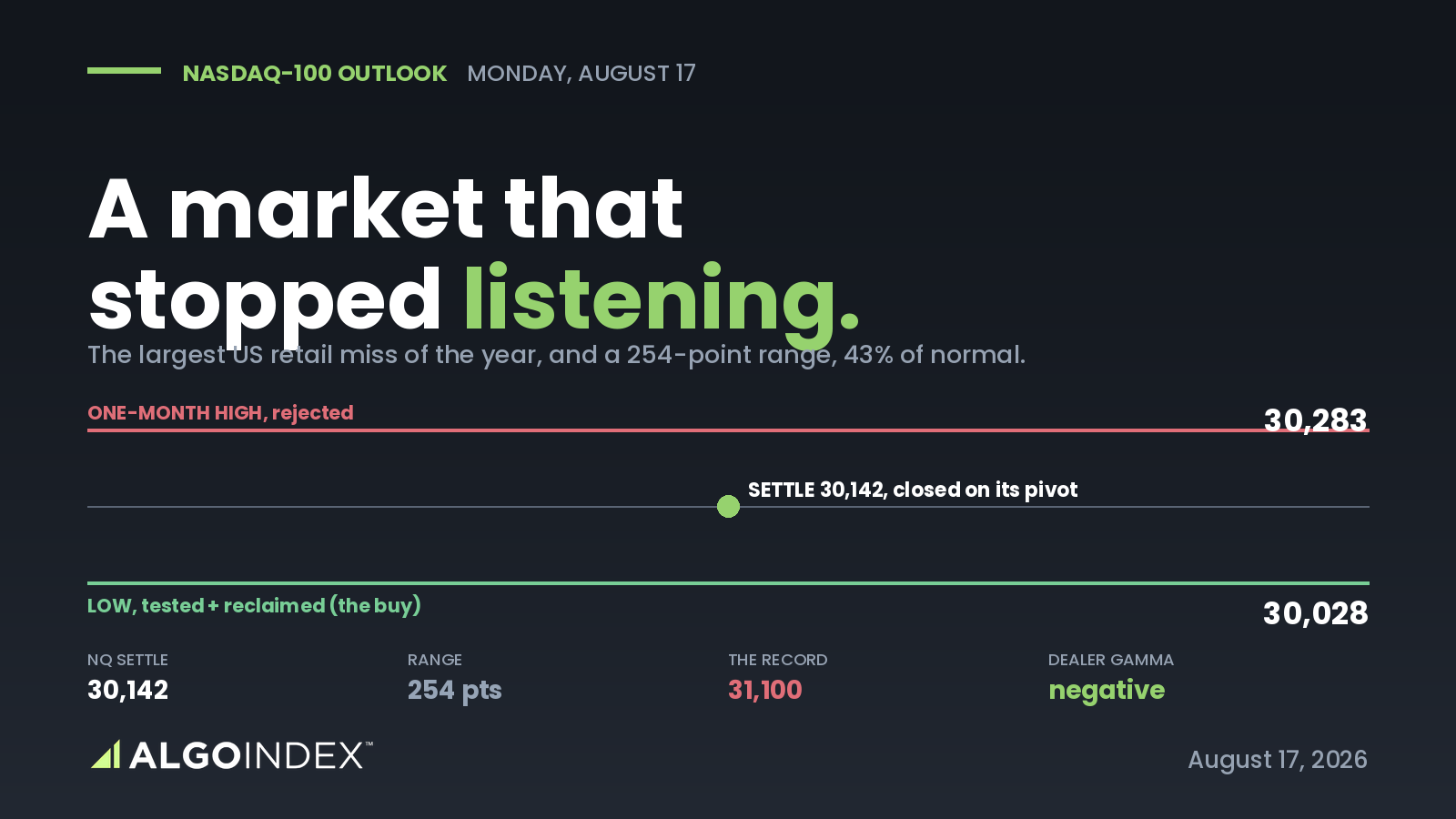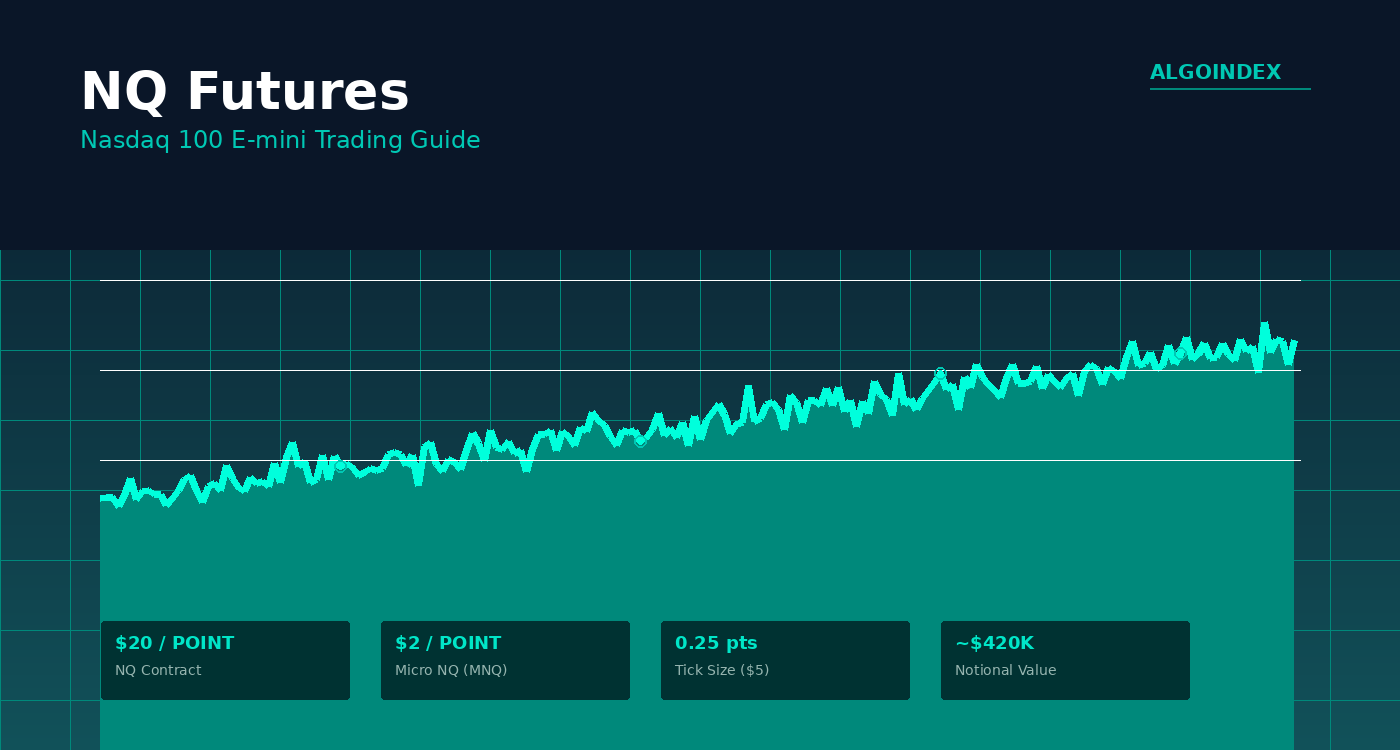
NQ is the E-mini Nasdaq 100 futures contract, which tracks the Nasdaq 100 index of the 100 largest non-financial companies on the Nasdaq. One point is worth $20 per contract and it trades nearly 23 hours a day. NQ is more technology-heavy and more volatile than the S&P 500 ES contract, with a typical daily range of 250 to 400 points. Its smaller version, MNQ (Micro E-mini Nasdaq 100), is worth $2 per point.
At 3:58 PM on a Wednesday in late January, Nvidia’s earnings release hit the wire. Within 90 seconds, NQ futures moved 300 points, roughly $6,000 per contract, while ES barely flinched beyond 40 handles. That gap between the two instruments tells you everything about what NQ futures are and why thousands of day traders choose them over every other product on the CME.
NQ futures, formally the E-mini Nasdaq 100, track the Nasdaq 100 index, a market-cap-weighted collection of the 100 largest non-financial companies listed on the Nasdaq exchange. The contract trades on the CME Globex platform under the symbol NQ, with each point worth $20. A move from 21,000 to 21,010 is $200 per contract. The Micro E-mini version (MNQ) scales that down to $2 per point, making it accessible to smaller accounts.
Why NQ Moves Differently Than ES
The Nasdaq 100 is not the S&P 500. Where the S&P 500 spreads its weight across 500 companies and 11 sectors, the Nasdaq 100 concentrates roughly 60% of its weight in technology. Apple, Microsoft, Nvidia, Amazon, Meta, Alphabet, and Broadcom alone account for nearly half the index.
That concentration creates a specific trading personality. NQ futures amplify tech sentiment. When semiconductor earnings surprise to the upside, NQ can rally 2-3% while ES moves half that. When the Fed signals higher-for-longer rates, NQ sells off harder because growth stocks carry longer duration, meaning their valuations are more sensitive to discount rate changes.
For day traders, this translates into wider intraday ranges. On a typical session, NQ moves 250-400 points from low to high. ES futures, by comparison, tend to range 50-80 points. More range means more opportunity per contract, but also more risk per tick.
Contract Specifications
Understanding the contract mechanics prevents expensive mistakes on your first trade.
The standard E-mini NQ contract (NQ) has a $20 multiplier. At a notional value near 21,000, one contract represents roughly $420,000 worth of Nasdaq 100 exposure. Initial margin requirements vary by broker but typically run $15,000-$18,000 for overnight holds. Most futures brokers offer reduced day-trading margins between $500 and $2,000 per contract during regular trading hours.
Tick size is 0.25 points, or $5 per tick. The contract settles quarterly (March, June, September, December), though most day traders roll to the next contract before expiration and never take settlement.
Trading hours run nearly around the clock: Sunday 6:00 PM ET through Friday 5:00 PM ET, with a daily maintenance break from 5:00-6:00 PM ET. Regular trading hours (RTH), when volume and liquidity are highest, span 9:30 AM to 4:00 PM ET. The pre-market session from 8:00-9:30 AM often sets the tone, especially on days with economic data releases at 8:30 AM.
The Micro E-mini NQ (MNQ) carries a $2 multiplier, one-tenth the size. It uses the same order book and price feed. For traders learning the instrument or managing risk on smaller accounts, MNQ provides identical price action exposure without the full contract’s capital requirement.
What Drives NQ Price Action
Three forces dominate NQ movement on any given day, and recognizing which one is in control separates reactive trading from informed positioning.
Tech earnings and guidance carry outsized weight because of the index concentration. A single name like Nvidia or Apple can move NQ 100+ points after hours. During earnings season (January, April, July, October), NQ volatility expands significantly. Traders who focus on NQ learn to track the earnings calendar for the top 10 holdings the way macro traders track the economic calendar.
Interest rate expectations are the second major driver. The Nasdaq 100 is packed with growth companies whose valuations depend on future cash flows discounted back to present value. When Treasury yields rise, those future cash flows are worth less today, and NQ reprices lower. This relationship means NQ often leads the selloff when Fed policy shifts hawkish or CPI prints hot.
Options and gamma mechanics represent the third force that many newer traders overlook. Like ES, NQ has an active options market where dealer gamma positioning influences intraday price behavior. When dealers are short gamma, NQ’s natural volatility gets amplified further. When dealers sit in positive gamma territory, moves tend to get dampened. Understanding where gamma flips from positive to negative, and how gamma exposure (GEX) shapes the day’s price action, gives NQ traders an edge that pure technical analysis cannot provide.
NQ vs ES: Choosing Your Instrument
Many futures traders start with ES and wonder whether NQ is worth adding. The decision comes down to personality and strategy.
NQ rewards conviction. Its wider range means a correctly timed entry produces larger gains per contract. A 100-point move on NQ is $2,000; that same percentage move on ES might produce $800-$1,000. But the flip side is equally true: stops get hit faster, and slippage during volatile moments can be significant.
ES rewards patience and precision. Its tighter range and deeper liquidity (ES routinely trades 1.5-2 million contracts daily versus NQ’s 600,000-800,000) mean smaller spreads and smoother fills. For strategies that rely on scalping small moves with tight risk, ES futures remain the benchmark product.
Some traders run both. ES for range-bound, high-liquidity scalping. NQ for momentum plays on tech catalysts or rate-driven directional moves. The instruments correlate roughly 85-90% on a daily basis, but those 10-15% divergence windows are where the real edge lives.
Getting Started with NQ Futures
Opening a futures account requires choosing a broker that offers CME products with competitive commissions and reasonable margin requirements. Most retail futures brokers provide NQ access alongside ES, with commission structures ranging from $0.50 to $2.50 per side per contract.
Start with Micro NQ (MNQ). There is no educational shortcut that replaces the experience of watching your P&L move in real time. MNQ lets you build that experience at one-tenth the financial exposure. Trade MNQ for at least 50-100 sessions before sizing up to the full NQ contract.
Study market internals alongside price. NQ does not trade in isolation. TICK, ADD, and VOLD readings for Nasdaq-listed stocks tell you whether the move you are watching has broad participation or is being driven by two or three mega-cap names. A 200-point NQ rally on negative Nasdaq TICK divergence is a move that lacks conviction and often reverses.
The Nasdaq 100 is where technology, monetary policy, and options mechanics collide at the speed of a single earnings print, and that collision is exactly what makes NQ the most dynamic futures contract on the board.
For traders looking to understand how macro events reshape the futures landscape, our guide on how FOMC decisions and CPI releases move ES futures covers the mechanics, gamma dynamics, and practical timing frameworks for event trading.
AlgoIndex | Algorithmic Trading Intelligence
Frequently Asked Questions
One NQ point is worth $20 per contract. One tick is 0.25 points, worth $5. The Micro E-mini (MNQ) is worth $2 per point and $0.50 per tick.
NQ is the E-mini Nasdaq 100 at $20 per point. MNQ is the Micro E-mini, one tenth the size, at $2 per point. MNQ lets smaller accounts trade the same index with less risk per point.
NQ tracks the Nasdaq 100, the 100 largest non-financial companies listed on the Nasdaq, heavily weighted toward technology names.
NQ tracks the technology-heavy Nasdaq 100 and is more volatile, with a typical daily range of 250 to 400 points at $20 each. ES tracks the broader S&P 500 at $50 per point and usually moves less.
NQ trades nearly 23 hours a day, Sunday evening through Friday afternoon US Eastern Time, with a short daily maintenance break.
Join the Discussion
Connect with other ES futures and SPY options traders. Share setups, discuss levels, and get real-time market insights from our community.
Join AlgoIndex Trading Community