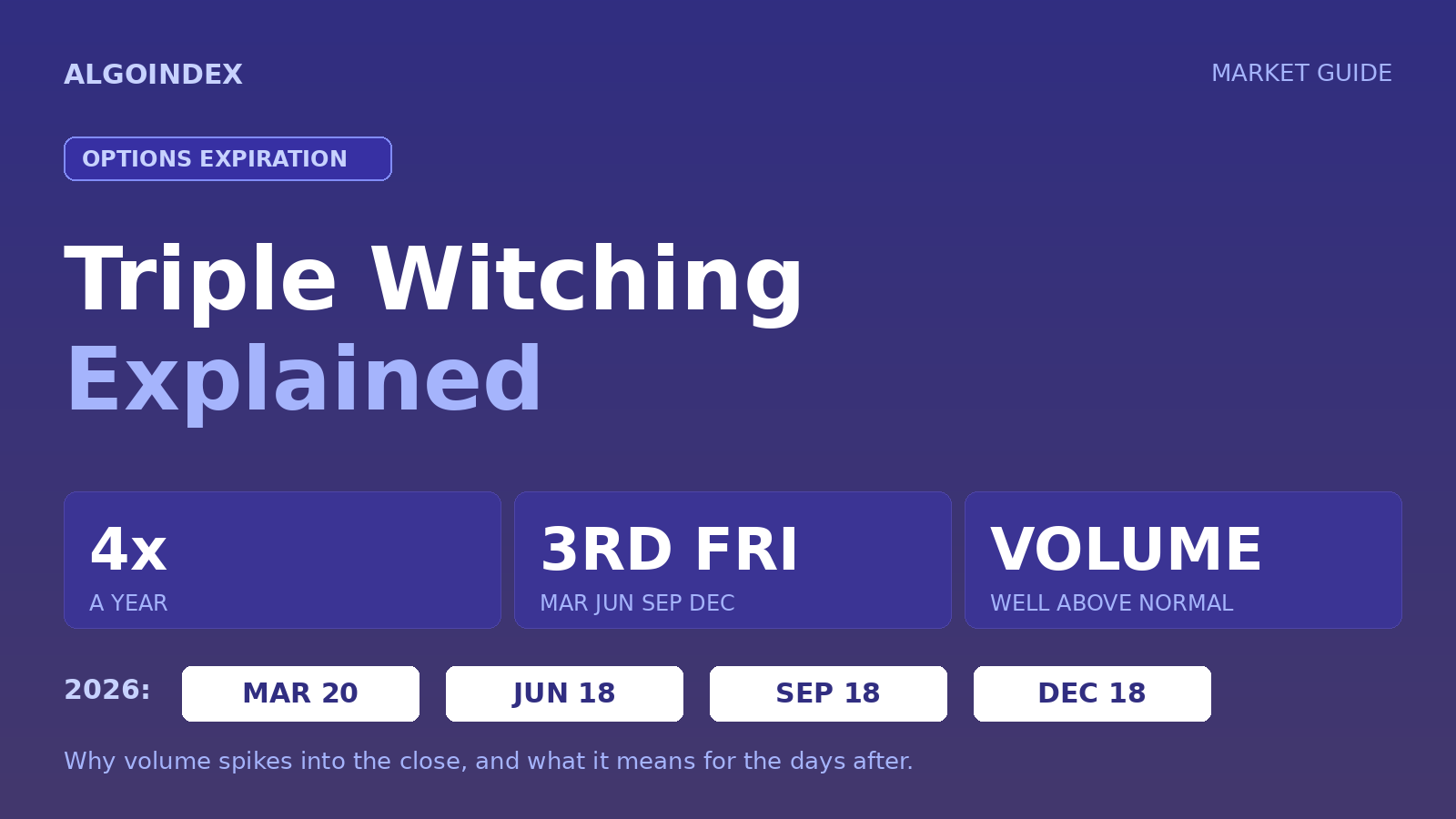
Triple witching is the day, four times a year, when three kinds of derivatives all expire at once: stock options, stock index options, and stock index futures. It lands on the third Friday of March, June, September, and December, and it is known for a surge of trading volume and sharp price swings, especially in the final hour. The name sounds ominous, but the mechanics are straightforward once the pieces are laid out.
For most of a witching Friday the market can look ordinary. Then the closing stretch arrives. In the last hour, and especially the last few minutes, volume balloons as funds and dealers settle and roll enormous positions at once. Prices that drifted all afternoon can jump or sag into the closing auction, and the final print is often less a verdict on the day than the sound of a lot of expiring contracts being squared away. A trader who does not know it is a witching day can mistake that noise for a signal.
That is the whole reason triple witching is worth understanding. The volume and the swings are real, but they are mechanical, driven by expirations, rolls, and index housekeeping that happen to land on the same afternoon. Knowing what is actually moving the market lets a trader treat the day with the right amount of caution instead of reading too much into it.
What actually expires
The word triple points to three layers of contracts hitting expiration on the same day.
On their own, any one of these expirations would pass without much drama. The reason the quarterly date stands out is that all of them, plus the quarterly rebalancing many index funds run on the same schedule, converge into a single closing auction. The flows stack.
Triple witching vs OPEX
OPEX is short for options expiration, and standard monthly options expire on the third Friday of every month. So every month has an OPEX, but only four of those Fridays, in March, June, September, and December, are triple witching, when the index futures and the quarterly index-option and futures contracts expire alongside the monthly options. Think of OPEX as the monthly event and triple witching as the supersized quarterly version of it. The quarterly date carries more weight because there is simply more expiring, and because the futures roll and index rebalances pile on.
Why volume and volatility spike
Heading into the expiration, every holder of an expiring contract has to do something: close it, let it settle, or roll it forward to the next contract. Multiply that across stock options, index options, and index futures, layer on the funds rebalancing their holdings to track an index, and a large share of all that activity concentrates into the final hour and the closing auction. Witching-day volume routinely runs well above an average session, and the moves can be sharp even when nothing fundamental has changed.
The gamma that rolls off
Here is the part that matters most for anyone trading the S&P 500 around these dates. In the days leading into a big expiration, dealers are carrying a large book of options they have sold, and they hedge it in the underlying market to stay neutral. When that book is concentrated at heavily traded strikes, the hedging often acts like a magnet, keeping price pinned near those strikes and the session unusually quiet. Then expiration arrives, the contracts settle, and that whole book disappears at once. The hedging demand that was holding price in place rolls off with it.
That is why the most useful read often comes not on the witching day itself but in the sessions right after it. The witching close is dominated by mechanical flow; once it clears, the market frequently shows its real tone. The deeper mechanics of how dealer hedging pins and amplifies price live in our guides to gamma exposure and dealer gamma positioning; this is that same force, viewed through the lens of expiration day.
How to handle a witching day
For most traders the right posture is caution, not opportunism. The open can be noisy, the close can be violent, and the sharpest move of the day often arrives in the final minutes for reasons that have nothing to do with direction. Position size deserves to come down, not up. Reading the witching-day close as a clean directional signal is a common trap, because so much of that print is settlement and rolling rather than conviction. Many traders simply let the day pass, then trade the cleaner tone that shows up the following week. Triple witching is a date to respect on the calendar, not a setup to force.
Four Fridays a year, the plumbing of the market comes due all at once. The volume is real and the swings are real, but they are mechanical. Know the date, expect the noise, and do not mistake the sound of expiring contracts for the voice of the market.
Frequently Asked Questions
Triple witching is the simultaneous expiration of stock options, stock index options, and stock index futures on the same day. It happens on the third Friday of March, June, September, and December, and it is associated with higher trading volume and sharper price moves, especially into the close.
When is triple witching in 2026?The 2026 triple witching dates are March 20, June 18, September 18, and December 18. June falls on Thursday the 18th because the third Friday, June 19, is the Juneteenth holiday and the market is closed.
What is the difference between triple witching and OPEX?OPEX, or options expiration, is the third Friday of every month, when standard monthly options expire. Triple witching is the quarterly version in March, June, September, and December, when index futures and quarterly index options expire alongside the monthly options. Adding single-stock futures is sometimes called quadruple witching, though traders use the terms interchangeably.
Does the market go up or down on triple witching?Neither reliably. Triple witching adds volume and volatility, not a fixed direction. Much of the movement is mechanical, driven by settlements, rolls, and index rebalancing rather than conviction, so the day has no consistent up or down bias.
Should I trade on triple witching day?Many traders reduce size or stand aside. The open is noisy and the close can swing sharply on mechanical flow, so the witching-day print is a poor directional signal. A common approach is to let the day clear and trade the cleaner tone in the sessions that follow. Trade only risk capital.
The pinning pressure on expiration days is measurable, and we measure it. It is the same dealer-hedging machinery behind max pain: the heaviest open-interest strikes pull price toward them as the clock runs out, and the pull is strongest on quarterly expirations when the most contracts settle at once. We score that behavior every session in our free gamma level accuracy tracker, where the dealer gamma flip has held 81 percent of tested sessions, and on the May 15, 2026 monthly expiration our published review flagged price pinning at a heavily traded strike into the close. How often the daily options-implied range holds overall is in our expected move break-rate study.
Know what is moving the market on the dates that matter.
AlgoIndex maps dealer gamma and key levels every session and runs an automated SPY options strategy on it. See the performance statement for how it is tracked, then view pricing.
Related: gamma exposure (GEX), dealer gamma positioning, and the 0DTE SPY options guide.
If you want to see how your own trades held up through sessions like these, log them in the free AI trading journal and let the coach grade each one. No card required.