On the morning of June 12, 2026, a company that spent two decades refusing to go public will open for trading as the largest listing in the history of financial markets.
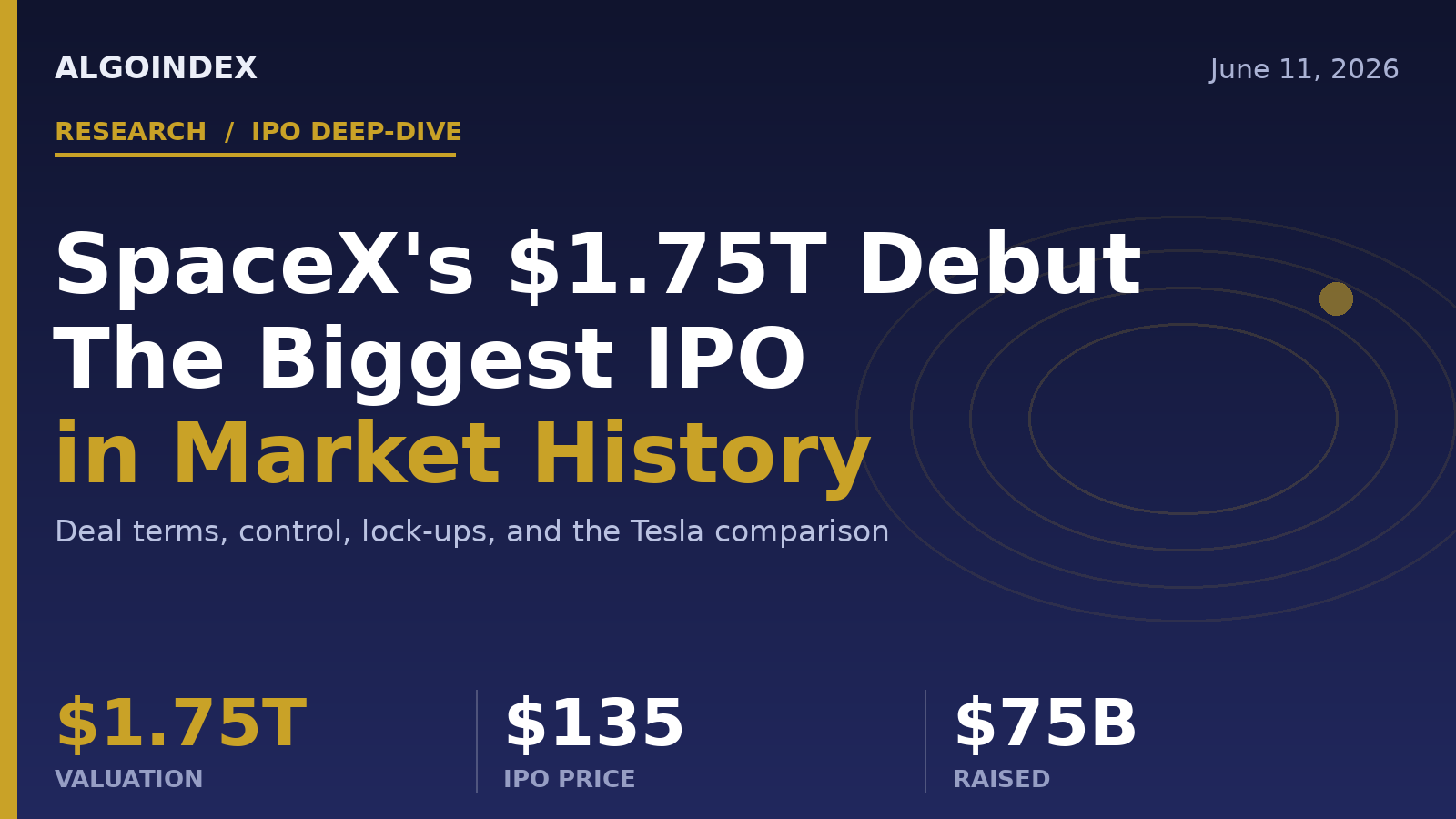
Space Exploration Technologies Corp. filed its S-1 with the SEC on May 20, 2026, priced its offering at 135.00 dollars per share on June 11, and begins trading on the Nasdaq under the ticker SPCX. The deal raises roughly 75 billion dollars at a valuation near 1.75 to 1.77 trillion dollars, with some outlets putting the debut figure as high as 1.8 trillion. That dwarfs the prior record holder, Saudi Aramco's 2019 listing, which raised about 29.4 billion dollars including its over-allotment.
What you are actually buying is a dominant, fast-growing, and currently loss-making space and satellite-internet company, wrapped inside one of the most founder-controlled governance structures ever brought to public markets. Public buyers receive Class A shares carrying one vote each. Elon Musk's Class B shares carry ten votes each, handing him roughly 82 percent of the voting power on about 42 percent of the economics. Put plainly: the public gets the economic exposure and almost none of the control. This report walks through every layer of that trade, and it uses all of the figures from the underlying filing and press coverage, flagging the places where sources disagree.
The one-line read: a genuinely extraordinary asset and a once-in-a-generation franchise, offered at a rich price through a structure that is close to uninvestable for governance-screened funds, into euphoric demand. History says mega-IPOs with this much hype usually disappoint in year one even when the underlying business is excellent. The right move is to size both expectations and position accordingly.
The deal, and why now
SpaceX is selling 555,555,555 Class A shares at 135.00 dollars, with underwriters holding a 30-day option to buy an additional 83,333,333 shares, the over-allotment commonly called the greenshoe. Exercised in full, that lifts the raise to roughly 75 billion dollars and ranks the deal ahead of Saudi Aramco in 2019, Alibaba in 2014, and SoftBank in 2018 by capital raised.
The lower per-share price deserves a footnote, because it looks alarming next to recent private marks and is not what it seems. Private tender offers valued the stock near 212 dollars in July 2025 and around 421 dollars in December 2025. The 135-dollar listing price is lower in absolute terms only because the share count was expanded ahead of the offering, effectively a split. Do not read 135 against 421 as a markdown. On a whole-company basis the valuation roughly doubled, from about 400 billion dollars in July 2025 to the 1.75 trillion IPO mark.
Musk long resisted a SpaceX listing, arguing that quarterly public-market pressure was incompatible with multi-decade Mars ambitions. The filing reframes the rationale. Proceeds will fund what the company calls an extreme flight rate for Starship, AI data centers in space, lunar infrastructure, and continued Starlink build-out. The listing also creates an acquisition currency and a liquidity event for employees and a long roster of early investors locked in for as much as two decades. Crucially, Starlink is the engine: its subscribers and revenue made up roughly 58 percent of SpaceX's total revenue in 2024, and the company is listing with Starlink retained inside it rather than spun out, a structure Musk had floated earlier.
Big revenue, big losses, and the xAI wrinkle
The S-1 gave the public its first detailed look at the books, and the picture is a high-growth franchise that does not yet make money on a consolidated basis. Revenue landed near 18.5 to 18.7 billion dollars in 2025, climbing sharply on launch dominance through the Falcon 9 cadence and on Starlink growth. Against that sat an operating loss of about 4.2 billion dollars and a net loss reported near 5 billion.
The swing to a larger loss traces in significant part to SpaceX's acquisition of xAI, Musk's artificial-intelligence venture, in February 2026. That deal folded an unprofitable, capital-hungry AI business and a web of related-party dealings into the listed company. Investors, in other words, are buying a growth story whose headline loss is muddied by an intercompany purchase from another Musk entity. Morningstar's review carried the pointed headline, Big Spending, Big Losses. The same tension between a magnificent franchise and a demanding price sits at the center of our deep dive on whether today's AI boom rhymes with the dot-com era.
Who owns SpaceX
For more than fifteen years SpaceX has been one of the most sought-after private holdings in the world, and its cap table reads like a directory of venture capital, crossover funds, asset managers, pension plans, strategic corporates, and sovereign wealth. At the top sits the founder. Musk holds about 42 percent of the equity and roughly 82.4 percent of the votes through some 5.22 billion Class B shares, with some reports putting his control as high as 85 percent. Employees have accumulated meaningful equity through options and restricted stock over two decades, and up to 5 percent of the offering is set aside for certain employees and what the company calls friends.
Sequoia Capital
Andreessen Horowitz
Gigafund · Kleiner Perkins
Capricorn · K5 Global
Baillie Gifford
T. Rowe Price
D1 Capital Partners
Blue Owl · Brookfield
EchoStar
Ontario Teachers'
Tesla, Inc. 18.99M sh
Sovereign wealth funds
The named backers map to a remarkable run of paper gains. Founders Fund put roughly 20 million dollars in as early as 2008 and rode multiple rounds to among the highest multiples on the table. Sequoia committed about 1 billion dollars to the 2015 Series F. Andreessen Horowitz led a roughly 750 million dollar Series J in 2023. Fidelity led several rounds and marks the stock inside its public funds. Alphabet invested about 900 million dollars in 2015 and saw its stake grow to roughly 7 percent, among the largest outside positions. Even Tesla itself holds about 18.99 million shares, around 0.15 percent before the offering, a stake worth roughly 2.6 billion dollars at the 135-dollar price.
Control, and why governance funds are wary
After the offering SpaceX will have two classes of common stock. Class A, the shares the public buys through SPCX, carries one vote. Class B, held by Musk and insiders, carries ten. Through roughly 5.22 billion Class B shares, Musk holds about 82.4 percent of the total voting power while owning about 42 percent of the economics. In practice, public shareholders get the upside and downside of the stock and effectively no say over the board, strategy, pay, or mergers. There are no realistic activist or takeover dynamics. The founder controls outcomes outright.
That gap is why a wall of institutional money is uneasy. In May 2026, CalPERS, the largest public pension in the United States, joined the New York State and New York City Comptrollers, together overseeing more than 1 trillion dollars, in a joint letter to SpaceX. Morningstar published a piece titled A Long List of Unfriendly Shareholder Policies. Fortune wondered whether SpaceX could be the least shareholder-friendly public company of all time. Their objections fall into four buckets, and they are concrete.
First, the super-voting control of more than 82 percent of votes on 42 percent of economics violates the one-share-one-vote standard many funds require. Second is key-person and attention risk: Musk would be chief executive, chief technology officer, and chair of SpaceX while also running Tesla, X, xAI, the Boring Company, and Neuralink, with SpaceX and Tesla effectively competing for his focus and his incentives. Third are related-party transactions, and the filing disclosed several material ones across Musk entities. Fourth, governance teams flagged board-independence concerns.
The practical consequence is unusual. A meaningful slice of natural institutional demand, the ESG and governance-screened funds and some pensions, is sitting the deal out, and yet the book is still substantially oversubscribed on retail and growth-mandate money. The twist comes later: if SPCX enters major indices, governance-averse index funds may be forced to hold it anyway.
Lock-ups, Rule 144, and when insiders can cash out
A lock-up is a private contract demanded by underwriters, not an SEC rule. For a technology IPO of this scale the convention runs 90 to 180 days from listing. With a June 12, 2026 debut, insider and employee selling generally opens somewhere between mid-September and mid-December 2026. The exact terms, whether a single cliff or a staggered release, whether there are early-release price triggers or carve-outs, will be spelled out in the final prospectus.
Once the contractual lock-up lifts, insider sales remain governed by SEC Rule 144. The holding period is six months for restricted securities of a reporting company, typically already satisfied by the time a 180-day lock-up ends. Affiliates, meaning directors, officers, and holders of 10 percent or more such as Musk, face a volume cap in each three-month window of no more than the greater of 1 percent of shares outstanding or the average weekly trading volume over the prior four weeks. They must file Form 144 and sell only in open windows or through pre-arranged 10b5-1 plans, with current public information available. In short, the founder cannot dump.
Why this matters for price is straightforward. When long-locked holders, some sitting on gains of 100 times or more, become free to sell, supply can spike and the stock can dip, a pattern seen across many listings. Mark the September-to-December 2026 window.
How ordinary investors can, and cannot, get in
Unusually, SpaceX courted the retail crowd. It targeted roughly 30 percent of the offering for retail, three to six times the typical 5 to 10 percent, though June 11 reporting said the slice was trimmed to the low 20s percent amid record institutional demand. The filing named Charles Schwab, Fidelity, Robinhood, SoFi, and Morgan Stanley's E-Trade as platforms making shares available to eligible clients. At the 135-dollar IPO price, shares went only to clients who received an allocation through a participating broker, and that was neither guaranteed nor easy, with retail orders alone reportedly topping 100 billion dollars. On the open market from June 12, anyone with a brokerage account can buy SPCX, likely above 135 dollars if it pops, with the usual first-day volatility. One caution worth stating plainly: beware look-alike pre-IPO SpaceX vehicles charging high fees and markups, since many how-to-buy pages are marketing rather than neutral sources.
What the record of mega-IPOs actually shows
The useful question is not whether SpaceX is a great company, because it is, but how enormous, hyped listings actually trade afterward. The record is sobering. Big first-day pops are common, but year-one and multi-year outcomes diverge wildly, and the winners shared one trait: durable compounding economics that exceeded the debut hype.
| Company (IPO) | First Day | Later Outcome |
|---|---|---|
| Saudi Aramco 2019 | +10% | Flat to down, about -17% to -26% by 2024; tracks oil. |
| Alibaba 2014 | +38% | Volatile, big drawdowns, roughly tripled at peaks. |
| Facebook / Meta 2012 | Flat | Fell about 50% to 17.55, then compounded near 29% a year. |
| Visa 2008 | +28% | Up about 2,300%, near 18.5% a year, best in class. |
| Rivian 2021 | +29% | Down about 90% as cash burn crushed it. |
| Arm 2023 | +25% | Up more than 400% since, on AI tailwind plus real profits. |
| Reddit 2024 | +48% | Up near 48% on the trailing year but down 25% within 2025. |
| CoreWeave 2025 | Flat | Up 367% to about 187 by mid-2025, then volatile; founders sold 2.3B. |
Four implications follow for SPCX. A first-day pop is likely but not guaranteed; with an order book above 250 billion dollars a debut above 135 is the base case, yet Meta and Aramco show megacap debuts can open flat when fully priced and underwriter-defended. Year one is often the weakest stretch, as lock-ups expire and the scarcity premium fades, and even eventual blowout winners like Meta fell about 50 percent first. The long-run outcome depends on execution, not the listing; Visa and Arm rewarded holders because economics compounded, while Rivian and Aramco disappointed because they did not. And the starting point is steep: listing near 1.75 trillion dollars on about 18.7 billion in revenue, more than 90 times sales, with current losses, leaves little margin for stumbles. The multiple itself is a risk factor.
Musk's third trip to public markets
This is the third Musk company to reach public markets, and the contrasts are stark. Tesla went public on June 29, 2010 at 17.00 dollars a share, selling 13.3 million shares to raise about 226 million dollars, the first American automaker to list in decades. The stock jumped 40.5 percent to close at 23.89, an end-of-day value near 2.2 billion dollars. It listed with a single class of stock, one share and one vote, no super-voting. It was deeply unprofitable, pre-mass-production, with a near-bankruptcy history behind it. And it went on to return roughly 300 times, more than 23,000 percent by 2025.
The crucial nuance is that the monster return was a slow burn. Tesla spent roughly two and a half years going essentially sideways after its 2010 debut before the move began, a reminder that even Musk's greatest public winner punished impatient early buyers. His first listing came earlier still: Musk co-founded X.com, which became PayPal, but had been removed as chief executive before PayPal's 2002 IPO. He was its largest shareholder, eBay acquired PayPal months later for about 1.5 billion dollars, and that capital seeded both SpaceX and Tesla.
| Tesla (2010) | SpaceX (2026) | |
|---|---|---|
| IPO valuation | 1.7 to 2.2 billion | 1.75 trillion (1,000x larger) |
| Capital raised | 226 million | 75 billion |
| Share structure | One share, one vote | Dual-class; Musk 82% votes |
| Company maturity | Pre-scale, near-bankruptcy | Dominant launch + Starlink |
| Profitability | Heavy losses | Heavy losses (muddied by xAI) |
| Retail framing | Conventional institutional deal | Deliberate large retail slice |
| Starting multiple | Low base, substantial runway | 90x sales, priced for perfection |
The takeaway is uncomfortable for anyone hoping for a repeat. Tesla's asymmetry, a small and cheap base with enormous runway and clean governance, is what produced 300 times. SpaceX is a magnificent but already-gigantic, richly valued, founder-locked company. The business quality is far higher; the entry asymmetry is far lower. A Tesla-like multiple from a 1.75 trillion-dollar start is mathematically heroic, because it would imply SpaceX growing into a multi-tens-of-trillions company. The Musk lesson that does carry over is to be prepared for a flat or painful first chapter even when the long arc points up.
The bull case against the bear case
The bottom line
SpaceX is a phenomenal company being sold at a phenomenal price, into euphoria, with structurally minimal investor protections. All three of those can be true at once. The franchise quality is arguably the best to come public since the early-2010s technology giants. But you are entering near 1.75 trillion dollars, not at the earliest stage, with no governance rights, current losses, an xAI complication, and a known lock-up risk window in the fourth quarter of 2026.
The practical framing is to treat SPCX as a high-conviction, high-volatility, long-horizon position rather than a guaranteed first-day-pop trade. The comparable record, Meta and Tesla itself, suggests the best long-term outcomes still ran through ugly first chapters. If you buy, four habits help: decide in advance whether you want an allocation at 135 dollars or are willing to chase the open; size it as a speculative sleeve you can hold for years; expect, and be able to withstand, a possible 30 to 50 percent drawdown in year one even under a bullish long thesis; and treat the lock-up expiry as a potential entry, not exit, opportunity.
A magnificent business and a magnificent price are not the same thing, and at 1.75 trillion dollars the public is being asked to buy both at once.
This report is research and educational analysis, not investment advice. Figures are drawn from press reporting and the SpaceX S-1 as of June 11, 2026; some numbers are reported in slightly different forms across sources, and ranges are flagged where they conflict. Verify the final prospectus terms and consult a licensed financial professional before acting.
See how AlgoIndex turns deep research like this into systematic, level-based signals.
View pricing →