At 10:10 on Monday morning, the S&P 500 E-mini was down on the day, sitting at 7,410 after the opening gap had been sold to nothing, and the index had just slipped under the one level dealers most needed it to hold. Forty minutes later it was a different market. Buyers stepped in hard at the 7,410 to 7,420 demand shelf, the contract reclaimed its volatility-inflection line by midday, ground through the 7,490 to 7,497 supply band in the afternoon, and closed near 7,500, up roughly 1.3 percent. The outside-up reversal did more than repair Friday's failed breakout. It flipped the entire dealer-positioning map back to the side of the bulls.
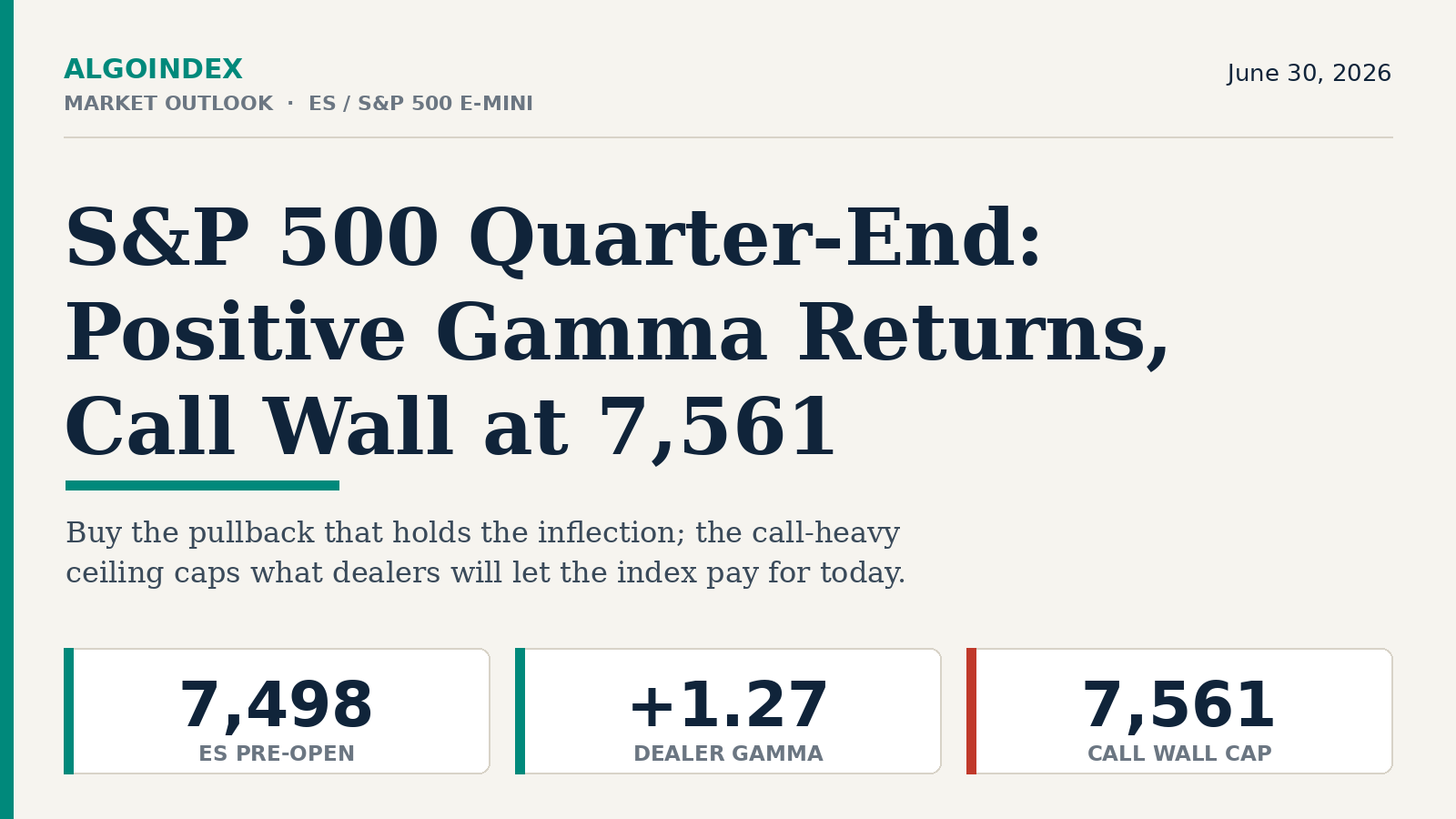
That single session is why today, the final trade of the quarter, opens with a constructive tilt rather than a defensive one. The dealer gamma index on the contract has turned positive, at about plus 1.27 versus deeply negative last week, and with price holding above both the 7,471 volatility inflection and the 7,458 gamma-flip line, dealer hedging is back in move-dampening mode. The 7:00 AM dealer note calls it directly: this is not a very crashy setup, with positive gamma now present at every strike down to 7,000 cash. The question for the session is not whether support holds. It is whether buyers can pay up into a ceiling that the options market has stacked heavily with calls.
The recovery restored the upper half of the range, nothing more
Monday's reversal was a change of character, but it was not a breakout. The contract sits in the upper half of the multi-week 7,361 to 7,561 band (7,300 to 7,500 cash), having reclaimed the inflection and the gamma-flip line on the way up. The early-June high near 7,688 (7,620.90 cash) remains the dominant ceiling and the structural lower-high reference, and the index has not come close to challenging it. On an absolute basis the secular uptrend is intact, with price far above the 100-day and 200-day equivalents at 7,125 and 6,990, and the quarter closing as the strongest in six years. What changed Monday is the near-term tilt, from Friday's distribution back to recovery. What did not change is the burden on the bulls, which is to clear and hold the 7,485 to 7,500 cash peak-gamma shelf and press the 7,550 cash level into Thursday.
The moving-average stack tells the same story of a partial repair. Price near 7,498 trades back above the 9-day (7,471 ES) and 18-day (7,481 ES) equivalents and is now pressing the 40-day at 7,508 ES, the immediate overhead barrier. Hold the 7,471 to 7,481 band on any pullback and the short-term structure stays constructive. Reclaim and hold the 40-day at 7,508 and the recovery has room toward the peak-gamma ceiling.
Positive gamma is the cushion, the call wall is the cap
The structural feature that matters most today is what dealers are now positioned to do. With the gamma index positive and price above the 7,441 risk-off trigger (7,380 cash), hedging flows lean against movement in both directions, dampening dips and capping rips. Positive gamma cushions the entire path down to 7,000 cash, which is what the desk means by a non-crashy setup. The same mechanics define the ceiling: peak gamma concentrates at 7,485 and 7,500 cash, which is 7,546 and 7,561 in contract terms, and the call-heavy 7,561 level (7,500 cash, the round number) is where a same-day rally is most likely to stall. Above that, 7,610 (7,550 cash) is the major level into Thursday afternoon.
Two flows can override the technical map for stretches of the day. A large quarterly index collar position rolls today for the first time off the futures leg rather than the cash-index leg, which is likely to print large, fast hedging trades around 1:00 PM ET. The desk's guidance is to fade those moves as mean-reversion, not chase them. The second is quarter-end and month-end rebalancing into the close, which can produce sharp, non-fundamental swings in either direction with no technical warning.
"A one-month implied-correlation gauge has fallen below 8, an overbought-calls condition that has historically preceded short, sharp pullbacks, even as the desk expects volatility to keep compressing into the three-day weekend."
A quiet macro backdrop that lets volatility bleed
The backdrop is risk-supportive at the margin and deliberately so. Secured overnight funding held near 3.63 percent, the dollar firmed with the yen at its weakest since 1986, and the volatility index sits low near 17.6 as implied volatility is compressed into the long weekend, a vol-crush dynamic that is supportive of stocks. The only first-order release before midday is the JOLTS job-openings report at 10:00 AM, which the market is treating as an idiosyncratic event ahead of the marquee employment report on Thursday. Each data point that passes cleanly lets implied volatility sink further; the risk is a hot print that hands the market the trigger for a spasm.
Leadership carries the day's most interesting nuance. The artificial-intelligence memory leaders are losing their upside call skew for the first time since the April rally began, a sign the options market is paying less for further upside in the names that drove the advance. That softening skew sets up technology-sector volatility to come in, supportive of a calm grind, but it also removes some of the fuel that carried the index to the highs. The geopolitical backdrop stays a contained tail risk, with an Iran-sanctions overhang keeping crude modestly firm and weekend Strait of Hormuz and Israel-Lebanon headlines fading without escalation.
The trade: buy the hold, not the chase
The cleanest expression of this structure is to buy a controlled pullback that holds the inflection rather than chase strength into the call-heavy ceiling. The prime long location is a pullback into 7,471 to 7,481 ES that holds with firm internals, stop structural below 7,458, with a hard invalidation on a sustained loss of the 7,441 risk-off trigger. Targets stack at 7,508 (the 40-day and prior-week supply), 7,535 to 7,546 (the retracement band and the lower peak-gamma shelf), and 7,561 (the call-heavy resistance and the day's primary upside cap), for roughly 1:1.5, 1:3, and 1:4.5 reward against a 7,478 entry and a 7,458 stop.
The base case sits between those two flows: an opening hold above the 7,471 support band, a probe toward the 7,535 to 7,561 ceiling that struggles to clear on the first attempt, a midday collar spasm that mean-reverts, and a rebalancing-driven pin in the upper half of the day's range. The desk puts that constructive grind at about 50 percent, range-bound chop between the inflection and the ceiling at 30 percent, and a risk-off break of 7,441 at 20 percent.
Positive gamma will cushion the dips and the vol-crush will compress the moves, but the call wall at 7,561 is where conviction meets the limit of what dealers will let the index pay for today.
The complete data picture
Every level below is in the E-mini front-month (ESU26) domain, with cash-index equivalents in parentheses where relevant. The contract trades at roughly plus 60 to 61 points to cash, with the dealer model referencing near 7,501 ES against 7,440 cash. Related reading: Monday's ES bounce-into-resistance note, and the concept explainers on call walls and put walls and dealer gamma exposure.
Complete level map
| Resistance (top to bottom) | Support (top to bottom) |
|---|---|
| 7,860 ES (7,800 cash) upper call-heavy ceiling | 7,471 ES (7,410 cash) volatility inflection; 9-day 7,411; pivot 7,410.56 |
| 7,688 ES (7,620.90 cash) early-June high, lower-high | 7,481 to 7,471 ES 18-day / 9-day MA band |
| 7,610 ES (7,550 cash) major level into Thursday | 7,458 ES (7,397 cash) dealer gamma-flip line |
| 7,561 ES (7,500 cash) call-heavy resistance, peak gamma | 7,441 ES (7,380 cash) risk-off trigger |
| 7,573 ES (7,513.34 cash) stochastic-80 threshold | 7,410 to 7,420 ES (7,347 cash) Monday demand shelf |
| 7,546 ES (7,485 cash) lower peak-gamma shelf | 7,361 ES (7,300 cash) put-heavy base of range |
| 7,535 to 7,541 ES (7,474.92 / 7,481.34 cash) retracement + stoch-70 | 7,168 ES (7,100 cash) deeper magnet |
| 7,508 ES (7,447.52 cash) 40-day average + prior-week supply | 7,061 ES (7,000 cash) primary gamma concentration strike |
By the numbers
Intraday windows and expected-range envelope
| Window | Levels |
|---|---|
| Pre-open (to 09:30) | Hold 7,485 to 7,510; 7,500 magnet; below 7,485 early softness; above 7,510 early ceiling test |
| Open + opening range (09:30 to 09:45) | Forms 7,490 to 7,505; watch 7,471 inflection and 7,481 MA band (no entries before 9:45 ET) |
| Morning (09:45 to 12:00) | JOLTS pivot 10:00; in-line grind 7,508 then 7,535 to 7,546; hot = cushioned spasm to 7,471 / 7,458 |
| Afternoon (12:00 to 16:00) | about 1:00 PM collar roll (fade); rebalancing into close; base case grind-and-pin 7,485 to 7,561 (cash 7,425 to 7,500) |
| Expected low (likely) | about 7,471 to 7,481 ES |
| Expected mid (pivot) | about 7,490 to 7,508 ES |
| Expected high (likely) | about 7,535 to 7,561 ES |
| Event tails | Break above 7,561 extends to 7,610; loss of 7,441 re-exposes 7,410 then 7,361 |
Macro drivers in one view
| Driver | Read |
|---|---|
| Dollar / rates | Dollar firm, yen weakest since 1986; funding about 3.63%; JOLTS the only first-order US release before Thursday |
| Leadership / earnings | AI memory leaders losing upside call skew for the first time since April; tech volatility set to compress |
| Geopolitical | Contained tail risk; Iran-sanctions overhang keeps crude firm; weekend Hormuz / Israel-Lebanon faded |
| Breadth / rotation | Quarter-end rebalancing dominates breadth; quarter closing strongest in six years |
| Cross-asset / volatility | VIX about 17.6, IV compressed into the weekend, crude modestly higher; sub-8 correlation gauge compressed |
| Institutional positioning | Gamma index positive (+1.27); collar roll + rebalancing the dominant flows; 7,441 the risk-off trigger |
See how AlgoIndex turns a read like this, positive gamma below and a call wall above, into systematic signals.
View pricing →