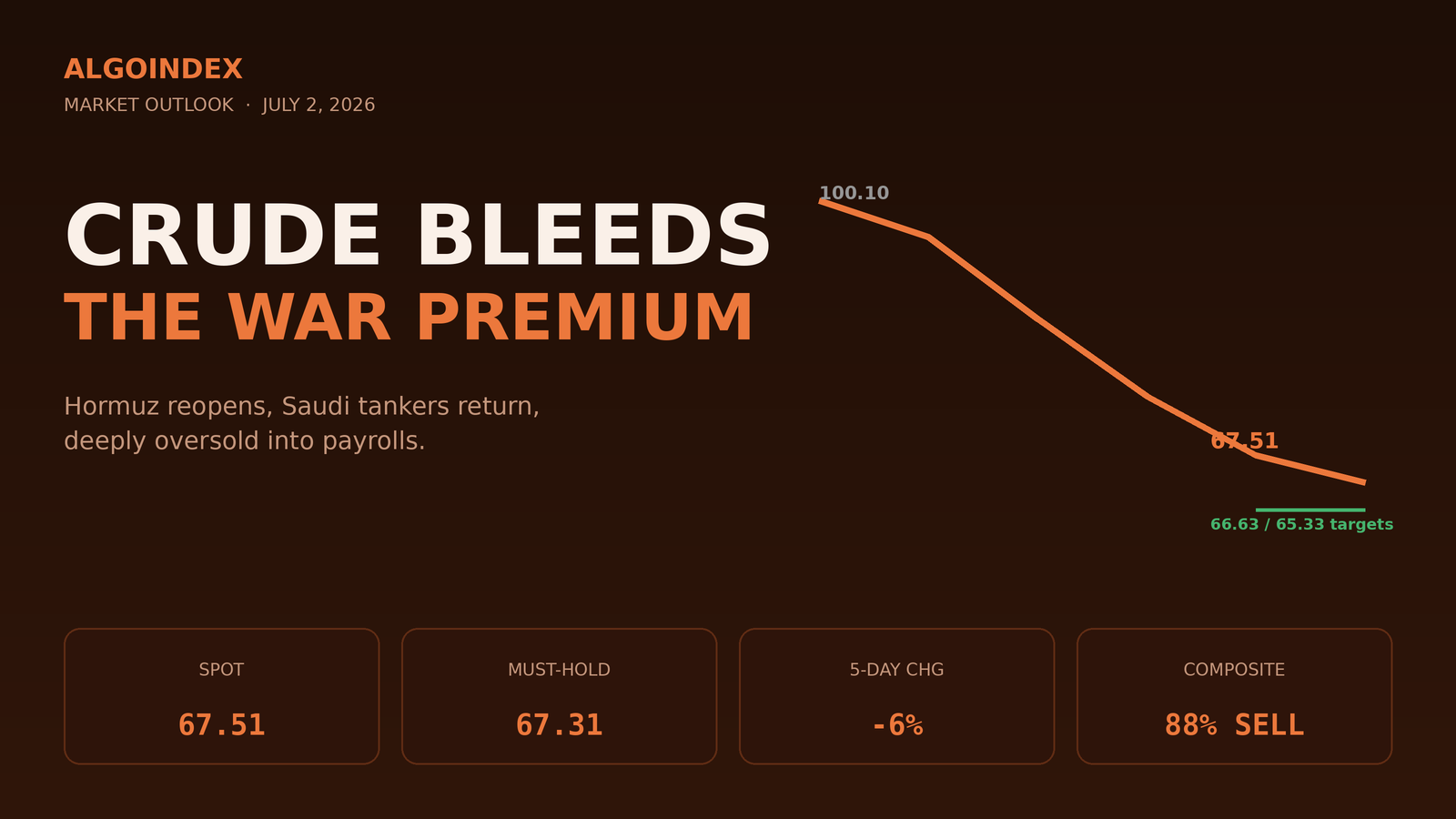
Crude oil enters Thursday on the defensive, extending a sharp multi-day unwind of the geopolitical risk premium that had inflated prices through the recent Middle East conflict. The front-month contract settled the prior session near 68.58 and trades around 67.51 in early dealings, off roughly 1.07 points or 1.56 percent, with the overnight range confined to 67.31 by 68.24. The driver is unambiguous: the Strait of Hormuz has reopened, Saudi Arabia is rushing supertanker exports back through the waterway, and the war-risk bid that carried WTI into the mid-to-upper band is bleeding out session after session. On a five-day basis price is down nearly 6 percent, and the longer moving-average structure, still elevated from the conflict spike, now sits far above spot.
The contradiction into today is a decisively bearish trend against a deeply oversold condition. Momentum confirms a strong, mature downtrend, yet short-term strength gauges are pinned near multi-week extremes, the kind of reading that historically precedes at least a mechanical relief bounce or a pause. Price trades below the computed daily pivot and beneath the first support shelf, which flips the burden of proof onto the bulls to reclaim broken levels. Layered on top is an unusually heavy data morning: an energy-specific supply report at 8:00 and a first-order US labor print at 8:30, the latter pulled forward into Thursday for the holiday-shortened week. That combination raises the odds of a two-sided, headline-sensitive open and argues for patience through the opening range.
Supply normalizes, and the premium drains
Supply is the heart of the move. With Hormuz reopened, roughly 10 million barrels of Saudi crude have cleared the waterway in recent days as supertankers resume normal routing, rapidly restoring the flow the conflict had threatened. That normalization is the mechanical driver behind the price collapse. Offsetting it at the margin, Chinese private refiners, the so-called teapots, are reported to be stepping in to buy Middle Eastern crude on the spot market as prices slide, a familiar bargain-hunting response that can slow a decline once value buyers engage. The balance of those two flows, Saudi export acceleration against Chinese spot demand, plus the labor-driven dollar reaction, will set the near-term tone.
The geopolitical picture is de-escalating but not fully benign. While Hormuz has reopened, Iran's armed-forces command has warned that vessels not following designated routes will have their security endangered, so the market is pricing a much smaller premium rather than none. Any headline suggesting renewed friction could spark a fast, sharp short-covering reaction given how one-sided positioning has become. The dollar and rate backdrop is front and center because the marquee labor release lands before the open: a hot print would firm the dollar and add downside pressure to dollar-priced crude, while a soft print would do the opposite and potentially fuel the oversold bounce.
The structure, level by level
The first ceiling is 67.60, the first support turned resistance and the line separating continuation from bounce. Above it sits the overnight and prior-session high at 68.24, then the computed daily pivot at 68.90, the pivotal reclaim level; regaining and holding above it would neutralize the immediate bearish edge. Extended resistance stacks at the 69.73 one-standard-deviation band and 69.87 first pivot resistance, a tight confluence that should cap most relief rallies, then 71.17 and 72.14. Far overhead, the 52-week high at 100.10 is a reminder of how far the conflict premium has already deflated.
Beneath spot, support is thin and close: the negative-one-deviation band at 67.43 sits just under price, then the overnight and prior-session low at 67.31, the first must-hold line. A sustained break exposes the 66.95 two-deviation support and the 66.63 second pivot, which form the next demand shelf and the primary continuation target, then the 66.59 three-deviation support and the 65.33 third pivot as the extended objective. The moving-average stack is emphatically bearish and still distorted by the conflict spike: 5-day 69.14, 20-day 77.66, 50-day 85.71, 100-day 80.90, 200-day 70.15, with price below every one. The 200-day at 70.15 is the first average the bulls would need to reclaim to argue for a durable trend change.
The complete data picture
Level map (CL futures)
| Zone | Level (CL) | What it is |
|---|---|---|
| Resistance | 72.14 / 71.17 | 3rd / 2nd pivot resistance (outer relief) |
| Resistance | 69.73 to 69.87 | 1 s.d. band + 1st pivot (caps rallies) |
| Reclaim pivot | 68.90 | Daily pivot, neutralizes bearish edge |
| Resistance | 68.24 | O.N. + prior-session high (broken shelf) |
| Flip line | 67.60 | 1st support turned resistance |
| At market | 67.51 | Lower half of the overnight range |
| Support | 67.43 / 67.31 | 1 s.d. band / o.n. low (must-hold) |
| Support | 66.95 / 66.63 | 2 s.d. / 2nd pivot (primary target) |
| Support | 66.59 / 65.33 / 55.39 | 3 s.d. / 3rd pivot / 52-week low |
By the numbers
Moving averages: 5-day 69.14, 20-day 77.66, 50-day 85.71, 100-day 80.90, 200-day 70.15 (all overhead). Stochastic 9-day %K 6.12 / %D 9.52; 9-day directional index 44.35 (negative line 30.64 vs positive 8.44). Volatility: 14-day ATR 3.70 (5.5% of price), 9-day 3.30, 20-day 3.94; 14-day ADR 3.21; annualized historic vol 35.6%. Pivot 68.90; one-ATR band roughly 65.20 to 72.60, practical band 66.0 to 69.2 absent a shock. No listed-options dealer surface for crude; the lens is physical and term-structure, with the front of the curve flattening as the acute scare drains. Prior-session close near the bottom quarter (23% closing range).
The three paths (desk probabilities)
Path A, continuation lower (about 45%): sell the failed retest of 67.60 to 68.00 toward 66.63, then 65.33 on a decisive break.
Path B, oversold relief bounce (about 35%): a bounce toward the 68.90 pivot that then stalls at the 69.73 to 69.87 confluence and rolls over.
Path C, trend reclaim (about 20%): a soft labor print sparks a reclaim above 68.90 that runs to 69.87 and holds.
Expected range today: low scenario 66.63 then 65.33 on a hot print, most-likely 66.90 to the 68.24 to 68.90 band net modestly lower to flat, high scenario a soft-print squeeze to 69.73 to 69.87 before sellers re-engage.
Today's calendar (ET)
- 7:45 · Regional Federal Reserve official speaks
- 8:00 · Oil-cartel monthly report (key energy-specific supply document)
- 8:30 · US nonfarm payrolls (113k f'cast, prior 172k), unemployment rate 4.3%, initial claims 218k (first-order catalyst, dollar swing factor)
- 10:00 · US factory orders -2% f'cast
- 12:00 · Energy supply-and-outlook report (tentative)
- Friday July 3 · Market closed for the Independence Day holiday
The setup fades strength rather than chasing lows. The higher-conviction expression is a short on a failed retest of the 67.60 to 68.00 shelf, ideally a rejection candle after 9:45 ET, targeting 67.00, then 66.63, then 65.33, with a stop above 68.30 beyond the overnight high and broken-shelf edge. The alternate is an oversold long only if the 67.31 to 66.63 zone holds first and price reclaims 67.60 with momentum on a dovish-data catalyst, targeting the 68.24 to 68.90 band with a stop below 66.55. A sustained reclaim of 68.90 negates the bearish structure and shifts the near-term bias to neutral.
Stand aside through the 8:30 release until the opening range forms, and respect the post-data volatility: a soft print can trigger a squeeze that runs the entry stop given how one-sided positioning has become. The premium that a supply disruption commanded is compressing back toward a normal shape, and the barrel is deeply oversold on the way down, a warning to size the shorts rather than a reason to buy the dip. Today crude trades the draw and the dollar, not the war that already ended.
Trade the levels, not the noise.
AlgoIndex marks the key session levels before each open and scores whether they hold. See the running numbers in the gamma level accuracy tracker, then view pricing.
Foundational guides: gamma exposure explained, call walls and put walls, and cumulative volume delta.