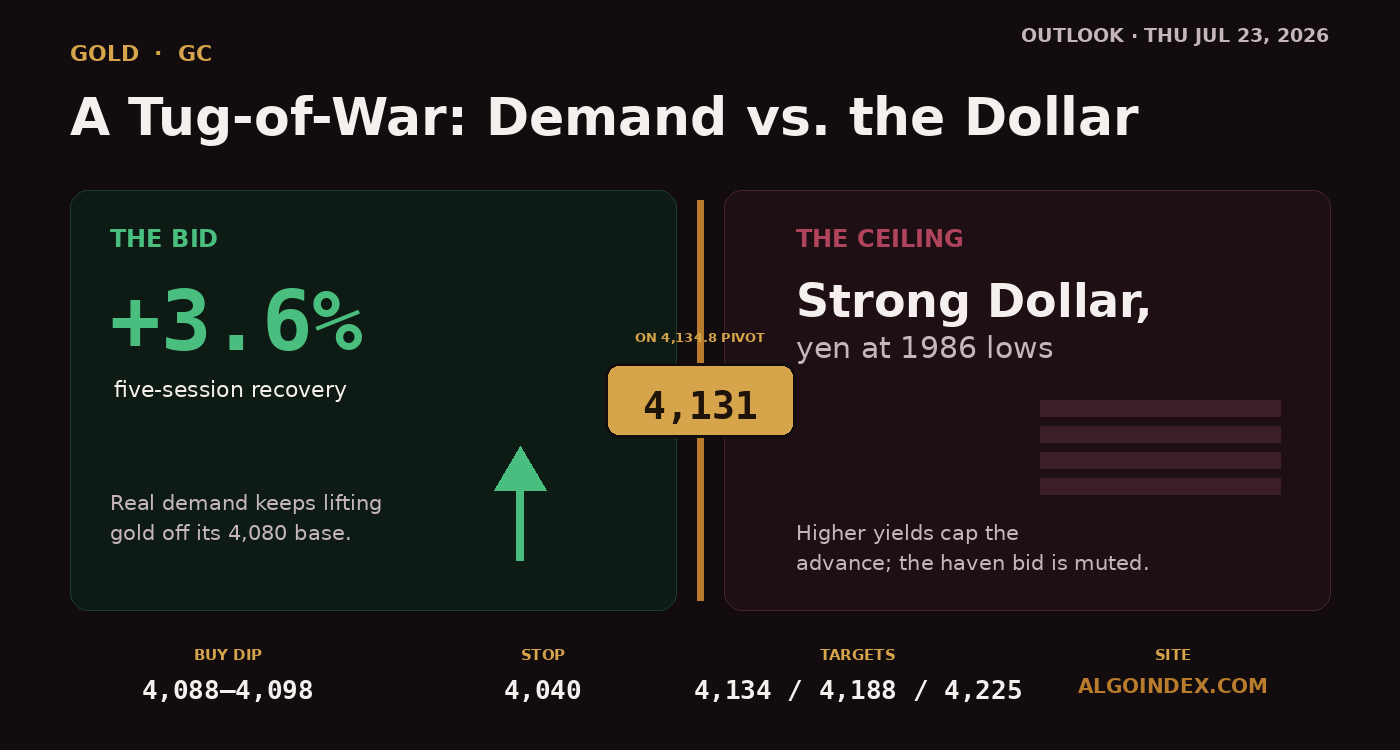
Gold extended a 3.6 percent five-session recovery to the 4,134.8 pivot, but a strong dollar and a yen at 1986 lows cap the advance while the safe-haven bid stays muted. Base case: buy the 4,088 to 4,098 shelf toward 4,134 then 4,188; a close below 4,040 reopens the base.
The 60-second read
Gold kept grinding higher on Wednesday, extending a five-session recovery worth about 3.6 percent, with the fund proxy adding about 1.1 percent while the front contract closed up near the 4,150 area. Into the overnight reopen it slipped about 20 points to 4,131, right on its 4,134.8 pivot. The bigger story is what kept a lid on it. The dollar is strong, the yen sits at its weakest since 1986, and Treasury yields keep grinding up, and every one of those raises the cost of holding an asset that pays nothing. Gold rose into that wall anyway, which tells you real demand is there, but the advance keeps bumping the ceiling. Our plan is to buy a dip into the shelf between 4,088 and 4,098 and to respect that Thursday’s central-bank decision and real-yield auction can settle the direction faster than the chart.
This is a recovery with a governor on it. The metal wants higher and the currency backdrop keeps pulling it back, so the whole session reads as a tug-of-war rather than a trend. It is the next chapter of Wednesday’s note, when gold first pushed higher against a firming dollar; a day later the bid is still there and so is the ceiling.
Walk the structure and you see two clocks running at once. Near term, gold is climbing: it holds over its 5-day as well as its 20-day line, each parked around 4,080, and short-window momentum has turned up. Medium term, it's still mending: price stays under the 50-day up at 4,291 and the two long lines up near 4,560, the residue of a hard pullback from the 5,706 record. One set of averages says recovery, the other says the repair is far from done.
A recovery capped by the dollar
+3.6%
Past 5 sessions
4,131
Front-month print
-27.5%
Below the record
+20.2%
Above 52-wk low
Five sessions of gains off the base, still a quarter below the 5,706 peak. The near-term turn is real; the strong dollar is the ceiling.
The contradiction: conflict up, haven bid muted
Here's what makes the session odd. The Middle East is escalating, oil jumped more than 3 percent on Strait of Hormuz threats plus a fresh blockade of Red Sea shipping, and yet gold’s safe-haven premium barely moved. The reason, flagged in desk commentary, is that currency markets have started treating the conflict as ambient noise instead of a live shock, so the usual flight-to-safety bid never fully showed up.
That's a sharp implication for anyone positioning gold, and it cuts one way. The premium is muted precisely because the market is desensitized, which skews the setup. A real shock that forced the market to re-price the fighting would light gold up quickly, while a longer slow burn leaves the premium quiet and leaves the dollar in charge.
Gold climbing into a strong dollar and rising yields is a demand signal, not a rates story. The metal is being bought on its own merits, but the currency ceiling is real, and it caps how far this leg can run without help.
Two clocks, and a stretched bounce
The momentum picture fits the two-clock read. The 14-day relative strength sits right at neutral near 49, but the 9-day stochastic up near 78 says the near-term bounce is stretched and due a pause. The directional-index readings still lean lower on the 14 and 20-day windows, the fingerprint of a downtrend that hasn't been broken, even as the 9-day gives the first hint of a turn. The composite sits at a soft 16 percent on the sell side, which is a low-conviction, in-transition signal, not a trend.
Put together, that argues against chasing. A stretched short-term move under a heavy medium-term ceiling is exactly the kind of setup where buying a pullback beats buying strength, which is why the plan waits for a dip rather than paying up at the pivot.
The shelf and the ceiling: 4,088 and 4,188
Two zones define Thursday. The first is the layered support running 4,078 up to 4,098, where the first pivot support, the one-standard-deviation line, the four-week retracement, and the 18-day line all stack together. That shelf is the decisive support for the whole structure and the cleanest place to get long. Beneath it, a decisive close under 4,040 breaks the higher-low sequence and reopens the base toward the 3,955 low.
Overhead, the decision area is the band from 4,188 up to 4,215, where the first pivot resistance meets the one-month high and the deviation line. Clear it on a softer dollar and 4,225 comes into view; stall there on a firm dollar and the fade sets up. The 50-day up at 4,291 is the bigger wall the recovery must clear before the medium-term trend even starts to mend.
The trade
The base case is to buy a pullback. Take the shelf between 4,088 and 4,098, where four supports converge, with the stop below 4,040 under the deviation base. Scale out at the 4,134 pivot, then up to 4,188 alongside the 4,195 target, then 4,225 only if the dollar keeps softening, roughly 1:0.8 to the first target and near 1:2.6 to the last. This is a tactical continuation inside a still-corrective trend, so keep it defined and don't treat it as a reversal.
The alternate is a short fade for a firm-greenback day: if gold spikes into the 4,188-through-4,215 zone on a headline and stalls, sell it with risk set above 4,228, aiming back down to the 4,152 shelf and then the pivot at 4,134. Two rules sit over the map. Stand aside through the first fifteen minutes and the 08:15 central-bank window until the dollar reaction settles, and treat the 13:00 inflation-protected auction as the day’s most gold-specific catalyst, because a weak auction that lifts real yields is the fastest way to press the metal back to its base. Consider half size with the central-bank decision and the auction clustered on the same day.
The complete data picture
Every number behind Thursday’s plan, charted first; the full numeric reference follows underneath.
CHARTED
Level map
COMEX gold, front month · every reference from the review, to scale
BELOW THE SHELF: CORRECTIVE 3,940-4,088ABOVE THE SHELF: RECOVERY 4,088-4,310BUY-THE-DIP SHELF 4,088-4,098
Price eased to 4,131 into the reopen, sitting almost exactly on the 4,134.8 pivot. The layered 4,078 to 4,098 shelf is the buy zone and the pivotal support for the whole structure; the 4,188 to 4,215 band is the primary upside decision area, with the 50-day near 4,291 the larger trend-repair wall.
Moving-average stack
The defining split: short averages up, long averages a wall
Price sits above the 5-day at 4,080 and the 20-day at 4,081, which have rolled up under the market to confirm the near-term turn, but below the 50-day at 4,291, the 200-day at 4,561 and the 100-day at 4,564, which remain a heavy overhead barrier. The 50-day near 4,291 is the first real trend-repair objective on continued strength.
The recovery, in context
A near-term bounce inside a large correction
Gold has added about 3.6 percent over five sessions off the early-month base, and it holds roughly 20 percent above the 52-week low. The context tempers it: the metal is still about 27.5 percent under its 5,706 record and the 50-day change is down 13 percent, so this is a recovery inside a correction, not a new trend.
Momentum and volatility
Stretched short-term, soft-sell medium-term
The 14-day relative strength near 49 is neutral, the 9-day near 55 leans slightly positive, and the 9-day stochastic near 78 says the near-term move is stretched and vulnerable to a pause. The multi-indicator composite reads a soft 16 percent sell, while the medium-term directional index stays tilted lower. The implied-volatility rank near 29 percent leaves room for a volatility expansion on a catalyst.
Expected range
Scenario bands against the one-ATR envelope
Average true range runs 92.7 to 105.1 points, about 2.2 to 2.5 percent. A one-ATR band on the 4,131 print projects roughly 4,038 to 4,224 for the session, with an expected daily traverse near 85 to 95 points. The lower edge sits near the 4,044 support, the upper near the 4,225 second resistance.
Primary setup
Buy the dip into the layered support shelf
Long the 4,088 to 4,098 shelf, into the confluence of the first pivot support, the one-SD support, the retracement and the 18-day crossing, stop below 4,040. Targets 4,134 pivot, then 4,188 with the 4,195 target, then 4,225 only on a dollar-softening continuation. The 08:15 central-bank decision and the 13:00 auction can override the technical setup toward the corrective path.
Dealer-positioning proxy
Gold-ETF stand-in, a fund, not the futures
The proxy closed near 378.91, up about 1.1 percent. Net call gamma reads about negative 88.95 million against positive put gamma near 14.37 million, a short-gamma posture above spot: dealer hedging tends to amplify a move rather than damp it, so a clean break of the pivot in either direction is more likely to run than to fade. The implied one-day move is about 1.4 percent and the implied-volatility rank near 29 percent leaves room to expand.
Thursday’s calendar
All times Eastern · currency first, real yields second
The first-order driver for gold is the currency complex around the 08:15 decision and the 08:45 press conference; the 13:00 inflation-protected auction is the most gold-specific event because it reads real yields directly. The decisive event looms a week out: the Federal Reserve decision on July 29.
Full numeric reference , every remaining figure from the review
Contract
COMEX gold front month. Review prepared Wednesday evening July 22 for the Thursday July 23 regular session. Forecast and setups are next-session-forward.
Session prints
The gold-ETF proxy closed at 378.91 against a 374.81 prior close, up about 1.1 percent, and the front futures contract settled in the 4,150 area (front-month reference 4,151.9). The recovery has added about 143.6 points, or 3.60 percent, over five sessions. Into the 18:00 ET electronic reopen the front contract eased to the 4,131 area on light volume near 10,400 contracts; the session range ran the low 4,070s to about 4,137. Price sits almost exactly on the 4,134.8 pivot.
Range context
A corrective pullback from the 52-week high of 5,706.0 leaves the metal roughly 27.5 percent below that peak and about 20.2 percent above the 52-week low of 3,441.5. The one-month range runs 3,955.4 low to 4,215.5 high, so the current print sits in the upper third. The 4-hour picture shows higher lows off the early-month base near 3,955, with the recovery testing the 4,137 to 4,152 supply shelf and the 4,074 to 4,081 session low beneath price; a close below 4,044 would break the higher-low sequence.
Moving averages
A split stack. Price above the 5-day at 4,079.7 and the 20-day at 4,080.5, but below the 50-day at 4,291.2, the 100-day at 4,564.3 and the 200-day at 4,561.4; the year-to-date average is 4,679.3. The 50-day change of minus 13.20 percent and the 100-day change of minus 22.36 percent size the corrective leg, while positive 5-day and 20-day changes confirm the near-term turn. The 50-day near 4,291 is the first real trend-repair objective.
Oscillators and trend
The 14-day relative strength reads 49.13 (neutral), the 9-day 54.74. Stochastics are elevated on the short windows, the 9-day percent-K at 78.23 and the 14-day at 62.71, so the near-term move is stretched. Directional index: the 14-day at 35.60 with negative direction 21.37 over positive 16.53, and the 20-day similar (negative 23.33 over positive 15.26), both confirming a downtrend; the 9-day at 32.72 has positive 19.44 just over negative 17.86, a first hint of a turn. The multi-indicator composite is a soft 16 percent sell; the weighted alpha reads a modestly positive 7.38.
Volatility
Average true range: 92.7 points (2.20 percent) on the 9-day, 99.6 (2.40 percent) on the 14-day, 105.1 (2.50 percent) on the 20-day; average daily range about 85 to 94 points; 14-day historical volatility 21.22 percent. A one-ATR band on the 4,131 print projects roughly 4,038 to 4,224, an expected traverse near 85 to 95 points, lining up with the 4,044 support below and the 4,225 second resistance above.
Key levels
Resistance: the 4,134.8 pivot, the 4,137.2 session high and the 4,152 recovery shelf, then 4,188.5 (first pivot), 4,195.6 (target), 4,215.4 (one-SD) into the 4,215.5 one-month high, 4,225.2 (second pivot), 4,241.7 (two-SD), 4,278.9 (third pivot), the 50-day near 4,291.2, and the 40-day crossing near 4,212.2. Support: the 4,113 (9-day) area, 4,098.1 (first pivot), 4,096.3 (18-day stall), 4,088.4 (one-SD), 4,085.5 (retracement), 4,078.2 (18-day); then 4,044.4 (second pivot) with 4,047.8 (9-day), 4,062.1 (two-SD) and 4,041.9 (three-SD); 4,007.7 (third pivot); and 3,955.4 (early-month and 13-week low).
Options and dealer proxy
Levels derive from the gold-ETF proxy (an exchange-traded fund standing in for gold, not the futures). It closed 378.91 against 374.81. The implied one-day move reads about 5.26 dollars, roughly 1.4 percent, mapping to a gold-equivalent band of about 57 dollars around spot. The implied-volatility rank sits at a moderate-to-low 29.21 percent. Net call gamma reads about negative 88.95 million against positive put gamma near 14.37 million, a short-gamma posture above spot that amplifies directional moves; a nearby volatility reference sits near the 376 proxy strike.
Macro drivers
The dollar is the primary driver: the yen sits at its weakest since 1986, near 163 per dollar, with rising Treasury yields reinforcing broad dollar strength, the mechanical headwind gold pushed against. Inflation cooled, consumer prices 3.5 percent against a 3.8 percent forecast and producer prices 5.5 percent against 6.2 percent; one Fed official warned stricter policy could still be required. Geopolitics: Strait of Hormuz escalation and a renewed Red Sea blockade pushed the international crude benchmark up more than 3 percent, yet currency markets treat the conflict as background noise, so gold's safe-haven premium is muted. Japan is reported open to raising rates faster. The decisive event is the Federal Reserve decision on July 29.
Setup and paths
Primary long on a pullback: entry 4,088 to 4,098 into the confluence of the first pivot support, one-SD support, four-week retracement and 18-day crossing; stop below 4,040 under the 4,044 second pivot and the 4,041 to 4,062 base; T1 4,134 pivot, T2 4,188 with the 4,195 target, T3 4,225 on a dollar-softening continuation; about 1:0.8, 1:1.9 and 1:2.6. Alternate short fade: a rejection in 4,188 to 4,215, stop above 4,228, back to the 4,152 shelf and the 4,134 pivot. Paths: A constructive about 45 percent (hold 4,098, reclaim 4,152, probe 4,188 to 4,195), B corrective about 35 percent (firm dollar and weak auction press through 4,098 to the 4,044 to 4,062 base), C range about 20 percent (chop 4,120 to 4,155). The opening 90 minutes should define the day's lean. Half size given the clustered catalysts; no entries before 09:45 ET.
Calendar
08:15 ET European central-bank rate decision (main rate near 2.40 percent, deposit 2.25 percent); 08:30 ET US initial jobless claims (210.5 thousand versus 208 thousand prior, continued claims near 1.809 million) and Canadian retail sales; 08:45 ET European central-bank press conference; 10:00 ET eurozone consumer confidence; 13:00 ET US 10-year inflation-protected auction, the most gold-specific event; 16:00 ET and after, large-cap technology earnings; 19:30 ET Japanese consumer prices. The decisive looming event is the Federal Reserve decision on July 29.
AlgoIndex publishes institutional-grade reviews on ES, NQ, GC, and CL, built on professional-grade market data and our own analysis, priced for individual traders.