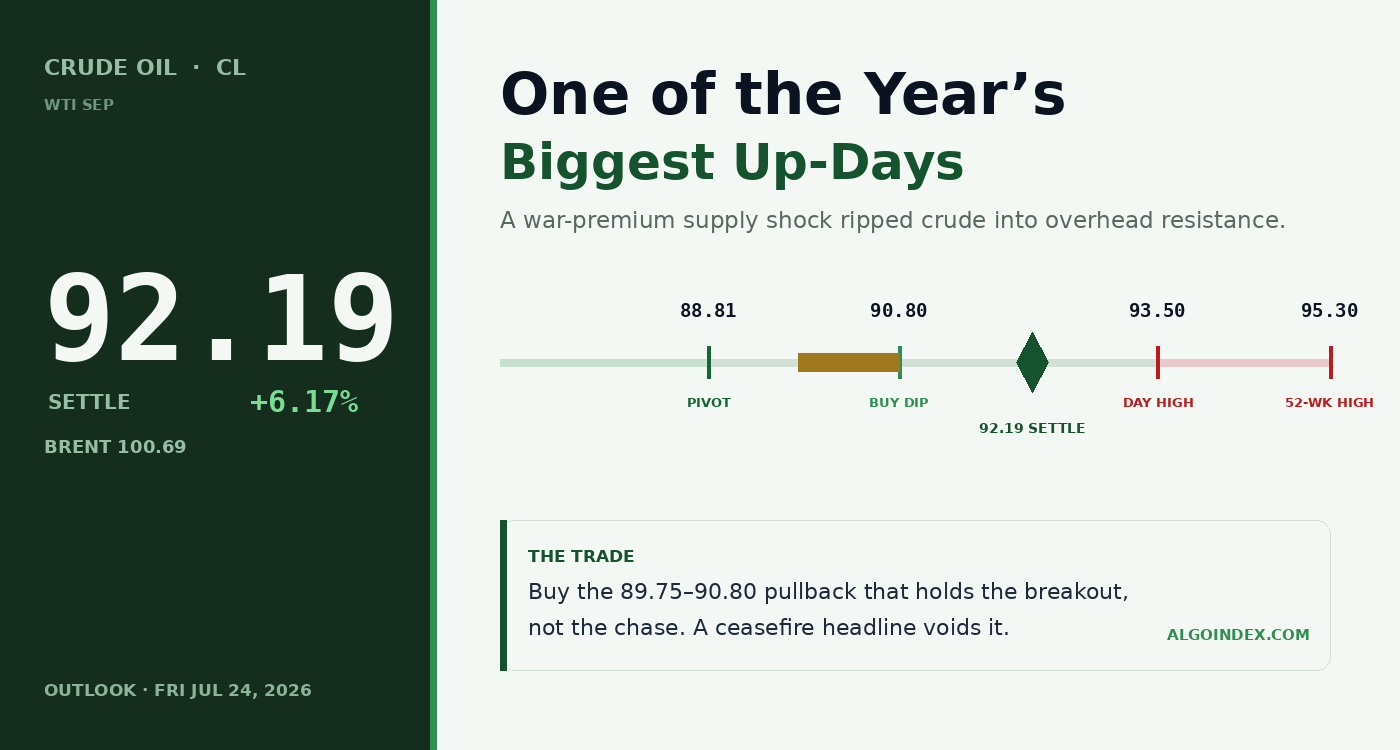
WTI ripped 6.17 percent to 92.19 and Brent cleared 100 in one of the year's biggest up-days, a war-premium supply shock into overhead resistance below the 95.30 high. Overbought: buy a controlled 89.75 to 90.80 pullback that holds 88.81; a ceasefire headline snaps it lower.
The 60-second read
Crude ripped on Thursday. September WTI settled 92.19, up 6.17 percent, one of the biggest single-session gains of the year, and Brent cleared 100, settling at 100.69. This was almost purely a supply-risk repricing: an intensifying Iran conflict, fresh threats against Hormuz and Red Sea shipping lanes, a fire at a major Kuwaiti power plant, and drone-hit Kazakh export flows all pulled a large war premium back into the barrel. Every trend gauge is aligned bullish, with price over all its averages, but the move is now parabolic into overhead resistance, the 93.50 session high pressing just beneath the 95.30 annual high, and momentum is deeply overbought. It's also a two-sided event: a hard escalation can gap the market higher overnight, while a credible ceasefire headline, mediators have floated a ten-day pause, can snap it lower just as fast. We buy a controlled pullback that holds the breakout rather than chase at resistance.
The direction isn't the hard part here. The trend runs strong and the catalyst is live. The hard part is location: this is a market that repriced a substantial premium in one session and now has to prove it can hold the gains. Wednesday’s note had crude pressing the 88.85 ceiling; a day later it blew through with a 6 percent surge and is now leaning on the next wall.
Start with how the move built. The contract gapped up from the prior 86.83 settle, opened 87.72, and then climbed in one direction all session to a 93.50 peak before easing back to settle near 92. The day low printed early and never got seriously retested, the fingerprint of a trend day where every shallow dip gets bought. Heavy volume near 378,692 contracts confirms real money building into the move, not a hollow squeeze.
A parabolic session into resistance
+6.17%
WTI on the day
92.19
Settle
100.69
Brent, above 100
93
Stochastic
One of the year’s biggest up-days, pressing the 93.50-through-93.94 band beneath the 95.30 high. Powerful trend, overbought, and headline-driven.
The whole barrel is bid
The tell is that the entire complex moved together. Brent settled over 100 at 100.69, a bigger percentage gain than WTI, which is what happens when the waterborne, geopolitically sensitive grade leads a supply scare. Gasoline and diesel firmed with their cracks holding, while natural gas barely budged, and that split is the giveaway: it's oil, on its own: this was an oil-only supply scare, not a broad commodity surge.
The supply story is concrete and stacked. There is a stated threat to hit back at any Iranian move in the Strait of Hormuz, reporting that Iran has told the Houthis to shut the Bab el-Mandeb gateway if the US strikes its power grid, a reported fire at a large Kuwaiti power plant, and, separately, drone strikes choking Kazakh export flows. Each rung adds premium, and with no inventory print due Friday, the barrel trades on headlines, not data.
A supply-scare rally is front-loaded and reflexive. The same premium that built it this fast can be pulled back out in minutes on a single ceasefire sentence, so this is a trade to size carefully and to enter on a dip, not a chase.
Powerful, but stretched
The overbought picture is the reason not to chase. The short stochastics are buried in the low 90s, the 14-day strength read is up in the low 70s, and spot has pulled roughly 17 percent above its fast 5-day average and well over 30 percent clear of the 20-day. A separation that wide almost always earns a sideways pause or a snap-back to relieve the stretch before the next leg, rather than an uninterrupted melt-up. New longs bought at 92 are paying up for what's already an overbought condition.
The counter-force is the two-sided catalyst. Mediators have floated a ten-day cessation of strikes and there's a live diplomatic track, so a credible de-escalation headline can unwind a crowded, freshly built long in a hurry. That two-way risk is exactly why the plan waits for a pullback into support rather than paying up at the highs, where a single sentence can turn the position against you overnight.
The pivot and the ceiling: 88.81 and 95.30
Two levels frame Friday. Beneath price, the 88.81 first pivot, effectively coincident with the 88.84 target, is the line the breakout has to hold; keep it and the continuation stays alive, with the 89.75-through-90.80 zone the cleaner place to get long. A loss of 88.81 exposes the 87.32 day low, then the gap between 86.83 and 86.63, come into view, which would neutralize the breakout.
Overhead, the 93.50-through-93.94 band is the decisive test, the day high meeting a deviation reference. Clear and hold over 93.94 and the 95.30 annual high, the top print of the last quarter and the year, is the objective, and a break there opens ground not seen in years and the 96-to-100 zone Brent has already entered. Short of that, a rally that stalls under 92.98 favors a drift back to the 90.80 base.
The trade
The base case is a long on a controlled pullback: buy the 89.75-through-90.80 zone if it stabilizes and turns while holding above the 88.81 pivot, stop below 88.55. Scale out at 92.20, then the 93.50 day high, then the 95.30 annual high, roughly 1:1.1 to the first target and about 1:3.2 to the last. A confirmed escalation, a shutdown of Hormuz or Bab el-Mandeb, or direct strikes, makes the case for buying strength and lifting the targets past 95.30 instead.
The alternate is the fade for a de-escalation day. A ceasefire-track headline plus a confirmed failure and retest back under 88.81, then the 87.32 low sets up a short from around 87.75, stop above 89.60, aiming at the 86.63 pivot and the gap-fill, then 84.64. Two things to sit out entirely: a vertical gap-up open over 95 that chases straight into the ceiling with no pullback, and a quiet pin between 91 and 93 with no clean level to trade against.
The complete data picture
Every number behind Friday’s plan, charted first; the full numeric reference follows underneath.
CHARTED
Level map
NYMEX WTI, September front month · every reference from the review, to scale
BELOW THE PIVOT: BREAKOUT AT RISK 80-89ABOVE THE PIVOT: TREND INTACT 89-101BUY-THE-DIP ZONE 90-91
Crude jumped 6.17 percent to settle 92.19, one of the largest single-session advances of the year, the day high at 93.50 pressing right into the 93.50 to 93.94 band beneath the 95.30 annual high. The 89.75 to 90.80 zone is the buy-the-dip area; holding above the 88.81 pivot keeps the breakout intact.
Moving-average stack
Above every average, and stretched
Spot near 92.36 trades above the entire stack: the 5-day at 85.47, the 50-day at 80.98, the 100-day at 80.77, the 20-day at 75.70 and the 200-day at 70.17. That confirms trend health, but the separation is now wide, roughly 17 percent above the 5-day and more than 30 percent above the 20-day, the kind of stretch that historically precedes a sideways pause or a mean-reverting pullback.
A parabolic advance
One of the largest single-day moves of the year
This was a genuine repricing, not a thin-liquidity spike: heavy volume near 378,692 contracts behind the move. The advance is large and fast, about 26.7 percent on the month and 53 percent over six months off a January base near 59.31, and at roughly 3 percent below the 95.30 annual high there is little room before the ceiling.
Momentum
Powerful trend, firmly overbought
The 9, 14 and 20-day stochastics all sit in the 92 to 94 percent band, deep in overbought, and the 14-day relative strength is in the low-to-mid 70s, stretched but short of a blow-off. Trend strength is exceptional, a 9-day directional read near 50 with the positive line near 46.7 dwarfing the negative near 5.1. The trend is powerful, but fresh longs at resistance carry poor reward without a pullback.
Expected range
Scenario bands against the one-ATR envelope
Average true range runs 3.80 to 3.98 points, about 4.2 to 4.3 percent, and today’s realized 6.18 ran well beyond it. A one-ATR band on the 92.19 settle frames roughly 88.4 to 96.0, but because the driver is a live headline event, a single-event shock can push realized range beyond the statistical band in either direction.
Primary setup
Buy the pullback that holds the breakout
Long a controlled pullback into 89.75 to 90.80 that stabilizes and reverses, holding above the 88.81 to 88.84 pivot, stop below 88.55. Targets 92.20, then the 93.50 day high, then the 95.30 annual high. A confirmed escalation headline argues for buying strength and raising targets; a credible ceasefire headline voids the long and favors a fade back through the 88.81 pivot toward the gap.
The whole barrel is bid
Brent led, above the century mark
The energy complex moved together, confirming a real crude repricing rather than a WTI distortion. Brent settled above 100 at 100.69, a larger percentage move that says the waterborne, geopolitically sensitive grade led. Gasoline near 3.4964 and diesel near 4.3416 stayed firm with cracks holding, while natural gas near 2.9160 was broadly unaffected, marking this as an oil-specific, supply-risk event.
Friday’s calendar
All times Eastern · no crude data, so headlines lead
There is no weekly crude inventory print Friday, so the first-order driver stays the unscheduled Iran, Hormuz and Red Sea headline flow, which can hit at any hour. The main scheduled event for the complex is the 09:45 flash purchasing-manager survey, a demand-and-dollar read; two scheduled presidential appearances are additional sources of Iran-related headlines.
Full numeric reference , every remaining figure from the review
Contract
NYMEX WTI front month, September 2026 (CLU26). Review prepared Thursday evening July 23 for the Friday July 24 regular session. Forecast and setups are next-session-forward.
Session prints
September WTI settled 92.19, up 5.36 points or 6.17 percent, one of the largest single-session advances of the year. It opened 87.72 (a 0.89 gap from the 86.83 prior settle), climbed to a 93.50 high, and eased into the settle; the 87.32 day low, set early, was never seriously retested. The post-settle session holds near 92.36 to 92.42. Brent settled above the century mark at 100.69, up 7.04 percent. Volume printed 378,692 contracts against open interest near 301,094, heavy participation consistent with a genuine repricing.
Range context
Fresh multi-month highs: the 93.50 day high is the immediate one-month peak and 95.30 is the shared 13-week and 52-week high. The advance is about 26.7 percent on the month and above 53 percent over six months from a January base near 59.31. Higher highs and higher lows with no completed downside change-of-character; the current one-hour bar read 91.61 open, 92.43 high, 91.42 low, 92.36 close, the 30-minute bar a 91.93 open. The first test of buyer conviction is how price treats the 90.80 to 88.81 shelf on any pullback.
Moving averages
Fully bullish, price above every major average: the 5-day near 85.47, the 20-day near 75.70, the 50-day near 80.98, the 100-day near 80.77 and the 200-day near 70.17, with the year-to-date average near 75.23. Spot near 92.36 is extended roughly 17 percent above the 5-day and more than 30 percent above the 20-day, a separation that historically precedes a sideways consolidation or a mean-reverting pullback.
Oscillators and trend
Firmly overbought. The 9, 14 and 20-day stochastics all sit in the 92 to 94 percent band. The 14-day relative strength is in the low-to-mid 70s (the 70 threshold near a price of 87.74, the 80 threshold near 99.86), overbought but short of a blow-off. Trend strength is exceptional: the 9-day directional read near 50 with the positive line near 46.70 dominating the negative near 5.11, and the 14-day near 29.89. The multi-indicator composite leans buy at 64 percent.
Volatility
The 14-day average true range is near 3.83 (about 4.17 percent), the 9-day near 3.98 (4.33 percent), the 20-day near 3.80. Today's realized range of 6.18 dollars ran well beyond the average, an expansion-day print. A one-ATR projection around the 92.19 settle frames a band of roughly 88.4 downside to 96.0 upside, but a single-event headline can push realized range beyond it in either direction, so treat the envelope as a baseline.
Key levels
Resistance: the 92.64 two-SD (at the settle), the 92.98 third pivot, the 93.50 day high with the 93.94 three-SD (the decisive band), then the 95.30 annual high (the single most important overhead line) and the 99.86 relative-strength-80 level. Support: the 90.80 second pivot (first level to convert to base), the 88.81 first pivot with the coincident 88.84 target (the key defense), the 87.32 day low with the 87.74 relative-strength-70 reference, the 86.83 prior settle and 86.63 daily pivot (the gap-fill), then 84.64 (first pivot support), 84.54 (38.2 percent retracement), 82.46 (second pivot support) and a calculated 81.02 to 81.21 extended objective on a full reversal.
Positioning and complex
Crude carries no listed dealer-gamma surface, so the lens is the physical and derivatives structure. The front-led advance and Brent's outperformance are consistent with a prompt, geopolitically driven bid that steepens backwardation; the product complex confirms, with gasoline near 3.4964 (about 3.50 a gallon) and diesel near 4.3416 firm and cracks holding, while natural gas near 2.9160 was broadly unaffected. Heavy volume with rising participation points to genuine hedging and speculative demand, not a hollow squeeze. The primary two-sided risk is a rapid unwind of freshly built length on any credible de-escalation.
Macro and geopolitics
Supply-risk premium was the entire story: an intensifying Iran conflict, an explicit threat to retaliate against any Strait of Hormuz action, reporting Iran told the Houthis to close Bab el-Mandeb if the US strikes its power grid, a reported fire at Kuwait's largest power plant, a Houthi navigation ban on Saudi Arabia, and drone strikes choking Kazakh export flows. Countering it, mediators floated a 10-day cessation of strikes on an active diplomatic track. Cooler inflation (consumer prices 3.5 percent, producer prices 5.5) eases policy pressure, though a supply-driven oil spike toward the mid-90s reintroduces an energy-led inflation risk that can firm the dollar. Equities and bonds were pressured by the oil jump and technology capital-spending concerns.
Setup and paths
Primary long on a controlled pullback: entry 89.75 to 90.80 that stabilizes and reverses while holding the 88.81 to 88.84 pivot, stop below 88.55; T1 92.20, T2 93.50, T3 95.30; about 1:1.1, 1:2.1 and 1:3.2 from a 90.30 mid-entry. Invalidation on a decisive break and hold below 88.81 that fills toward the 86.83 to 86.63 gap. Alternate short: a de-escalation headline plus a confirmed break and retest below 88.81 and the 87.32 low, entry near 87.75, stop 89.60, targets 86.63 and the 86.83 gap-fill then 84.64. Paths: A consolidation about 45 percent (range 91.00 to 93.50), B escalation continuation about 30 percent (break 93.94 toward 95.30), C de-escalation pullback about 25 percent (fill toward 88.81 and the gap). Friday scenario bands: low 88.50 to 89.50, mid 91.00 to 93.50, high 94.50 to 96.50; the overnight base case holds 91.5 to 93.00; a quiet pin between 91.00 and 93.00 is a stand-aside. Stand aside through the first 15 minutes; the alternate short retests the broken 88.00 area. No overnight hold; no entries before 09:45 ET.
Calendar
06:30 ET Russian interest-rate decision (prior 14.25 percent); 07:00 ET earnings from a major card issuer and a large telecom; 08:30 ET Canadian producer prices; 09:45 ET US flash purchasing-manager survey (services forecast 51.5, manufacturing 54.4, composite 51.8), the key demand and dollar event; 10:00 ET US new home sales (forecast 0.606 million); 11:30 ET a senior euro-area central-bank official; plus two scheduled presidential appearances that can inject Iran-related headlines. There is no weekly crude inventory print, so the first-order driver stays the unscheduled geopolitical newsflow.
AlgoIndex publishes institutional-grade reviews on ES, NQ, GC, and CL, built on professional-grade market data and our own analysis, priced for individual traders.