WTI extended its war-premium run near 88 as the whole barrel repriced supply risk, but it is overbought and pressing an 88.40 to 88.85 ceiling that has capped it for a month. Buy the pullback into the 86.60 to 86.85 base toward 88.85; a ceasefire headline unwinds the premium fast.
The 60-second read
Crude kept climbing on Wednesday and pushed higher again into the evening, carrying a live war-risk premium into Thursday. September WTI settled 86.83 and trades near 88.0 into the reopen, up about 1.4 percent, while Brent led the way with a 3.36 percent gain to 94.07, so the whole barrel is repricing supply risk, not one grade. The engine is an escalating Middle East conflict: fresh threats against Red Sea and Hormuz shipping lanes have dropped estimated Persian Gulf flows under 45 percent of pre-war throughput. The catch is that the market is loud but stretched, overbought and pressing an 88.40-to-88.85 ceiling that has held it back a full month, and a single ceasefire headline could drain the premium fast. So we buy a pullback into the 86.60/86.85 base rather than chase at 88, and we stand aside on any de-escalation headline.
This is a strong trend riding on a two-way switch. The direction isn't the hard part; the hard part is that the same headline flow lifting oil could reverse it between one sentence and the next. Wednesday’s note had crude pressing the 85 breakout; a day later it has cleared into the high 80s and is leaning on the next wall.
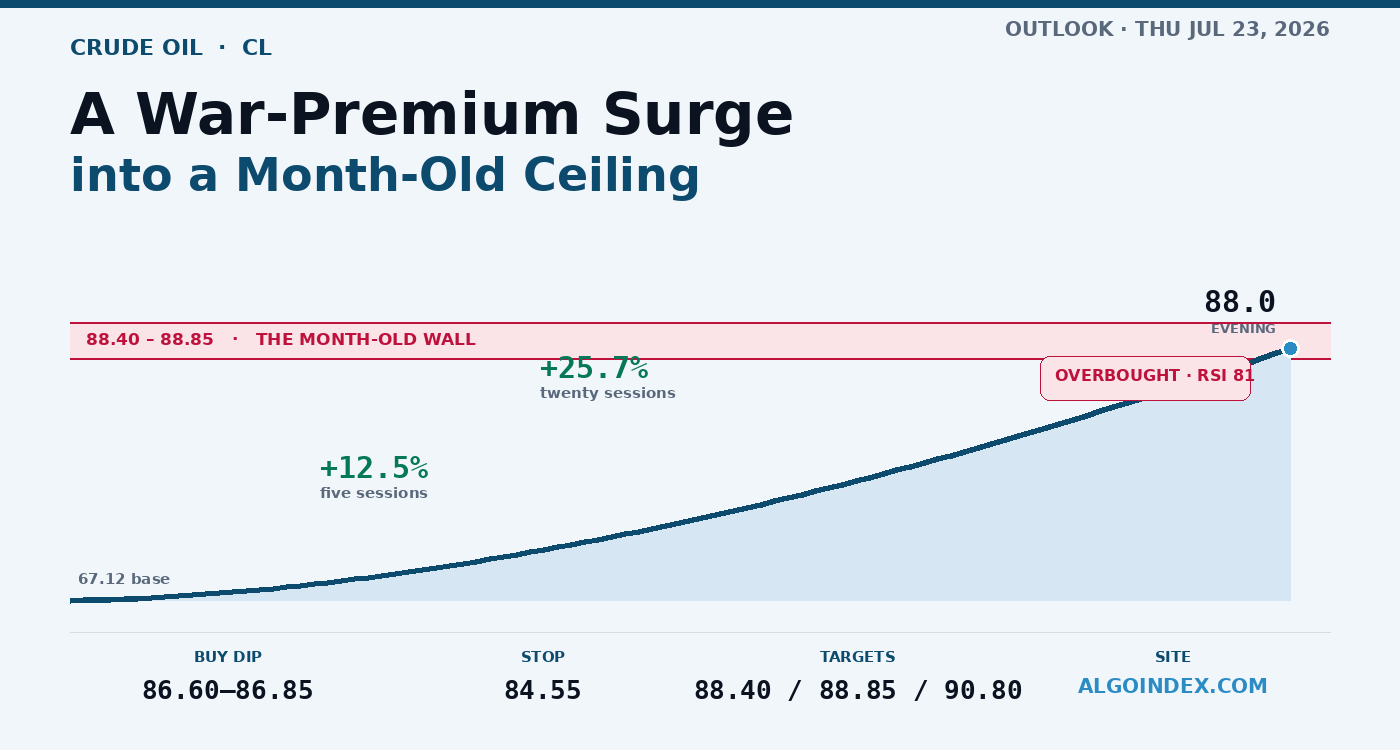
Start with the trend, because it's real. Spot near 88 sits above every major average, the daily read is decisively up, and the move off the mid-July base has been close to vertical, about 12.5 percent in five sessions and nearly 26 percent in twenty. Each pullback along the way has held above the prior swing low. Nothing about that structure says the uptrend is over.
A vertical run into a ceiling
+12.5%
Five sessions
+25.7%
Twenty sessions
88.0
Evening print
81
RSI, 9-day
A near-vertical advance off the 67.12 base, now overbought and pressing the 88.40-to-88.85 wall. Trend intact, snap-back risk high.
The whole barrel is bid
The tell is in the spread. Brent’s 3.36 percent jump outran WTI, which is what happens when the premium sits in seaborne, Gulf-exposed grades rather than in landlocked crude. Energy equities and natural gas firmed alongside, while gold slipped and equity volatility eased, so this was a focused energy-supply trade, not a broad rush into safety. When the barrel leads and the haven assets do not follow, the message is that traders are pricing a physical-supply problem, not a macro fear.
That supply problem is concrete. A renewed navigation ban on Saudi shipping and threats to shut the Bab el-Mandeb gateway threaten to reroute roughly 4 million barrels a day of Saudi crude, on top of a Gulf-flow estimate already under 45 percent of what moved before the war. Washington has promised to strike Iranian infrastructure for any hit on shipping in the strait. Each rung of that ladder has added premium to the price.
A premium-led rally is front-loaded and headline-reactive by nature. The same supply fear that built it can be unwound by a single credible ceasefire sentence, which is why this is a trade to size carefully rather than to marry.
Loud, but stretched
Here's the tension. Every trend gauge is bullish, yet the momentum picture is flashing overbought: the 9-day relative strength near 81, the short stochastics buried in the mid-90s, and spot sitting roughly 4 percent above even its fast 5-day average. Price this far above its near-term mean usually earns a sideways rest or a pull toward the low 80s before the next leg, not an uninterrupted melt-up. New longs bought at 88 are chasing an overbought condition, not buying value.
And the pushback is verbal. Officials in Washington have said out loud that prices "will come tumbling down," that Hormuz is a strait the country "does not need", and that Venezuelan barrels are coming back to the market. None of it is a supply fact yet, but it's a standing reminder that the premium is a headline away from compressing. Soft Chinese demand sits underneath as another reason the advance could fade if the geopolitics cool.
The ceiling and the base: 88.85 and 86.63
Two levels frame Thursday. Overhead, the 88.40 session high meets a dense band, the 88.61 one-month high, the 88.81 pivot and the 88.84 target, all within a quarter-point of each other. That stack is the single most important barrier on the sheet, and it has boxed the contract in for weeks. Clear 88.85 on a sustained push and 89.50 opens, then the 90.80 pivot. Fail there and the day is a fade.
Beneath price, the 86.63 pivot with the 86.83 settle and the 40-day average near 87.15 form the first support base to hold, the 86.6-to-87.2 shelf. Lose it and the zone at 84.2 to 84.6, where the first support pivot meets the deviation band, is the line that decides whether this is a pause or a deeper corrective leg. A sustained trade under 84.55 kills the continuation thesis.
The trade
The base case is a pullback-buy: long the base between 86.60 and 86.85 if it holds, stop below 84.55, and scale out at 88.40, then 88.85, then 90.80, trailing the rest. From an entry near 86.72 the reward against risk runs about 1:0.8 to the first target and near 1:1.9 to the last, so the discipline is to buy the dip rather than pay up at the highs, where an overbought market leaning on month-old resistance offers poor location.
The alternate is for traders who prefer strength: a decisive, sustained break and hold above 88.85, best taken once the 09:45 gate has passed, aims at 89.50 and then 90.80, risk reset under 88.20. Sitting over both is the override. A credible ceasefire, an Iran deal, or a Hormuz-reopening headline removes the reason for the whole position, so stand aside or cut on any real de-escalation. There's no crude inventory print Thursday, so the market trades on headlines and the dollar reaction to the morning European rate decision, not on data.
The complete data picture
Every number behind Thursday’s plan, charted first; the full numeric reference follows underneath.
CHARTED
Level map
NYMEX WTI, September front month · every reference from the review, to scale
Crude pressed to an 88.00 evening print, right under the 88.40 to 88.85 band that has capped it for a month. The 86.63 pivot with the 86.83 settle is the buy-the-dip base; a clean push through 88.85 opens 89.50 then 90.80, while a break of 84.64 would invalidate the continuation.
Moving-average stack
Above every average, and stretched
Spot near 88 trades above the entire stack: the 5-day at 84.67, the 50-day at 80.90, the 100-day at 80.73, the 20-day at 75.50 and the 200-day at 70.15. That is the mark of a strong uptrend, but the roughly 3.3 points between spot and even the fast 5-day, about 4 percent, is the stretch signal that invites a pause or a snap-back toward 84 to 85.
The rally, in context
A near-vertical multi-week run
The advance is large and fast: about 12.5 percent over five sessions and nearly 26 percent over twenty, off a base near 67.12. At roughly 7 percent below the 55.49-to-95.30 annual range high, there is room overhead, but a move this steep can snap back quickly if the catalyst fades.
Momentum
Firmly bullish, flashing overbought
The 9-day relative strength near 80.7 and the 14-day near 70.2 are both high, and the short stochastics sit in the mid-90s, so new longs at spot are chasing an overbought condition. The directional-trend read confirms a strong one-directional move, the positive line near 33.8 dominating the negative near 10.5, but the oscillators warn against buying the highs.
Expected range
Scenario bands against the one-ATR envelope
Average true range runs 3.41 to 3.47 points, near 3.9 percent, with 14-day historical volatility around 40.7 percent. A one-ATR band on the 86.63 pivot projects roughly 83.2 to 90.1; on current spot near 88, roughly 84.5 to 91.5. Size for a session that can travel more than 3 points in a day.
Primary setup
Buy the pullback, not the chase
Long the 86.60 to 86.85 pivot-and-settle base, stop below 84.55 under the first support pivot. Targets 88.40, then 88.85, then 90.80; scale at T1 and T2 and trail the rest. A decisive break above 88.85 is the breakout-continuation alternate toward 89.50 and 90.80. A credible ceasefire or Hormuz-reopening headline overrides the setup, since the whole move is premium-driven.
The whole barrel is bid
Brent leads WTI, a seaborne supply premium
This is a targeted energy-supply trade, not a broad risk move: Brent’s 3.36 percent gain outpaced WTI, the tell that the premium sits in seaborne, Gulf-exposed grades. Energy equities and natural gas firmed while gold slipped and equity volatility eased, so the barrel led rather than a flight to safety. Estimated Persian Gulf flows have dropped below 45 percent of pre-war levels.
Thursday’s calendar
All times Eastern · no crude data, so headlines lead
There is no US weekly crude-inventory release on Thursday, so crude has no first-order scheduled event and trades off the Middle East escalation headline flow. The largest indirect input is the dollar reaction to the 08:15 European rate decision; all the timed data lands before the 09:45 entry window.
Full numeric reference , every remaining figure from the review
Contract
NYMEX WTI front month, September 2026 (CLU26). Review prepared Wednesday evening July 22 for the Thursday July 23 regular session. Forecast and setups are next-session-forward.
Session prints
WTI September settled the Wednesday session at 86.83 and, into the Thursday-dated electronic reopen, trades near 88.0, up roughly 1.20 (about 1.4 percent). The reopen printed a 87.32 low to 88.40 high on an 87.72 open. Brent settled the prior session up about 3.36 percent near 94.07. Early Globex volume near 13,592 lots is light; open interest sits near 303,800 contracts. The evening pop lined up with a roughly 16:40 ET escalation statement and a roughly 18:01 ET Red Sea blockade headline.
Range context
The daily trend is decisively up and stretched: about 12.46 percent over five sessions and 25.74 percent over twenty, off a one-month and three-month base near 67.12. The 52-week range runs 55.49 to 95.30, placing spot near 88 in the upper third but about 7 percent below the high. The one-month high at 88.61 sits directly overhead. The current 1-hour candle read open 87.80, high 88.40, low 87.36, close near 88.09, with an extension objective near 88.04 already reached. Higher highs and higher lows off the mid-July base; swing structure stays bullish while 86.60 holds, and a close below 86.63 flips the near-term swing neutral. Measured pullback magnets sit near 83.18, 82.60 and 77.74.
Moving averages
Spot near 88 trades above the entire stack, the hallmark of a strong uptrend: the 5-day at 84.67, the 20-day at 75.50, the 50-day at 80.90, the 100-day at 80.73 and the 200-day at 70.15, with the year-to-date average near 75.20. Spot roughly 3.3 points (about 4 percent) above even the fast 5-day quantifies how extended the advance is, which historically invites a pause or a snap-back toward 84 to 85.
Oscillators and trend
Trend-strength is firmly bullish but overbought. The 9-day directional-trend index near 49.6 and the 14-day near 29.3 are strong, with the positive line near 33.8 dominating the negative near 10.5. Short-term momentum is stretched: the 9-day relative strength near 80.7, the 14-day near 70.2, and 9-day and 14-day stochastics in the mid-90s. The multi-indicator composite reads a strong-buy trend posture, but the oscillators warn new longs at spot are chasing an overbought condition.
Volatility
The 14-day average true range is about 3.47 points (roughly 3.94 percent), the 9-day about 3.41, and the 14-day average daily range about 3.32; 14-day historical volatility sits near 40.7 percent. A one-ATR envelope on the 86.63 pivot projects roughly 83.2 to 90.1; on current spot near 88, roughly 84.5 to 91.5. Size for a session that can travel more than 3 points in a day.
Key levels
Resistance: the 88.40 session high, the 88.61 one-month high, the 88.81 first-resistance pivot and the 88.84 target (all within a quarter-point, the key barrier); a push through 88.85 opens 89.50 (one-SD), the 90.80 second pivot with 90.64 and 90.61, then the 92.98 third pivot and the 95.30 annual high. Support: the 86.63 pivot with the 86.83 settle, the 87.15 40-day and the 86.85 stall (the 86.6 to 87.2 base); then 84.64 (first support pivot) with 84.16 (one-SD) and 84.54 (38.2 percent retracement); 82.46 (second pivot) with 82.20 (two-SD); 80.47 (third pivot) near the 80.09 61.8 percent retracement. The 30-minute scalp ladder steps 87.89, 87.55, 87.50, 87.31, 87.15, 87.00, 86.84.
Supply and geopolitics
Supply is the whole story: estimated Persian Gulf flows below 45 percent of pre-war levels, a renewed Houthi navigation ban on Saudi Arabia, and threats to close the Bab el-Mandeb gateway put as much as 4 million barrels a day of redirected Saudi crude at risk. Washington has promised to strike Iranian infrastructure for any attack on Strait of Hormuz shipping; late Wednesday flagged an expected qualitative military operation and a renewed Red Sea blockade threat. The countervailing force is verbal (claims oil will come tumbling down, that the US does not need Hormuz, and that Venezuelan barrels are returning). Soft Chinese demand is the fundamental counterweight.
Macro and complex
The dollar index near 101.1 was little changed, so currency was not a material headwind. This week's US data cooled (producer prices 5.5 percent versus 6.2 percent forecast, consumer prices 3.5 percent versus 3.8 percent), tempering the rate impulse, though the energy spike is expected to keep headline inflation near 3.1 percent. Cross-asset: energy equities up about 1.2 percent, natural gas up about 0.8 percent, Brent's 3.36 percent outpacing WTI, gold down about 0.5 percent, the broad equity index off about 0.14 percent, the volatility index near 16.6, and the yen at its weakest since 1986 near 163. Crude has no listed dealer-gamma surface; the lens is the term structure, with a supply-disruption rally typically steepening front-month backwardation.
Setup and paths
Primary long pullback-buy: entry 86.60 to 86.85 (pivot plus settle plus the 40-day interaction), stop below 84.55 (under the 84.64 first support pivot and 84.16 one-SD), T1 88.40, T2 88.85, T3 90.80; from an entry near 86.72 with a stop at 84.55 (about 2.17 of risk), roughly 1:0.8, 1:1.0 and 1:1.9. Breakout alternate: a decisive hold above 88.85 targets 89.50 then 90.80, stop below 88.20. Invalidation below 84.55 opens the 82.5 to 82.2 zone. Paths: A about 45 percent (hold the base, chop 86.8 to 88.85, favor dip-buyers), B about 35 percent (escalation breaks 88.85 toward 89.5 then 90.8), C about 20 percent (de-escalation unwinds the premium through the pivot toward 84.6). No entries before 09:45 ET.
Calendar
No US weekly crude-inventory release Thursday, so crude has no first-order scheduled event. Timed set-pieces (ET): 02:45 French business climate; 06:00 UK industrial orders; pre-open large-cap earnings at 06:30, 06:55, 07:00 and 07:35 (defense and telecom names); 08:15 European central-bank rate decision (largest scheduled dollar driver); 08:30 US initial jobless claims (about 210.5k versus 208k prior), continued claims and Canadian retail sales; 08:45 European central-bank press conference; 10:00 eurozone flash consumer confidence; 13:00 US 10-year inflation-protected auction; 16:00 a major semiconductor report after the close; 19:30 Japanese national inflation. Crude trades primarily off the Middle East escalation headline flow.
AlgoIndex publishes institutional-grade reviews on ES, NQ, GC, and CL, built on professional-grade market data and our own analysis, priced for individual traders.