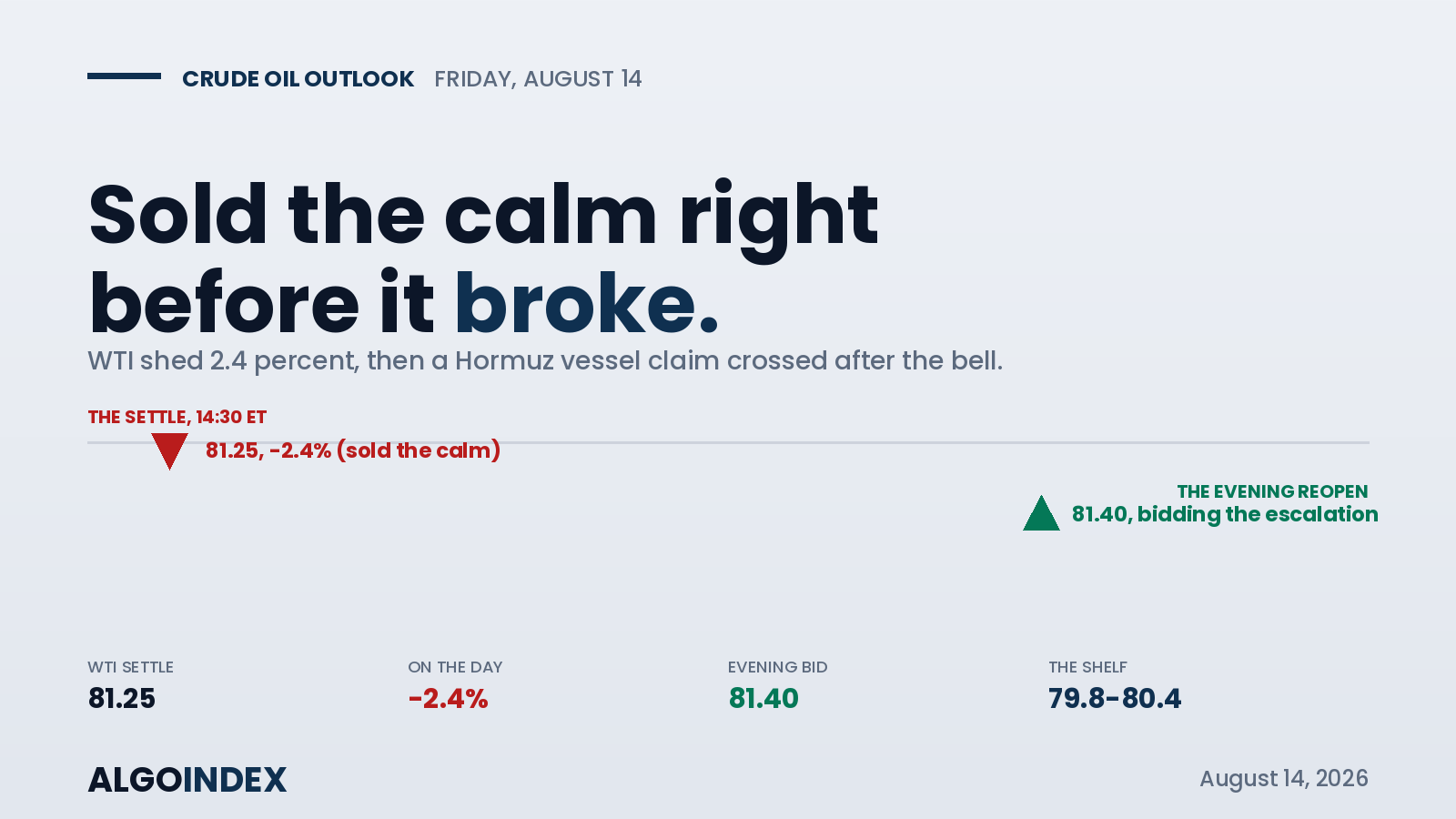
Crude did something on Thursday that it took back within three hours. Front-month WTI settled at 81.25, down 2.4 percent, giving back roughly two-thirds of the prior day's advance, and the move had a clear story: with no fresh overnight strikes in the Persian Gulf and reports the US was leaning toward economic pressure rather than new ones, the market let a slice of its geopolitical premium bleed out. It sold the calm. It's the sort of orderly de-escalation session that looks settled by the close.
Except the close wasn't the end of it. After the 14:30 settle was struck, two supply-risk headlines crossed, a reported refinery strike and, more pointedly, a claim that two tankers tied to an Abu Dhabi state oil company were attacked in the Strait of Hormuz, alongside hawkish US commentary. The electronic reopen is already grinding above the settle, near 81.40, which means the evening is quietly re-pricing the exact risk the daytime session shed. That divergence, a settle that flatters de-escalation against an evening that's bidding on fresh escalation, is the single most important thing heading into Friday. The settle that looked so orderly was already the wrong price.
A range, not a trend
Underneath the headline drama, the structure is quieter than it looks. Crude is sitting at the lower edge of a broad 80-to-100 environment, resting right on its 100-day average, and the trend-strength reading is low, in the teens, which is the signature of a market consolidating inside a range rather than starting a downtrend. Momentum is neutral: relative strength is dead flat near 51 on every window, and the short-window stochastic is rolling over from an overbought reading while the 20-day already sits mid-range. There isn't a directional signal here for the trend-followers to lean on, and the mechanical gauges read a weak sixteen percent buy. This is a decelerating pullback inside a bigger uptrend, not a break.
The averages tell the same story. Price is below the five and 20-day, sitting right on the 100-day, and comfortably above the 50 and 200-day, which is the mixed configuration a ranging market produces. The 82.2 to 82.4 short-term-average band is the first real resistance overhead, and the 78.6 fifty-day is the line that separates ordinary consolidation from a deeper corrective leg.
The asymmetry is the whole trade
The reason to lean long from support isn't a momentum call, it's the shape of the risk. The supply picture is genuinely two-sided: the diplomatic track carries the higher day-to-day odds of a quiet drift lower, but the escalation track carries the far larger single-session move. When two tails carry similar odds but wildly different size, you build on the side that benefits. Here that side is up. The product complex agrees: diesel stayed firm even as crude sold, on a collapse in Russian exports, and the Brent premium to WTI is still pricing waterborne risk directly. The physical market has tracked reality more faithfully than the paper market through this conflict, so a paper-led give-back like Thursday's can overstate how much has actually resolved.
Buy the shelf, mind the headline
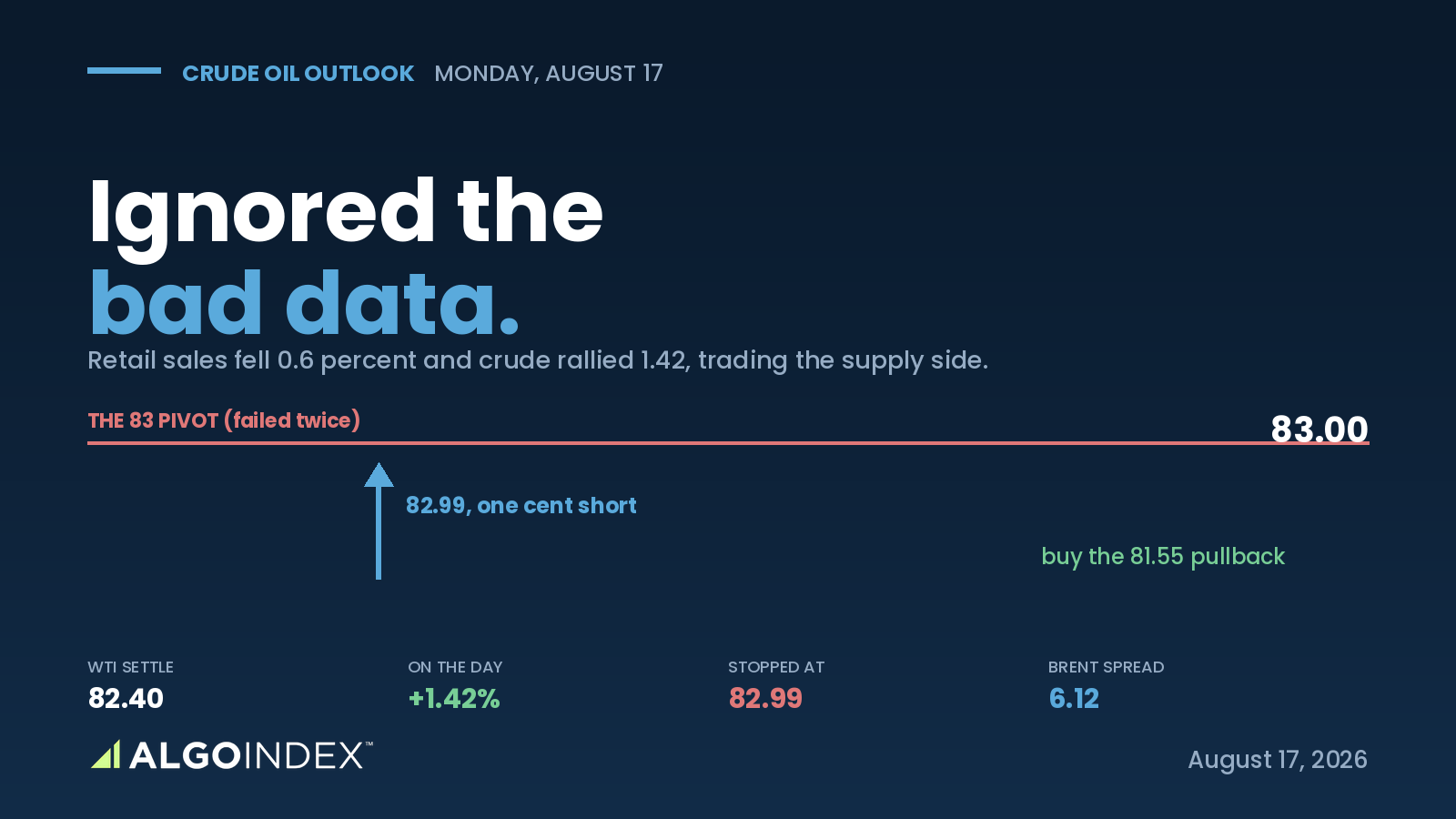
The plan is a support-reclaim long from the 79.90 to 80.40 shelf, the highest-quality confluence on the board, taken on a reclaim of 80.5 rather than a falling-knife fill. The stop sits below 79.30, and the targets run to the 81.50 fulcrum and the 100-day, then the 82.70 supply shelf, then the 83 pivot that would neutralize Thursday's break. There's a mirror trade if the overnight bid fails: a fade of a stall into 82.70 to 83.00 back toward the settle. Either way the discipline is the same, no entries before 9:45, and stand aside entirely if a Gulf headline gaps price outside the range before the open, because you can't chase a geopolitical spike. How we grade these afterward is in our performance methodology.
Crude sold the calm in the afternoon and the calm broke three hours later, so the settle that looked so orderly was already the wrong price.
When a market sells the calm and the calm breaks the same evening, the settle isn't information, it's a head start for whoever reads the divergence first.
This is the read our members get every session, before the bell, with the levels drawn and the setup defined. See how the same dealer-positioning work turns into systematic signals.
View pricingThe complete data picture
Every number behind Thursday’s plan, charted first; the full numeric reference follows underneath.
Full numeric reference , every remaining figure from the review
| Average | Value | Settle vs 81.25 |
|---|---|---|
| 5-day | 82.20 | -0.95 (rolling over) |
| 20-day | 82.38 | -1.13 (first resistance) |
| 100-day | 81.52 | -0.27 (essentially on it) |
| 50-day | 78.63 | +2.62 |
| 200-day | 71.93 | +9.32 |
| YTD | 75.86 | +5.39 |
| Zone | Detail |
|---|---|
| 81.5-83 | heaviest recent acceptance, now overhead |
| 80.0-80.5 | thin, reactive shelf |
| 79.8-80.2 | pivot-support confluence, the long |
| 78.34-78.63 | second pivot and 50-day |
| 74.23 | one-month low |
| 93.50 / 95.30 | one-month and yearly high, the ceiling |
| Item | Reading |
|---|---|
| Brent-WTI spread | 5.82 (waterborne risk priced) |
| Diesel | firm on Russian export collapse |
| Physical vs paper | physical has tracked reality; paper swings on sentiment |
| Net read | paper-led give-back, tightness unresolved |
| Open interest | 149,626 |
| Composite buy | weak 16%, no directional conviction |
| Input | |
|---|---|
| De-escalation read | no fresh overnight strikes; blockade-track talk |
| After the settle | Jizan refinery + Hormuz vessel claim |
| US commentary | hawkish, strong-position endgame on Iran |
| Dollar index | about 99.92, soft-to-flat |
| Equities | records on cool inflation; crude did not join |
| Asymmetry | B and C similar odds, C the larger move |
| When | Event |
|---|---|
| Fri | NO energy-specific data (strait + structure only) |
| Fri 08:30 | US retail sales (demand proxy) |
| Fri 10:00 | Michigan sentiment + inflation expectations |
| Weekend | China activity data (marginal demand) |
| Aug 20 | September contract expiry |
| Mon | China industrial output + retail sales |