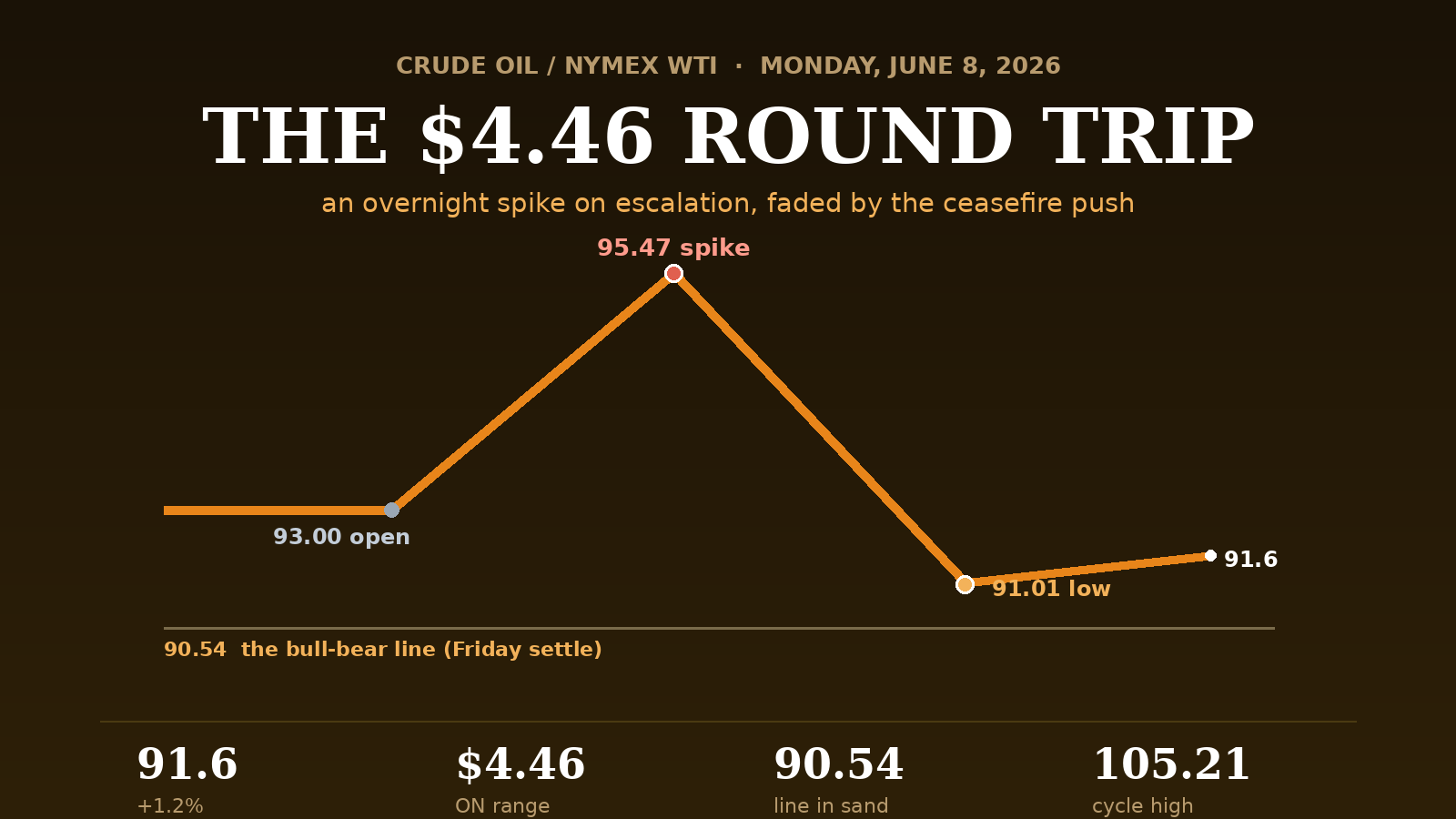
In the span of one overnight session, crude oil opened at 93.00, spiked to 95.47 on a flare-up in the Israel, Iran and Lebanon conflict, then gave almost all of it back to 91.01 as the United States pushed both sides toward an immediate ceasefire. That is a 4.46-dollar round trip, nearly a full average day's range, consumed before the New York pit even opened. The July WTI contract sits near 91.6 into Monday's session, up about 1.2 percent from Friday's 90.54 settle but well off the spike high, and the reason is no mystery: the prompt-month risk premium is being set tick by tick by the Middle East news flow, not by fundamentals. This is a market where the chart matters less than the next headline, and the headlines point both ways at once. It is the same dollar-versus-geopolitics tension mapped in last week's consolidation-and-dollar read.
The Overnight Whipsaw, Move by Move
The Globex session was a clean headline whipsaw. Price gapped higher to a 93.00 open as weekend escalation reports crossed, then accelerated to 95.47 as the Red Sea shipping threat and the Lebanon exchange intensified, with Brent printing near 94. The spike failed almost immediately once de-escalation headlines arrived: Israel reportedly halted strikes on Iran at the United States' request, both sides signaled openness to an immediate ceasefire, and Iran's armed forces announced an end to operations against Israel while warning of harsher action if Israel resumes attacks on Lebanon. Crude unwound roughly four dollars to 91.01 before stabilizing and grinding back toward 91.6. The net result is a contract up on the day but holding only a fraction of its risk-premium spike.
A Two-Sided Driver Nobody Controls
The reason the session is so hard to position is that the single dominant driver pulls in both directions and can reverse on a single report. The geopolitical bid lives in the chokepoints, the Strait of Hormuz, through which roughly a fifth of global seaborne crude transits, and the Red Sea corridor where Houthi forces are again targeting Israeli-linked vessels. Any credible threat injects a premium instantly; any de-escalation drains it just as fast, which is exactly the round trip the market just ran. Working against that bid is a firm dollar at a roughly seven-week high after Friday's hot payrolls print, softer demand signals including weak China oil demand and soft German industrial data, and a research consensus leaning toward no Federal Reserve rate cuts this year.
The Line in the Sand at 90.54
For all the headline noise, the structure reduces to a few prices. Spot is defending a support base at 91.0 to 91.3, the confluence of the session pivot at 91.28, the 9-day average cross at 91.31, and the prior-session low at 91.01. Just beneath sits the level that matters most: 90.54, Friday's settle, the line that separates a held risk premium from a full fade. Lose it on acceptance and the path opens to the 90.09 target and the 88.94 pivot support, the magnet on a confirmed de-escalation. Overhead, the 50-day average at 91.97 caps the recovery first, then a 92.6 to 92.9 shelf, the 93.3 to 93.9 zone, and the heavy 95.2 to 95.8 supply that contains the overnight high. Beyond all of it, the prior cycle high at 105.21 is the same level on the 13-week and one-month charts, a triple-confluence ceiling.
Three Ways the Session Resolves
With no scheduled US oil data until the industry estimate Tuesday afternoon and the official report Wednesday, today trades off chart structure and the next headline. The one dollar-sensitive item is the NY Fed one-year inflation expectations release at 11:00 ET, a secondary input. Three paths frame the day.
The Setup: A Held Pullback, Both Directions Respected
Price is defending the 91.0 to 91.3 base and holding a net gain above the 90.54 prior close while a live geopolitical bid persists, so a held pullback into support offers favorable structure for a recovery toward the overhead shelf. The symmetric risk is explicit: a confirmed ceasefire that breaks 90.54 flips the trade.
Strip away the noise and crude is a market in a shallow correction inside a major uptrend, consolidating after a run from a 52-week low of 55.27 to a high of 105.21, with geopolitics supplying the only real intraday energy. The 90.54 line decides whether the prompt premium holds or drains, and the 95-handle supply shelf caps any escalation spike absent something genuinely new. Until a confirmed ceasefire or a fresh flare-up resolves the two-sided risk, the barrel trades from the edges of its range, and the next headline matters more than the last candle.
Next day: the whipsaw resolved into a one-way bleed as the war premium priced out, in The Premium Bleeds Out.
\nThis analysis is for educational purposes and reflects a fast-moving, headline-driven market ahead of the Monday, June 8, 2026 cash open. It is not investment advice. Energy markets are highly volatile and can gap sharply on geopolitical news; conduct independent research before acting.