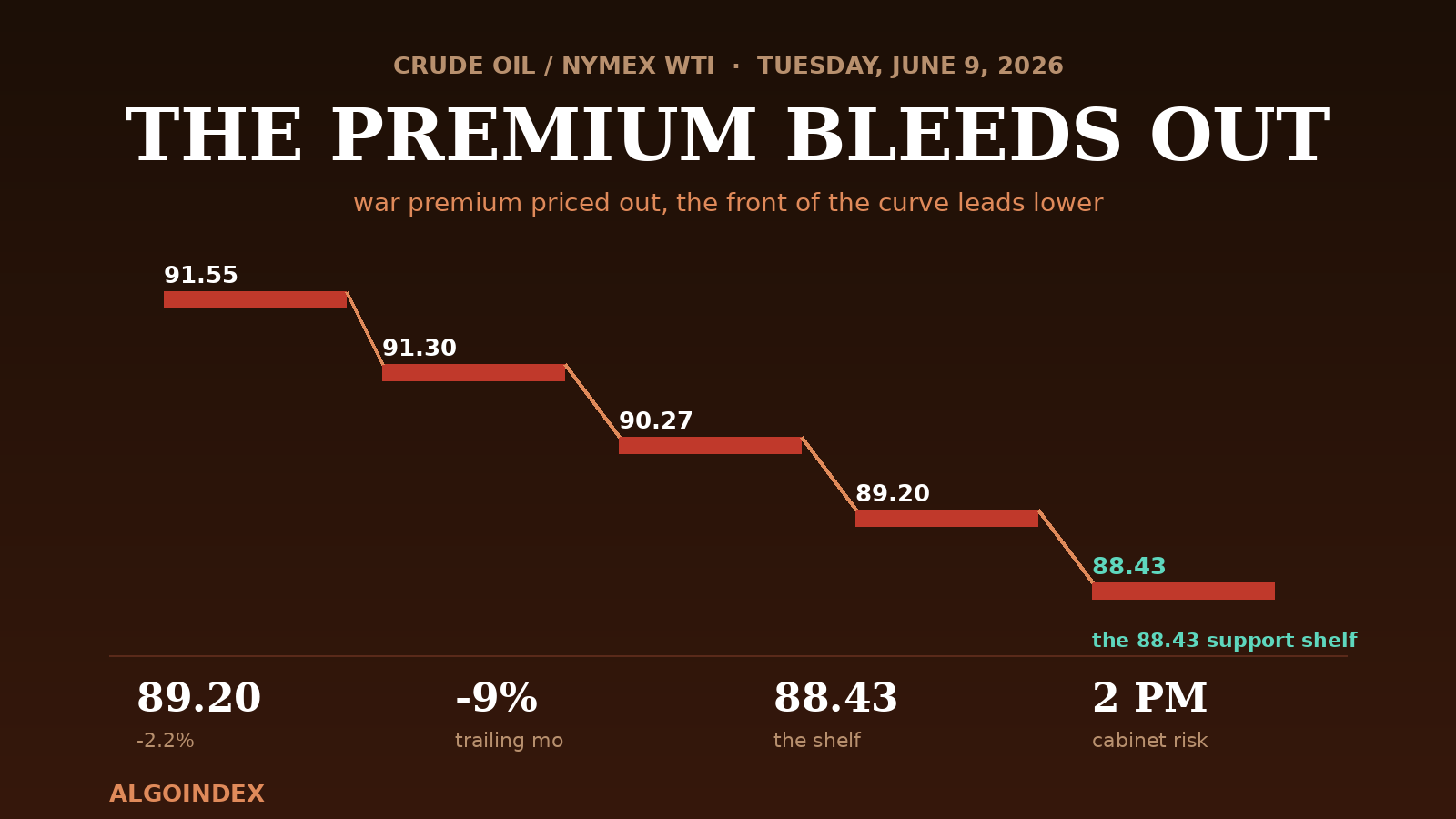
Yesterday crude whipsawed 4.46 dollars in a single overnight session as the Israel-Iran conflict flared and then cooled. Today the whipsaw has resolved into a one-way bleed. The July WTI contract settled Monday at 91.30, gapped lower, and accelerated overnight to near 89.20, off roughly 2.1 to 2.3 percent on the day with a session low of 88.80, extending a slide that has erased close to 9 percent over the trailing month. Monday's intraday rally on Israeli strikes inside Iran has fully reversed: Iran signaled an end to its current operations, reports point toward an immediate stand-down, and the war premium that had been embedded in the front of the curve is being priced out barrel by barrel. The desk read across the energy complex is blunt: oil continues to drop on Middle East optimism.
From Whipsaw to Bleed: How the Premium Unwinds
A geopolitical premium is built in spikes and unwound in a grind. Monday's session showed the build: crude rallied intraday as Israel struck military targets inside Iran and Iran signaled readiness for a prolonged conflict. But the close was poor relative to the range, a sign the spike was a fade rather than a base, and the overnight follow-through confirmed it. Once Iran indicated an end to its current operations and the stand-down reports surfaced, the prompt premium had no reason to stay, and sellers took control from the 91.55 overnight high down to 88.80. The front of the curve is leading the decline, the telltale signature of a premium unwind concentrated in the near-dated barrels where the supply risk actually sat.
Geopolitics Out, Demand Worry In
With the war premium draining, the market's attention swings back to a demand backdrop that is anything but supportive. The features circulating this morning are pointed: an oil shock weakening the Indian economy, Asia described as the center of an energy crisis, and most concretely, one major Asian importer's crude imports falling to an eight-year low. Soft demand from the largest marginal buyer is a structural drag that compounds the geopolitical unwind. The dollar is a marginal tailwind, down about 0.19 percent near 99.81, but it is being overwhelmed by the premium drain and the demand caution. The one genuinely two-sided variable left on the board is the 2:00 PM ET Israeli security cabinet meeting, the single event that can reprice the premium decisively in either direction before the close.
Asian importer demand at 8-year low
Composite Sell, below all short averages
Soft dollar, intact long-term uptrend
2 PM cabinet meeting, a two-way swing factor
The Wall of Resistance, the Shelf of Support
The structure is a descending wall above and a defended shelf below. Every short-to-intermediate average, the 5-day at 92.0, the 50-day at 92.0, the 20-day at 94.9, now sits overhead as layered resistance, with the 91.30 prior settle the nearest magnet and the 92.39 pivot the line that would shift the short-term tone back to balance. Beneath price, the support base is dense: the session low at 88.80 backed by a tight group at 88.68, 88.62, and the 88.43 retracement that marks the base of the shelf. A decisive break of 88.4 to 88.8 opens 87.31 and then the one-month low at 86.35. The oversold short-term oscillator is the reason that shelf is worth watching for a reflex bounce rather than assuming a clean break.
Three Ways the Session Resolves
The energy-relevant calendar is back-loaded: a secondary inflation-expectations print at 11:00 ET, the first-order Israeli cabinet meeting at 2:00 PM ET, and the private weekly petroleum-stock estimate after the close, with the government inventory report Wednesday. Three paths.
The Setup: Sell the Rally, Watch the Shelf
With price below the 5-, 20- and 50-day averages and a strengthening Sell composite as the premium unwinds, the primary expression is to sell strength into overhead supply. The mirror is the oversold bounce off a defended shelf, and both have to respect the 2:00 PM cabinet meeting as a size-down event.
Crude's two-day arc tells the whole story of a geopolitical premium: built fast on the strike, faded on the stand-down, bled out on the unwind. With the front of the curve leading lower and demand signals soft, the path of least resistance is down, gated by an oversold shelf that has earned the right to a bounce and a cabinet meeting that can rewrite the afternoon. Sell the rallies while the trend points down, respect the 88.4 shelf as the line that decides whether this is a pause or the next leg, and keep size light around the 2:00 PM headline.
This analysis is for educational purposes and reflects a headline-driven market ahead of the Tuesday, June 9, 2026 cash open. It is not investment advice. Energy markets are highly volatile and can gap sharply on geopolitical news; conduct independent research before acting.