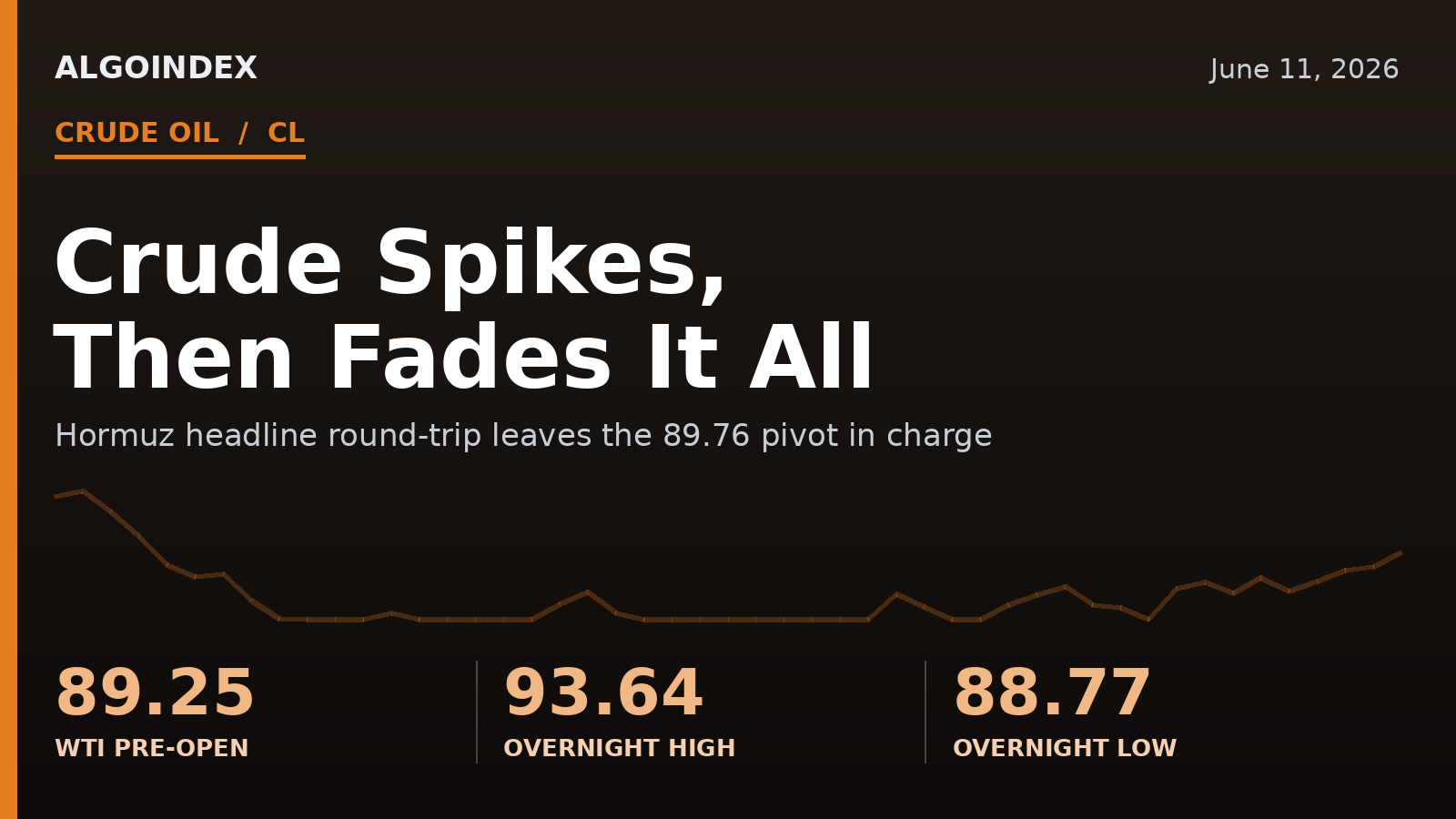
By the time New York desks settled in Thursday morning, crude oil had already traveled more than five dollars and landed almost exactly where it began.
The July contract gapped to a 92.25 open and ran to 93.64 on a single pair of headlines: Iran declaring the Strait of Hormuz closed until further notice, and reports of naval action against three vessels in the Gulf of Oman. Then, within hours, the entire advance vanished. Price collapsed to 88.77 as a competing set of headlines crossed, talks between Tehran and Washington continuing on an initial agreement, Qatari mediation active, and Japan confirming it had already locked in the equivalent of a full month of crude through routes that bypass the Strait.
That round trip is the entire story. A market that spikes on a supply shock and then fades the whole move is saying something specific: for now, traders are pricing real odds that the disruption is temporary or navigable. West Texas Intermediate opens the cash session near 89.25, below its 89.76 pivot and beneath Wednesday's 90.03 settlement, corrective on the intraday view yet still far above the longer averages that frame its primary uptrend. The market is structurally bullish on the multi-month horizon, tactically soft into the open, and exposed to enormous two-way risk on the next headline.
A spike repriced, then unwound
The overnight high at 93.64 was a war-premium repricing of roughly 3.60 in a matter of hours. The reversal was just as decisive. Price retraced the whole advance and pressed through the prior settle to an 88.77 low, a peak-to-trough collapse of nearly 4.90. The contract now trades in the 89.20 to 89.40 band, below the pivot and below the settle, with the most recent structure leaning lower.
Three reference points organize the session. The 93.64 spike high is where sellers rejected the move. The 88.77 low is the line that defines the bearish unwind. And the 90.03 settlement is the gravity price keeps returning toward. This is the same premium that has been draining out of the front of the curve all week, a process we traced in Tuesday's read on the front-curve lead and again after Monday's overnight whipsaw.
The trend layers disagree, and that is the point
On the daily chart WTI sits about 4.80 below its 20-day average near 94.06 and roughly 2.80 below its 50-day near 91.98, a clear short-term pullback. But price remains far above its 100-day near 81.86 and dramatically above its 200-day near 70.70. The fast averages have rolled over with the spike and fade while the slow averages keep sloping higher.
That is the signature of a healthy correction inside a larger advance, not a trend reversal. The mid-80s support base is where that read would actually be challenged. Until price loses it, every pullback is unfolding inside an intact uptrend, and the 14-day average true range near 5.08, almost 5.7 percent of price, says the daily swings have grown wide enough to respect.
The calendar is stacked against quiet
Few sessions carry this much scheduled risk. A monthly producer-group supply report lands before the bell and can reframe the supply narrative on its own. A major European central-bank decision and press conference hit at 8:15 ET, with a quarter-point hike to roughly 2.40 percent widely expected, the bank's first increase in some time and one driven explicitly by the energy-led inflation impulse. United States producer prices and weekly jobless claims print at 8:30 ET.
The single most important crude-specific event is the 10:30 ET weekly inventory report, where consensus looks for a draw near 2.2 million barrels against last week's far larger 7.97 million drawdown. A larger-than-expected draw on top of the supply backdrop would be doubly bullish; a build or a thin draw reinforces the corrective fade. Above every scheduled item sits the unscheduled Hormuz headline flow, which can override all of it in a single tick.
Thursday's timed catalysts that bear directly on crude (ET).
How to trade a powder keg
The cleanest tactical edge is to fade strength back into supply rather than chase the move lower. With price below the 89.76 pivot after a decisive rejection of the spike, a bounce into the 89.76 to 90.20 area, the pivot up into the prior-settle shelf, sets up a short toward 88.40 and the 87.66 support pivot that marks the primary unwind target. A reclaim and acceptance back above 90.34 voids that idea immediately and flips the bias long toward 91.18 and 92.14, the path a fresh re-escalation headline or a large inventory draw would take.
The discipline that matters most today is staying flat through the timed catalysts and sizing for the larger daily range, not the calmer pre-conflict one. This is the same conditional, level-gated approach that underpins our published performance methodology, and it is why the de-escalation relief now lifting equities, the subject of today's S&P read, matters to the oil bid too.
The flat price sits where it started, but the distance it traveled to get there is the real signal.
See how AlgoIndex turns this kind of level-gated read into systematic signals.
View pricing →