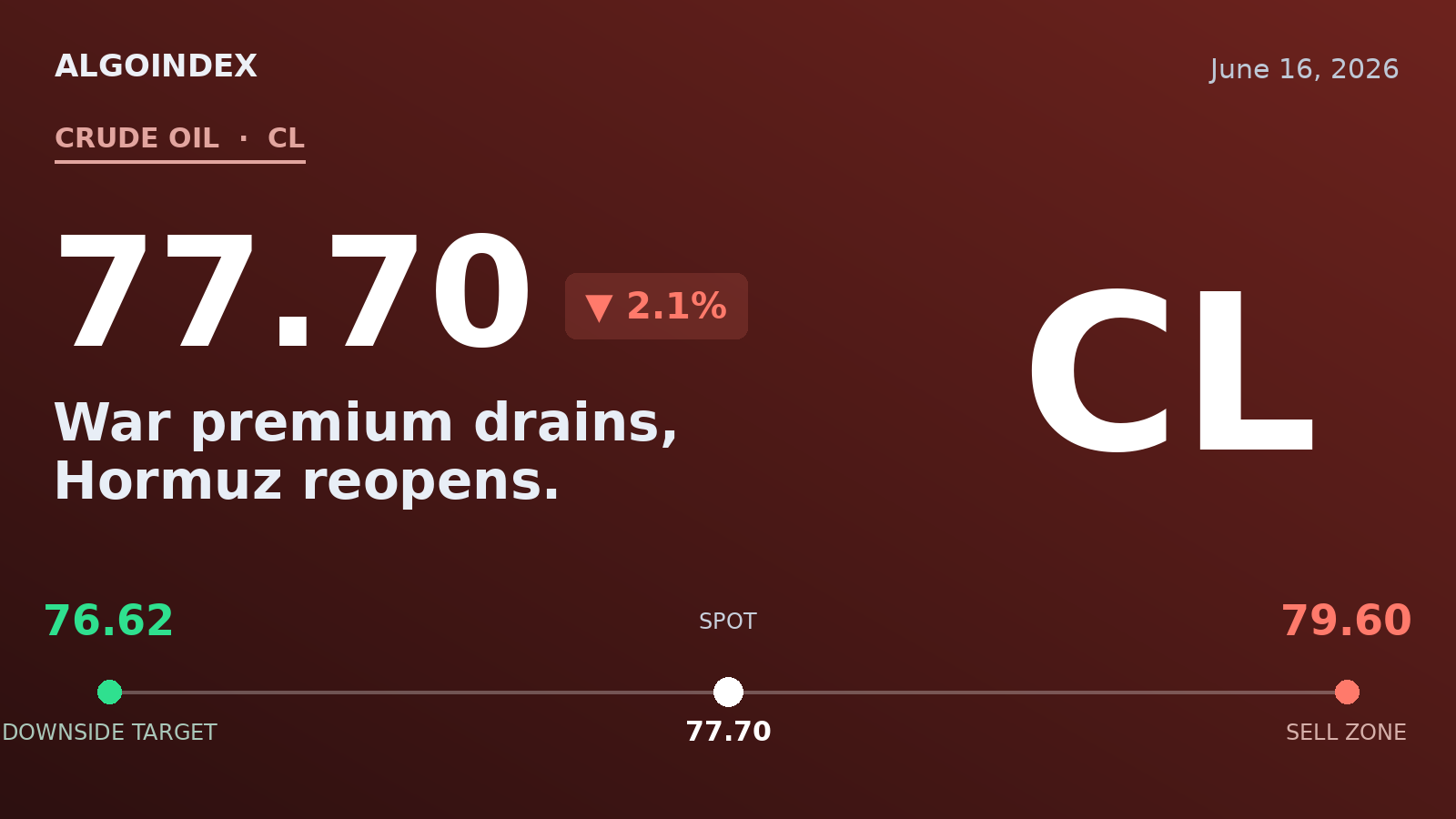
At 77.25 overnight, crude oil printed a fresh two-month low, the second leg of a collapse that has erased nearly a quarter of the price in a month.
West Texas Intermediate trades near 77.7 into the United States open, down roughly 2.1 percent from the prior 79.44 settle, after a brutal Monday that closed the lead contract down 4.87 percent. The one-week decline is now close to 10 percent, and price sits about 22 percent below the 100.10 high it printed at the peak of the Middle East conflict. This is a mean reversion, not a drift: crude spiked into triple-digit territory on war fear, and it is now retracing that entire spike as the fear discharges.
The driver is the rapid unwinding of the war-risk premium. Reports that the United States and Iran have agreed to end hostilities and reopen the Strait of Hormuz, paired with a stated plan for the waterway to reopen after a peace-deal signing in Switzerland this Friday, have collapsed the geopolitical bid. With nearly 600 vessels reported stranded in the Persian Gulf awaiting safe passage, a reopening would release a wave of delayed barrels, and a lifted blockade raises the prospect of restored Iranian exports. Scarcity flipped to abundance almost overnight.
Trend down, momentum stretched
The contradiction into today is a firmly bearish trend running into a deeply oversold short-term condition. The multi-indicator composite reads 56 percent sell with the trend signal negative, and price has lost the 5-day average at 83.06 by more than five dollars and trades well beneath the 20-day at 88.45 and the 50-day at 88.04. The 100-day at 79.85 is the first meaningful average overhead, aligned with the prior settle and pivot to reinforce the 79.4 to 79.9 zone as the line bulls must reclaim. The one structural comfort is the 200-day at 69.64, which price still holds comfortably above, so the long-term uptrend off the 52-week low is intact even as the short-term trend has snapped lower.
The oscillators say the easy part of the move is behind us. The 9-day relative-strength reading near 27 and stochastics pinned in single digits flag exhaustion, the kind of stretched condition that historically precedes at least a pause or a counter-trend bounce. Yet the directional system confirms sellers in control, with the 9-day negative directional indicator at 32.71 towering over the positive at 11.99, and the short-term composite direction strengthening rather than fading. This continues the unwind we tracked in Monday's gap-down crash.
Speculators were already heading for the exit
Positioning data, current as of the June 9 reporting date and therefore predating the sharpest part of this decline, shows managed-money accounts were already trimming length. Non-commercial longs fell by 22,786 contracts to 360,524 while non-commercial shorts stood at 230,223, leaving a still-net-long but shrinking speculative position. Commercials were net short, with longs at 919,786 and shorts at 1,090,512. The message is that speculative length was being unwound into the move even before the worst of the drop, which helps explain the velocity and suggests there is still long liquidation that can feed further downside, while also meaning the market is not yet washed out to a contrarian extreme.
The bearish package, and its two-sided risk
The de-escalation flow is dense and unambiguously bearish for crude: the deal is described as complete, scheduled strikes were cancelled, both sides are weighing an immediate ceasefire, and the Strait reopens after Friday's signing, which would begin a 60-day window of nuclear talks. The counterweight is the residual friction in the same feed. A dispute that the leaked terms do not match the written agreement, a message exchange between the two capitals reported paused for several days, a warning from the largest tanker operator against a rush back through Hormuz, and a comment about taking Kharg Island, Iran's principal oil-export terminal. The market is pricing the optimistic case aggressively, which makes any reversal in the headline tone the single largest risk to a short. The week's macro centerpiece, the central-bank decision and projections, lands midweek and will set the dollar path that modulates crude, and the weekly inventory report midweek is the first hard-data test of whether physical balances confirm the repricing.
Sell the bounce, do not chase the bottom
With price already at the lows and oscillators stretched, the higher-quality expression is to fade a bounce into broken support rather than chase the breakdown at the bottom of a double-digit weekly drop. Favor selling strength into the 78.30 to 79.60 supply shelf, where the broken first-pivot support, the prior settle, the session pivot, and the falling 5-day average converge, with a stop above 80.30, just over the 80.15 overnight high. The first objective is the 77.25 low, then the 76.62 downside target, then the 75.45 thirteen-week low. A sustained reclaim above 80.81 with the 5-day average back in hand says the oversold bounce has matured into a trend change, and the short stands down.
Deeper oversold relief (30%): a reclaim of 78.26 tests the 79.4 to 80.1 zone before stalling, downtrend intact.
Clean breakdown (20%): a fresh de-escalation headline drives a break of 77.25 straight to the low-75s.
A war premium that took weeks to build is unwinding in days, and the only thing standing between crude and the low-70s is a single headline that says the deal is not as done as it looks.
See how AlgoIndex turns this kind of level-gated read into systematic signals.
View pricing →Next session: Crude Oil Is Oversold and Stabilizing Into the Fed →