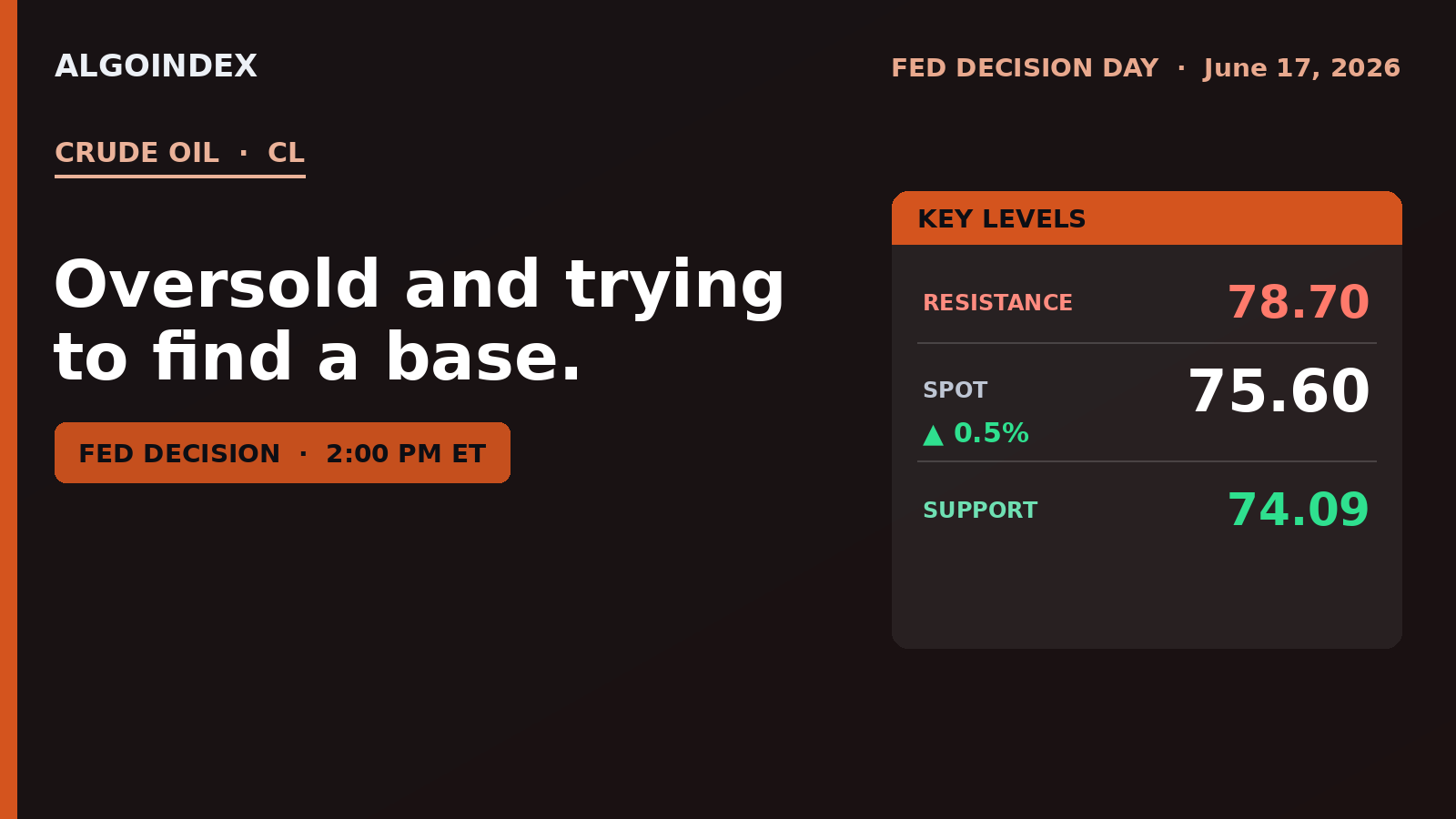
After shedding close to a quarter of its value in a month, crude oil spent the night trying to find a base it has not yet built.
The front contract trades near 75.6 into the United States session, up about half a percent, with the August continuation at 75.33 against a prior 75.27 settle, a marginal gain that does little to repair the damage. WTI has shed close to 15 percent over the trailing five sessions and roughly 24 percent over the month, collapsing from levels that pressed toward the 52-week high near 100.10 back into the mid-70s. The driver is a wholesale repricing of geopolitical supply risk: cancelled strike plans, a framework agreement described as complete, and active preparation to reopen the Strait of Hormuz, with tankers reportedly repositioning back toward the region.
That leaves an awkward setup. The short-term trend is decisively lower and the multi-indicator composite reads firmly bearish, yet momentum oscillators are pressed into deeply oversold territory, with the 9-day relative-strength reading near 23.8 and short stochastics near single digits. Layered on top is an unusually heavy calendar, headlined by the weekly petroleum inventory report at 10:30 ET and a Federal Reserve decision with updated projections at 2:00 PM ET. The contradiction is the whole trade: a broken short-term trend against a stretched, snap-prone market, into two first-order catalysts.
A trend broken, a market stretched
The moving-average stack is decisively bearish on the short and intermediate horizons. The 5-day sits near 79.87, the 20-day near 87.12, the 50-day near 87.79, and the 100-day near 79.97, with spot near 75.3 beneath all four. The only longer-horizon average still under the market is the 200-day near 69.69, the major structural support shelf roughly six dollars below. The yawning gap between spot and the 20-day and 50-day, both above 87, shows how far and how fast price has fallen, and it explains the oversold oscillators.
Yet the same depth that confirms the downtrend warns against chasing it. Short stochastics near 5.5 percent and the 9-day relative-strength near 23.8 are levels that historically precede a reflex bounce or at least a pause, and the composite near 72 percent sell is itself a contrarian caution flag at these extremes. The residual headline risk cuts the same way: Iran has warned of a response if attacks on Lebanon continue, so a hard one-directional short into support carries tail risk that any escalation can violently reverse. This is the next session of the unwind we tracked in Tuesday's two-month-low break.
Two catalysts, one afternoon
The calendar is unusually dense, and two items are first-order. The 10:30 ET weekly petroleum inventory report carries a consensus draw near 3 million barrels against a prior 7.2 million draw; a larger draw supports a bounce attempt toward 77.7 and the 78.70 reference, while a build or a thin draw confirms the bearish posture and invites a retest of the 74.1 base. Then the afternoon belongs to the Federal Reserve. The 2:00 PM ET decision is expected to hold near 3.75 percent, so the move comes from the projections and the press-conference tone, which will set the dollar path that modulates crude through the close. The discipline is to let each print clear and trade the level, not the headline.
Fade the failed rally, mind the event
With the trend lower and price below every short and intermediate average, the cleanest expression is to sell a rally that fails at the pivot rather than chase weakness into support. Favor a short into the 76.60 to 77.10 zone on a rejection back below the 76.72 pivot, ideally after the 10:30 print clears, with a stop at 78.85 above the 78.70 resistance. The first objective is 75.00, then the 74.10 base and one-month low, then the 73.30 first computed support. A sustained reclaim and hold above 78.70 flips the picture toward an oversold-bounce environment. The non-negotiable discipline is to stand aside in the 1:45 to 2:30 PM window around the decision and trade the post-Fed dollar reaction, not the announcement.
Bearish continuation (35%): the base breaks on a bearish print or hawkish Fed, 73.3 and lower open.
Oversold bounce (20%): a supportive draw or dovish Fed reclaims the pivot toward 77.7 and 78.70.
A month of war premium is nearly gone, and what is left of the trade now hangs on a barrel count at half past ten and a room full of central bankers at two.
See how AlgoIndex turns this kind of level-gated read into systematic signals.
View pricing →Next session: Crude Oil's War Premium Keeps Draining Toward the 200-Day →