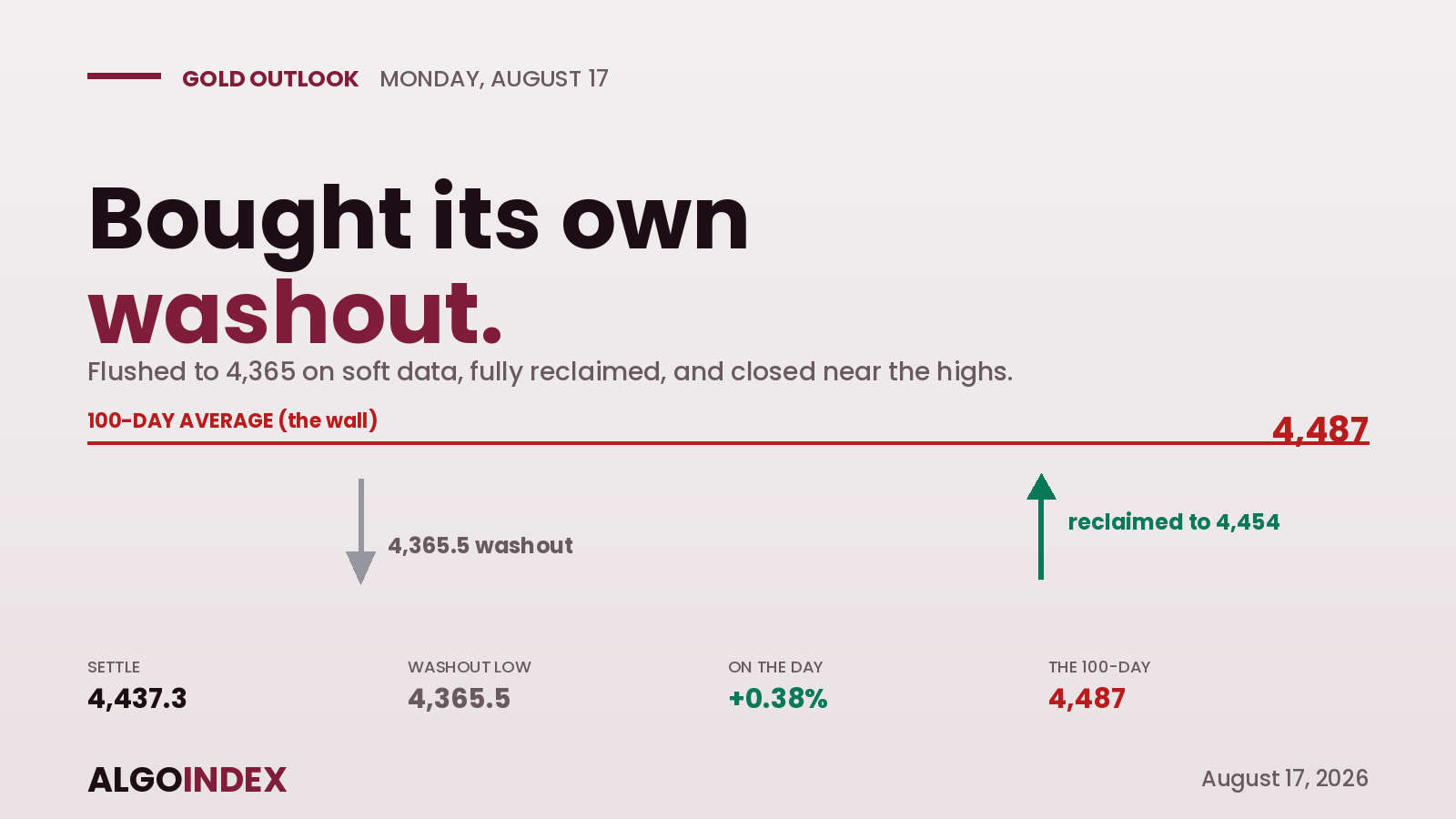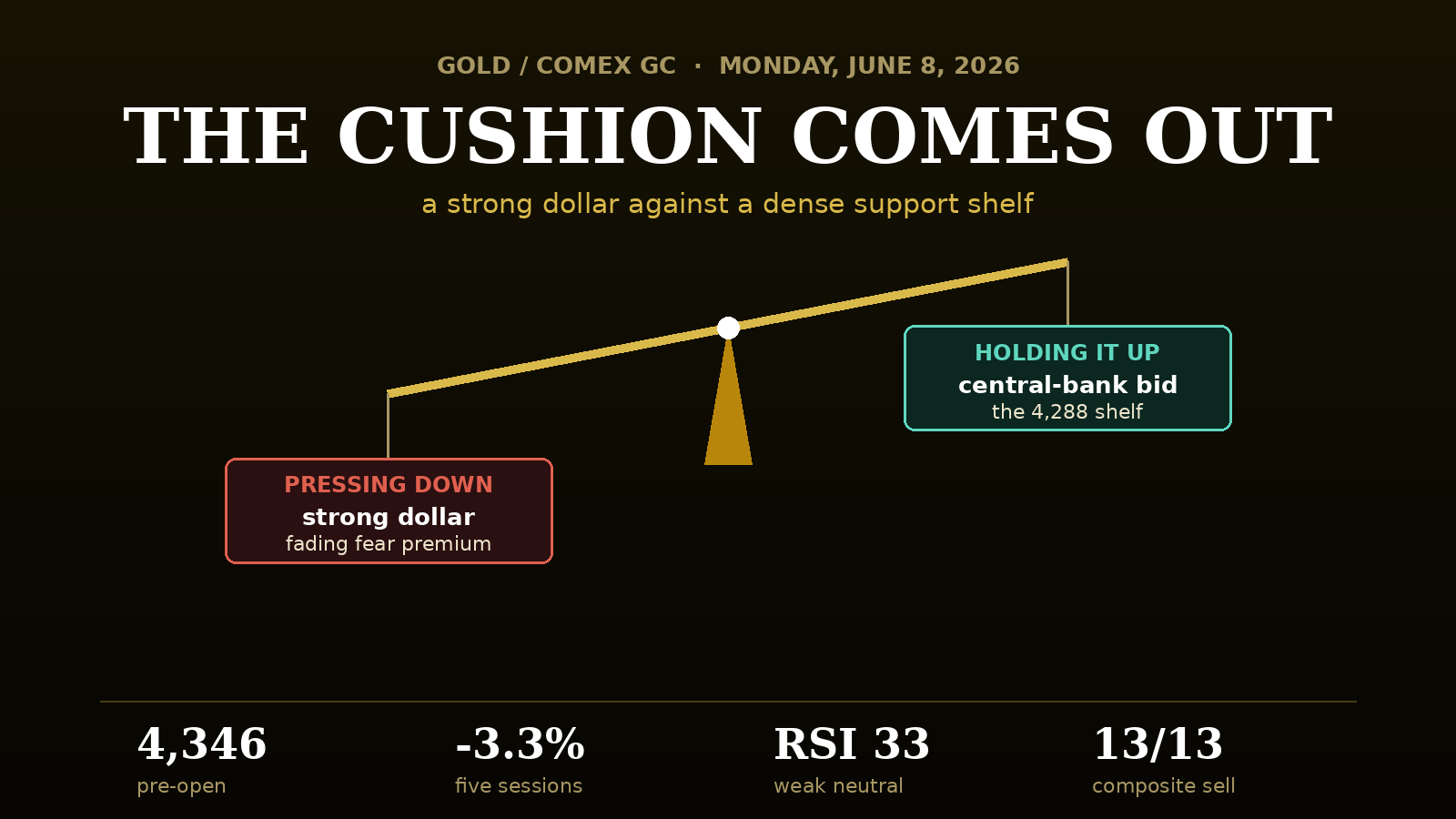
For most of the past month, gold had two things holding it up: a structural central-bank bid underneath and a geopolitical fear premium on top. This weekend, the top layer started to come out. Iran's armed forces announced an end to military operations against Israel, the US administration began publicly steering both sides toward an immediate ceasefire, and the safe-haven cushion that had partly offset a strengthening dollar began to deflate, extending the break below the 200-day the metal lost on Friday. Gold enters Monday's session near 4,346, down about 0.43 percent from Friday's 4,365.3 settle and roughly 3.3 percent lower over five sessions, leaning on a dense band of support that held overnight and waiting to see whether the dollar lets it bounce.
A Tug of War Gold Is Currently Losing
Gold sits between forces pulling in opposite directions, and right now the bearish side has the upper hand. On the downside, the dollar is the story: Friday's stronger-than-expected May payroll report drove the dollar index to a roughly 1.75-month high, and the market has begun pricing the possibility that the Federal Reserve's next move is an interest-rate increase rather than a cut. Higher nominal and real-rate expectations raise the opportunity cost of holding a non-yielding asset, and a firmer dollar pressures the metal directly in dollar terms. On the upside, two supports remain, but one is slow and the other is fading. Central-bank and official-sector accumulation still underpins the multi-year uptrend, which is why price sits so far above its 52-week low even now, but that is a structural support-builder, not a tactical bid that stops a correction. The geopolitical fear premium was the tactical cushion, and the weekend's de-escalation is removing it.
The Line in the Sand: A Dense Support Shelf
The single most important feature of the chart is how much support is packed into a narrow band just beneath price. Six independent reference points land between 4,288 and 4,305, and the overnight low printed at 4,293 directly on it, then held. When that many methods agree on one zone, a reaction there is more likely than at any single level alone, which is why this band is the line in the sand for bulls. Lose it on a clean break and the next layer down is thin until 4,257; defend it and the oversold oscillators have room to drive a bounce.
How Stretched the Decline Has Become
Price near 4,346 now sits below every major moving average, the hallmark of a momentum-backed correction rather than a drift. The directional indices confirm it: the 9-day average directional index at 32.7 with negative momentum dominating, and the multi-indicator composite reading a full sell across all thirteen component studies. But the same distance that confirms the downtrend also measures how stretched it is. Price is more than 200 points below the 20-day average, and the oscillators are washed out, which is the condition that produces sharp short-covering bounces inside a downtrend, even when the larger path stays lower.
No Magnet to Catch a Falling Price
Read through the gold-ETF proxy, dealer positioning carries a net-negative gamma posture, with call-side and put-side gamma both negative. In plain terms, dealers are positioned to amplify moves rather than dampen them, hedging in the direction price is already going, which favors trending, extended swings over tight pinning and is consistent with the elevated average true range of roughly 110 points. The proxy's lower volatility-inflection level sits well beneath current price and the upper one well above, so there is no nearby dealer-driven magnet holding price in place. The practical consequence: expect follow-through on a clean break of the support shelf rather than an automatic snap-back, and treat bounces as counter-trend until price reclaims the daily pivot at 4,403.
Three Ways the Session Resolves
The data slate is light and second-tier, the trade balance at 8:30 ET and existing-home sales at 10:00 ET, neither a first-order catalyst for gold, which leaves the dollar's post-payroll momentum and headline flow in control. The single most important forward driver is this week's US inflation read; positioning into it will likely dominate price through midweek. Within today, three paths.
The Setup: Fade the Bounce, Respect the Shelf
With an established downtrend, price below every major average, a unanimous sell on the composite, a hawkish-dollar backdrop, and a fading safe-haven bid, the higher-quality structure is to fade a rally that stalls beneath the resistance shelf rather than to chase weakness into support.
The shape of the day comes down to one question: can the dense 4,288 to 4,305 shelf keep absorbing the dollar's pressure long enough for oversold conditions to spark a bounce, or does the fading fear premium leave gold too exposed to hold. The structural bull case, central-bank demand and a 200-day still up 25 percent on the year, is not in doubt. What is in doubt is whether the correction has one more leg before the buyers who have defended this metal all year step back in. Until the dollar repricing settles and price reclaims its pivot, the burden of proof stays on the bounce.
Next day: the drain continued into Tuesday, pressing gold toward its demand pocket, in The Premium Keeps Draining.
\nThis analysis is for educational purposes and reflects market conditions ahead of the Monday, June 8, 2026 cash open. It is not investment advice. Markets carry risk; conduct independent research before acting.