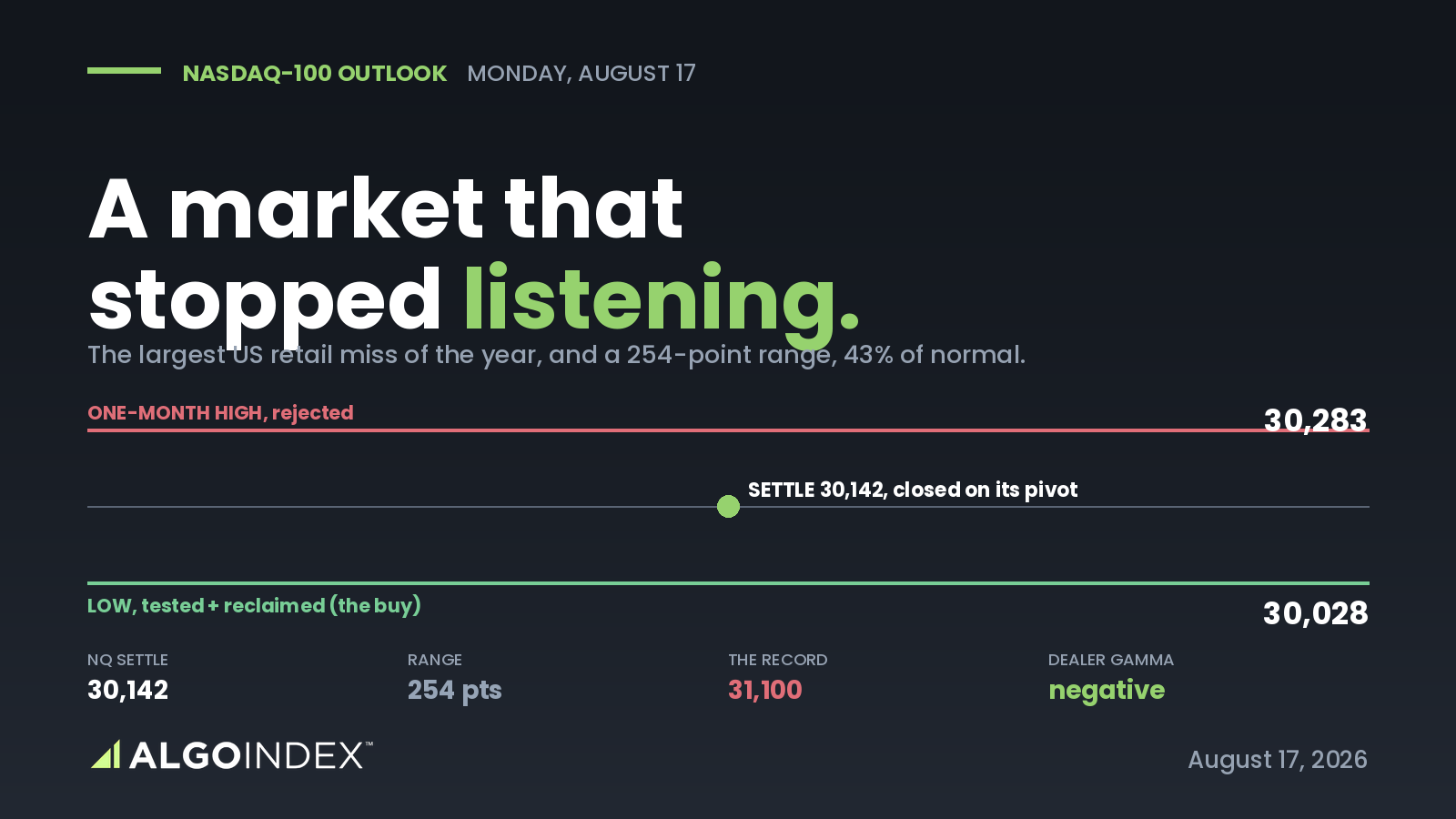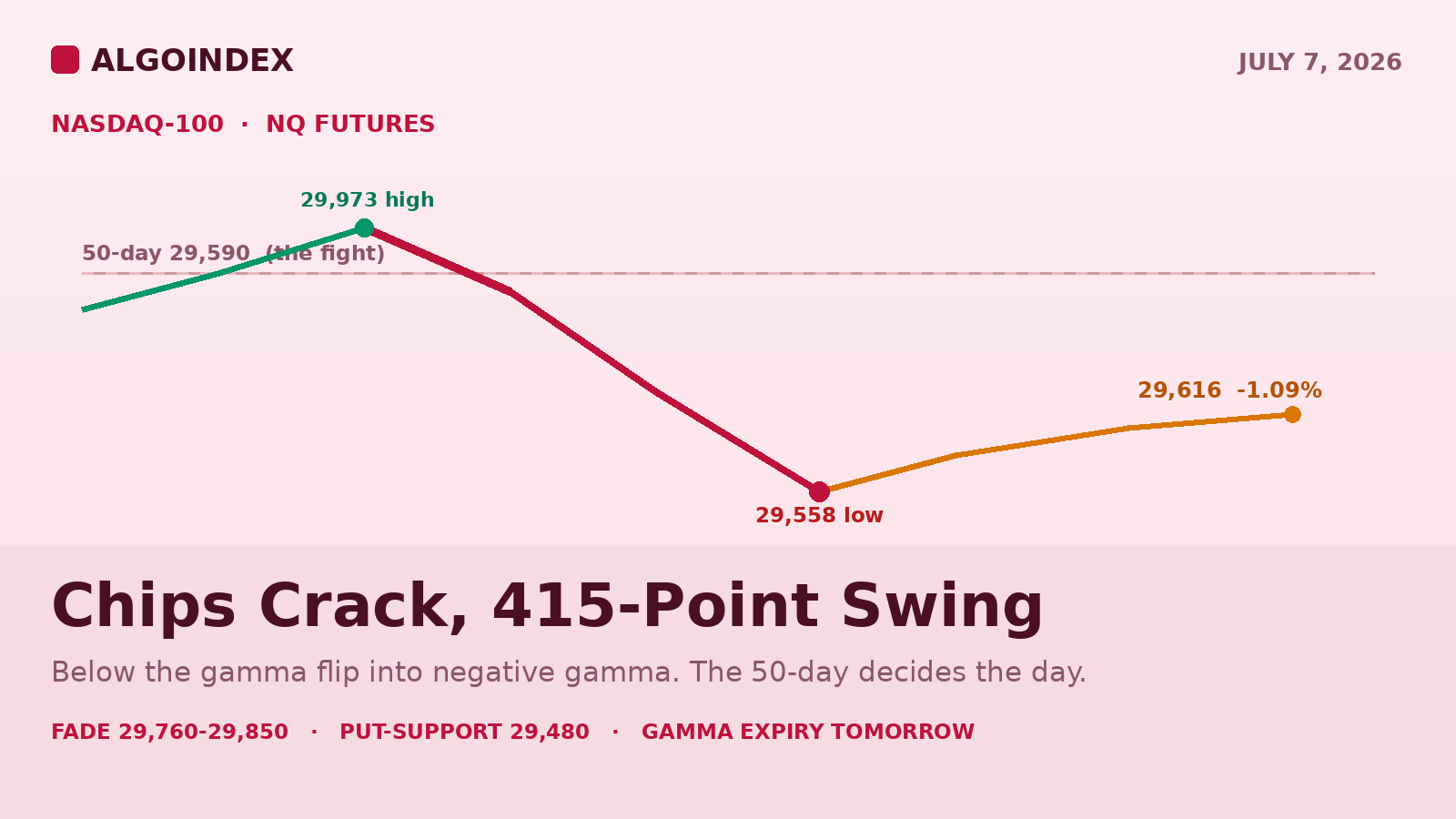
Nasdaq-100 futures gapped 1.09 percent lower to 29,616 on an Asian semiconductor unwind, a 415-point overnight swing that dragged the market back below the dealer gamma flip into negative-gamma territory. Price is now sitting on the 50-day average at 29,590, the line that has held every pullback since April. Dealers amplify moves here, the largest gamma expiration is tomorrow alongside the FOMC minutes, and a SpaceX index-inclusion bid cuts the other way. The plan: fade a laboring bounce into 29,760 to 29,850 toward the overnight low and the put-support shelf. Bias bearish for today, conviction moderate, inside an intact longer-term uptrend.
Samsung reported a 19-fold surge in quarterly profit and fell as much as 10 percent anyway. That single line is the clearest statement possible that expectations in the AI-hardware complex had outrun even excellent fundamentals. SK Hynix dropped 10 percent as it launched the marketing for its US listing, the Kospi collapsed 8 percent and tripped a trading halt, US memory names Micron and Sandisk fell more than 5 percent premarket, and NQ knifed from a 29,973.75 overnight high to a 29,558.50 low. Twenty-four hours earlier, this same chip complex led the Nasdaq-100 up 1.26 percent to help the Dow print an all-time high.
Yesterday we flagged 30,000 as the ceiling and a negative-gamma book waiting below it. Monday tagged the ceiling; the overnight session proved the amplifier. With futures back under the dealer gamma flip, hedging now chases price rather than fading it, and a 415-point swing before the cash open is the result. The whole session reduces to one question: does the 50-day average at 29,590 hold.
A change of character overnight
Monday's RTH session was strongly constructive. September E-mini Nasdaq futures rose 1.35 percent, the cash index gained 1.26 percent, and semiconductors led with the group up around 2 percent, validated by June ISM services at 54.0 in line with expectations and the prices-paid subindex easing to 67.7 from 71.3. Futures settled 29,941. The overnight session reversed that tone completely. NQ opened Globex at 29,960, printed 29,973.75 in the early hours, then sold off steadily as Asia absorbed the Samsung disappointment, bottoming 29,558.50 in the European morning before stabilizing into the 29,600 to 29,660 zone. Overnight volume of roughly 99,000 contracts is heavy for a Globex session, confirming genuine institutional repositioning rather than thin-liquidity drift. NQ underperformed ES by a wide margin, down 1.09 percent against down 0.23 percent, the clean signature of a technology-specific move.
The daily chart remains a primary uptrend from the April low near 23,170, a run of more than 30 percent into a mid-June all-time high at 31,100 (30,975.50 on the continuous contract). Since that peak, price has consolidated in a broad 28,508 to 31,100 band for roughly three weeks. A sharp late-June pullback into the 28,500 to 29,000 area was bought, the market recovered into 30,000 to 30,150 in early July, and last week closed with a 1.39 percent five-day decline. Today's overnight low sits in the lower third of that consolidation but well above its base. Price is up 14.46 percent year-to-date and 16.8 percent above the 200-day, so the medium-term structure is intact; what is being contested is the short-term range within it. On the intraday swings the picture turned bearish overnight, a clean sequence of lower highs and lower lows with a confirmed change-of-character break as price took out the prior session low, supply stacked at 29,900 to 29,950 and heavier near 30,050, with liquidity resting below 29,558 the obvious downside draw.
The moving-average stack tells the two-timeframe story precisely. Price at 29,616 is below the 5-day (29,950) and 20-day (29,915), both now acting as resistance and stacked with the computed daily pivot, but sits almost exactly on the 50-day (29,590), the level that has contained every meaningful pullback since April. The 100-day (27,444) and 200-day (26,709) are far below and rising. Today, in the simplest terms, is a fight for the 50-day. Momentum is soft but not washed out, the 14-day relative strength at 48.4 and the 9-day at 46.0 right at the midpoint, the 14-3 raw stochastic at 26 percent approaching but not reaching the sub-20 reversal zone, the directional index low at 16.4 with the down-line (20.4) above the up-line (16.3). The composite has decayed to 16 percent buy, short-term group 20 percent sell, medium-term 25 percent buy, long-term 67 percent buy.
Lose the 50-day and the negative-gamma book accelerates the move; hold it and the inclusion bid gets a base.
Negative gamma is the accelerant
Dealer-positioning levels for the Nasdaq complex are read through the Nasdaq-100 ETF proxy and the cash-index options board. On the proxy, Monday's close was 722.82: the call wall sits at 730, the put wall at 700, the dealer gamma flip level at 722, the volatility inflection at 724, and the primary gamma concentration strike at 710. The overnight decline implies the proxy opens near 715, decisively below both the flip and the inflection. That places the complex in negative-gamma territory, where dealer hedging chases price and amplifies both selloffs and rallies. Dealer gamma notional on the proxy is negative at roughly minus 360 million dollars with a gamma tilt of 0.71, among the most put-tilted of the major index products; total put gamma of minus 1.22 billion dwarfs call gamma of minus 341 million.
"Positioning is long, crowded, and increasingly hedged. That is precisely the configuration in which sharp air pockets occur."
On the cash-index board the gamma flip is 29,035, the put wall 28,870, the volatility inflection 29,440, and the call wall 30,325; adding the roughly 610-point September futures basis, those translate to about 29,645, 29,480, 30,050, and 30,935 in NQ terms. The current 29,616 quote is marginally below the translated flip, corroborating the negative-gamma read. Expect wider intraday swings, faster directional runs, and less pinning than last week. The 29,480 translated put-support zone is where hedging flows should begin to lean against further declines; a recovery through roughly 29,645 to 30,050 would move the market back toward stabilizing flows. The put-to-call open-interest ratio on the proxy stands at 1.35 with put volume exceeding call volume, and the largest gamma expiration falls tomorrow, July 8, the same day as the FOMC minutes, which should accelerate whatever directional resolution begins today. Monday's real-time hedging flow was strikingly bullish before the reversal, plus 5 billion of single-stock delta and plus 1.9 billion on the index, yet the desk we follow has been adding put exposure since July 1 and views the larger opportunity as a multi-week correction.
Rotation, inclusion, and a warning from London
The rates backdrop turned incrementally hostile: the 10-year yield rose 2 basis points to 4.49 percent as money markets added to tighter-policy bets, a notable dynamic given the July 2 payrolls miss at 57,000 against a 113,000 forecast. Nine of eighteen FOMC participants penciled a 2026 hike at the June meeting, and tomorrow's 2:00 PM ET minutes are the event most likely to force a repricing onto already-stretched valuations. The dollar index is flat at 100.93. The megacap complex is bifurcating in real time, overnight flows rotating out of semiconductors and into software and hyperscalers, Microsoft up 1.5 percent in early European trade with Amazon and Alphabet bid. A newly public rocket-and-satellite company joins the index before today's open with buy ratings from three major houses published this morning, and the passive rebalancing bid is a genuine one-day support factor.
Semiconductors are today's epicenter. Beyond Samsung and SK Hynix, reports overnight indicate a leading AI lab is developing its own chip and hiring chip-design engineers, another datapoint in the customer-silicon trend that pressures the merchant chip franchise long-term. The question is whether this is a one-day expectations reset in memory names or the start of the broader unwind the desk has been anticipating; Monday's chip-led advance argues the underlying demand narrative is intact. Cross-asset, the VIX rose 2.6 percent to just under 16, still low and near three-month lows. Realized volatility on the proxy (34.5 percent one-month) runs well above implied (25.8 percent), an unusual inversion flagging complacency, while the implied-volatility rank at 74 percent already prices this index richer than most of the past year. Bitcoin is down 1.4 percent, MSCI Asia Pacific closed down 2 percent, and Europe slipped only slightly with 14 of 20 sectors advancing, confirming a narrow technology drawdown rather than a systemic event. The Bank of England warned overnight that the risk of a sharp equity correction remains high, with valuation stretch extending beyond the AI theme.
The trade: fade the recovery bounce
Broken support between 29,740 and 29,850, the four-week 50 percent retrace plus the daily pivot, should now act as supply on the first laboring retest. Short 29,760 to 29,850 on evidence of stalling momentum after 09:45 ET, rejection wicks, declining breadth on the push, and chip names failing to participate. Stop 29,990, above the overnight high at 29,973.75 and the prior settle at 29,941, because a reclaim of that shelf invalidates the bearish overnight structure. Targets 29,560 (overnight low shelf), then 29,480 (translated put-support), then 29,285 (computed second support, two-SD band). From a 29,800 reference on a 190-point stop that is roughly 1:1.3, 1:1.7, and 1:2.7. A high-momentum reclaim of 29,852 that holds on retest, particularly if led by broad rotation rather than a short-covering spike, kills the setup.
The mirror trade is a long on a failed breakdown: if the opening drive flushes into 29,480 to 29,530 and is absorbed, with delta divergence at the lows and the proxy holding its put wall, buy the reclaim of 29,610 with a stop below 29,450, targeting 29,742 then 29,850, with the inclusion-day passive bid as a tailwind. Skip the session if price chops inside 29,600 to 29,740 without testing either edge, skip fresh entries after 2:30 PM ET ahead of the minutes, and skip the short if semiconductors gap down and immediately reverse green in the first half hour, a reversal pattern that has repeatedly marked the low of expectation-reset days this year.
In negative gamma, moves that start late tend to extend, so the final hour carries genuine tail risk both ways.
Monday's session says the demand narrative is intact. Today tests how much of that advance was crowded momentum, and the 50-day is the referee.
The complete data picture
Every level and reading from the morning NQ review, in full.
| Resistance (bottom to top) | Support (top to bottom) |
|---|---|
| 29,742 50% four-week retrace | 29,611 first computed support |
| 29,852 daily pivot (corrective vs repair line) | 29,590 50-day average |
| 29,915 to 29,960 20-day, 5-day, Monday acceptance | 29,558.50 overnight low; 29,554 one-SD support |
| 29,941 prior settle; 29,973.75 overnight high | 29,480 translated put-support (28,870 NDX + basis) |
| 30,050 volatility inflection (Monday RTH high area); 30,183 first computed resistance | 29,451 38.2% retrace; 29,394 two-SD; 29,280 second computed support |
| 30,328 to 30,611 upper SD bands; 30,424 second resistance; 30,975 to 31,100 all-time-high zone | 29,039 third computed support; 28,940 40-day zone; 28,508 one-month low |
Moving averages: 5-day 29,950, 20-day 29,915, 50-day 29,590, 100-day 27,444, 200-day 26,709. Performance: +14.46% YTD, 16.8% above the 200-day, last week -1.39% five-day. Proxy levels (Mon close 722.82): call wall 730, put wall 700, gamma flip 722, vol inflection 724, gamma concentration 710; opens near 715. Cash board (+about 610 basis to NQ): gamma flip 29,035 (about 29,645), put wall 28,870 (about 29,480), vol inflection 29,440 (about 30,050), call wall 30,325 (about 30,935). Largest gamma expiration tomorrow, July 8.
Intraday prints: overnight open 29,960, high 29,973.75, low 29,558.50, near 29,616, 415-point swing, volume about 99K. Monday settle 29,941, cash +1.26%, semis about +2%. Expected range: low 29,380 to 29,480, mid 29,500 to 29,850, high 29,975 to 30,180; one-ATR band 29,215 to 30,667; one-SD band 29,554 to 30,328; proxy implied daily move about 1.6%. Paths: A 45% (low 29,520 to 29,560 holds, recovery 29,750 to 29,850 stalls, close 29,650 to 29,780); B 35% (29,558 then 29,480 give way, accelerate 29,280 to 29,400, close weak below 29,500); C 20% (reclaim 29,941 to 29,975, squeeze 30,050 to 30,180). Setup: short 29,760 to 29,850, stop 29,990, T1 29,560, T2 29,480, T3 29,285, R:R 1:1.3 / 1:1.7 / 1:2.7. Alternate: long a failed breakdown, flush 29,480 to 29,530 absorbed, buy reclaim of 29,610, stop below 29,450, targets 29,742 then 29,850. Macro override: Hormuz escalation or a hawkish pre-minutes leak supersedes technicals. Calendar (ET): 8:30 US trade balance (-78.4B forecast, -55.9B prior); 11:00 NY Fed inflation expectations; 12:00 EIA short-term energy outlook (tentative); 1:00 US 3-year note auction (prior 4.192%); 10:00 PM RBNZ (2.5% forecast, 2.25% prior); Wednesday 2:00 PM FOMC minutes.
A crowded AI trade meets its first real expectations reset.
See how AlgoIndex turns this kind of read into systematic signals. Read today's S&P note and the pillar on how dealer call and put walls behave.
View pricing