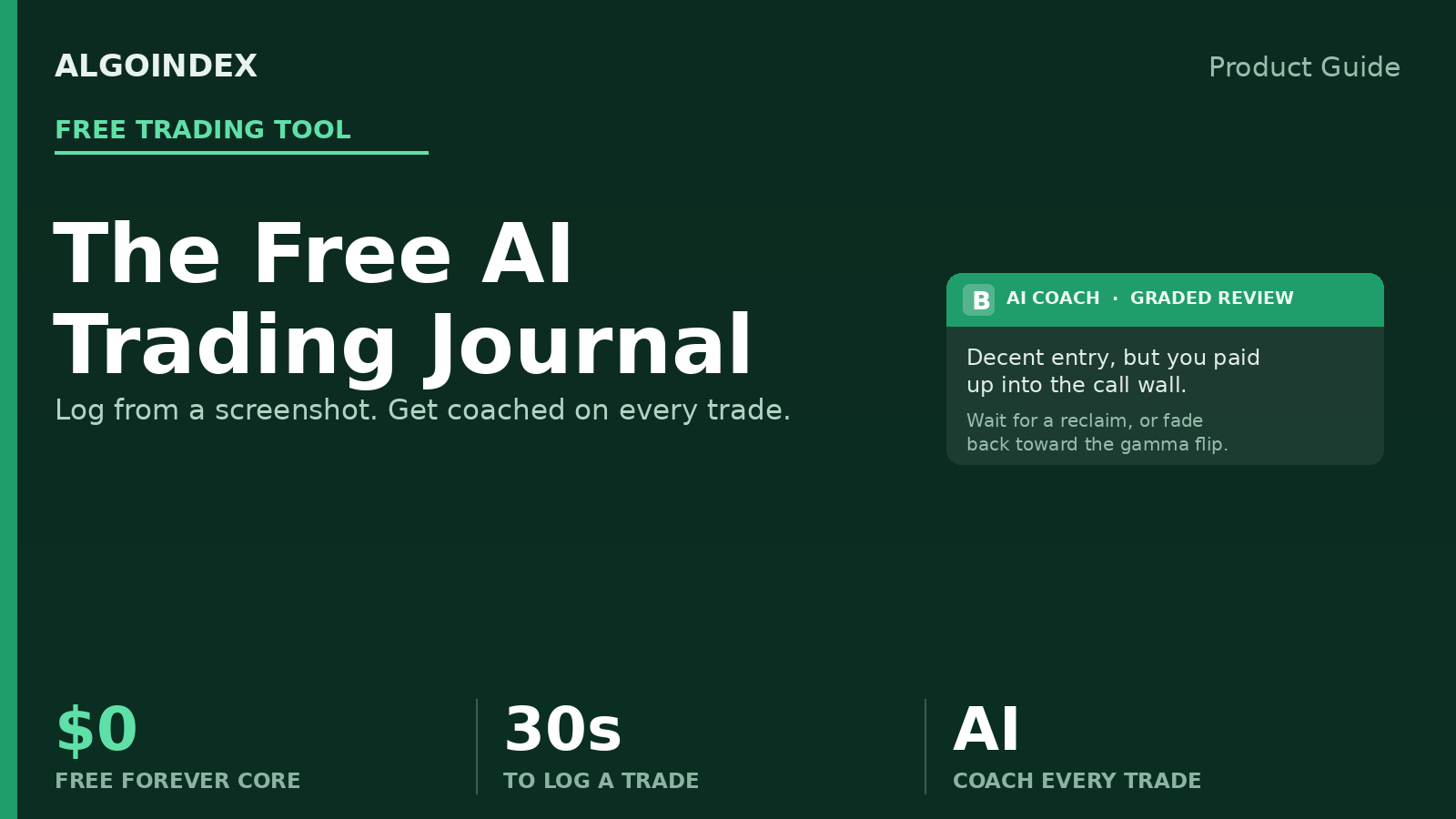
By the time most traders sit down to write up a trade, the trade is already cold, and most never sit down at all.
The reason is friction. The standard trading journal asks you to export a broker statement, map columns into a comma-separated file, upload it, tag every position by hand, and only then look at a chart of your results. It is good software that mostly goes unused, because the work of feeding it competes with the work of trading. So the single most useful habit in the business, writing down what you did and why, quietly dies in a spreadsheet nobody opens.
We built the AlgoIndex AI Trading Journal to remove that friction entirely, and we made the core of it free, with no credit card. You log a trade by typing a sentence or dropping a broker screenshot, and an AI reads it and fills in the fields for you to confirm. Your win rate, profit factor, expectancy, average R, and equity curve update as you go. And on a paid plan, an AI coach grades every trade against dealer-positioning levels for that exact symbol and your own statistics, then tells you what to fix next time. This is the long version of what it does, why journaling is the cheapest edge in trading, and how it stacks up against the paid journals most traders already know.
The cheapest edge in trading
A trading journal does one thing that nothing else does: it turns a stream of individual trades into a measurable process. Any single trade is noise. A green day proves nothing and a red day proves nothing. What proves something is the shape of a hundred trades together, and that shape is invisible until you record it. A journal is where a vague sense that you trade well becomes a number you can defend or a problem you can fix.
The numbers that matter are not complicated, but most traders never see their own. Win rate is the share of trades that finish green. Profit factor is gross profit divided by gross loss, where anything above 1.0 means the winners outweigh the losers. Expectancy is the average dollar result you can expect per trade over time. Average R expresses each result as a multiple of the risk you took, so a trade that made twice what you risked is a plus-two-R win regardless of the dollar size. Together they answer the only question that matters: does your approach make money on average, and why.
None of this requires a subscription to be worth doing. It requires that the journal actually gets used, which is exactly where the standard products fall down.
Why most journals end up abandoned
The paid journals are capable tools, and the good ones do a lot. The problem is the on-ramp. Auto-import from a broker means connecting an account, granting access, waiting for a sync, and reconciling executions that do not always line up with how you think about a position. Manual entry means typing every field by hand. Comma-separated import means wrangling a file. Each path works, and each adds a tax to the one moment when the lesson is freshest, right after the trade. Pay that tax a few dozen times and the journal becomes the thing you will get to later, which is to say never.
There is a second, quieter failure. Even a fully populated journal mostly shows you what happened, not why it happened or what to do about it. It draws the equity curve and leaves the interpretation to you. For an experienced trader that is enough. For everyone still building a process, the blank space where the feedback should be is where the habit stalls a second time.
From fill to feedback, in three steps
AlgoIndex collapses the whole loop into something you can finish before the adrenaline fades. There are three steps, and the first one is the one that changes the habit.
The detail that matters most is small and deliberate: when the AI reads your screenshot or sentence, any field it cannot determine stays blank. It does not invent an entry price or guess a stop to fill the form. A journal is only as useful as it is honest, and a tool that fabricates the data you are trying to learn from is worse than no tool at all. The same discipline runs through the rest of the product.
Logging works for whatever you actually trade. Equities, options, futures, forex, and crypto all live in one journal, so a trader who runs SPY options in the morning and a crypto position overnight is not stitching two tools together. For options specifically, you pick the exact contract from a broker-style chain with bid, ask, mark, in-the-money shading, and the at-the-money strike marked, and the expiration is captured for you. That last piece sounds minor until you have tried to reconstruct which weekly you traded from a screenshot three days later.
The part no other journal has
Every journal can tell you what you did. AlgoIndex can tell you where you did it. We built the engine behind our public gamma-level tool, then pointed it at any optionable ticker you log. When you journal a symbol, the journal can show you where options dealers are positioned in that name: the call wall, the put wall, the gamma flip, the expected move, and the implied range. These are not traditional support and resistance lines drawn on a chart. They are the strikes where dealer hedging concentrates, and they describe where price tends to stall, accelerate, or pin.
The vocabulary is worth knowing because it reframes your own trades. The call wall is the strike with the largest call-side hedging, and it tends to act as resistance because dealers sell into strength as price approaches it. The put wall is the same idea on the downside, the strike with the largest put-side hedging, where support tends to firm. The gamma flip is the level that separates a dampened, mean-reverting environment above it from a faster, trend-prone one below it. The expected move is how far the options market is pricing the name to travel. Put together, they tell you whether you bought into a ceiling, sold into a base of dealer demand, or took a trade in the calm zone where moves fade.
That context is what powers the AI coach, and it is what separates this from a journal that simply restates your results. The coach reads the trade you logged, pulls the dealer levels for that exact symbol, looks at your own win rate and average R on that kind of setup, and grades the trade on process rather than profit. A winner taken in a bad location still gets marked down, because over a hundred repetitions the location is what compounds. The grade is specific, it is tied to the levels and your statistics, and it never invents data it does not have.
The grade is saved to the trade, so reopening it later costs nothing and the review compounds over a season the way the trades do. If you want to see how reliable the underlying levels are before you trust them, we publish a live accuracy study of the same engine on our gamma-level accuracy tool.
How it compares to the journals you know
The established journals are good at what they do, and several have been refined over years. The honest comparison is not that they are bad. It is that they start behind a paywall, they lean on file imports and broker syncs to get data in, and none of them bring options dealer-positioning into the journal itself. AlgoIndex starts free, logs from a sentence or a screenshot, and adds the dealer-level context as the thing the coach grades against.
| AlgoIndex | TradeZella | Tradervue | Edgewonk | TraderSync | |
|---|---|---|---|---|---|
| Free tier | Full core, forever | Trial only | 30 trades/mo, stocks only | No | Trial only |
| Approx. paid price | Unlocks with any plan, from $89/mo | $29 to $49/mo | $29.95 to $49.95/mo | About $197/yr | Up to $79.95/mo |
| How you log | AI from text or screenshot | Broker sync, manual | Auto-import, file | Manual, file | Broker auto-import |
| Instruments | Stocks, options, futures, forex, crypto | Broad | Stocks free, rest paid | Broad | Broad |
| Dealer-gamma levels in journal | Yes | No | No | No | No |
| AI coach grades each trade | Yes, on levels + your stats | AI insights | Limited | Behavioral analysis | AI on top tier |
Read the table as a map of priorities rather than a scoreboard. If broad broker auto-import across hundreds of brokers is the single thing you need, TraderSync was built around that. If you want trade replay and backtesting in one place, TradeZella leans into those. If trading psychology and behavioral patterns are your focus, Edgewonk has spent years there. If you simply want a zero-budget place to log a handful of stock trades a month, the Tradervue free tier still does that. What none of them does is open for free with full analytics, read a screenshot or a sentence instead of a file, and put dealer-positioning levels and a process grade on the exact symbol you traded. That combination is the reason we built our own.
What is free, and what costs money
We are direct about the line, because a free product that turns out to be a trial is just an ad. The core journal is free forever. The dealer-level context and the AI coach are the parts that unlock with a paid plan, alongside the AlgoIndex signals, automated execution, and daily institutional reviews that make up the rest of the service.
Who it is for
A new trader gets the most obvious benefit: a journal that is free and takes seconds to use is a journal that actually gets used, which is the whole point. An options trader gets the part no general journal offers, the ability to see whether a position was taken into a wall or in the calm zone, on the exact names being traded. A systematic trader gets clean, consistent analytics without maintaining yet another import pipeline. And a trader who already pays for one of the established tools gets a free second opinion, with a grade on process that most journals leave as an exercise for the reader. If you want to see how we hold our own analysis to the same standard, our published performance methodology shows how the strategy is tracked, and our evergreen guides on contract specifications and ES, SPX, and SPY are the kind of reference the journal sits alongside.
The trade you just took is the most honest data you will ever get about how you trade. The only question is whether it survives long enough to teach you something, and that comes down to whether logging it is easy enough to actually do.
Frequently Asked Questions
Yes. The core journal is free forever with no credit card: AI quick-add from text or a screenshot, full performance analytics with an equity curve, support for any instrument and any broker, and a broker-style option-chain picker. Paid plans add the dealer-positioning levels and the AI Coach.
How do I log a trade?Type a sentence describing the trade or drop a broker screenshot. The AI extracts the symbol, side, size, entry, exit, stop, and times for you to confirm. Any field it cannot determine stays blank and is never guessed.
Do I need to connect my broker?No. Logging works from a sentence or a screenshot, so there is no broker connection, no file import, and no sync to set up. You can start journaling in about thirty seconds.
What can I journal?Equities, options, futures, forex, and crypto all live in one journal. For options you pick the exact contract from a real option-chain layout with bid, ask, mark, in-the-money shading, and the at-the-money strike marked, and the expiration is captured automatically.
What does the AI coach do?The AI Coach grades every trade on process rather than profit. It reads the trade, pulls the dealer-positioning levels for that exact symbol, looks at your own win rate and average R, assigns a letter grade, and gives a short list of what to do next time. The grade is saved to the trade so re-opening it later costs nothing.
What are call wall, put wall, and gamma flip?They are dealer-positioning levels. The call wall is the strike with the largest call-side hedging and tends to act as resistance. The put wall is the strike with the largest put-side hedging and tends to act as support. The gamma flip is the level separating a dampened, mean-reverting environment from a faster, trend-prone one. AlgoIndex computes them for any optionable ticker you journal.
Start journaling in 30 seconds.
Create a free account, log your first trade, and see your numbers. No credit card.
Try the free AI journal →