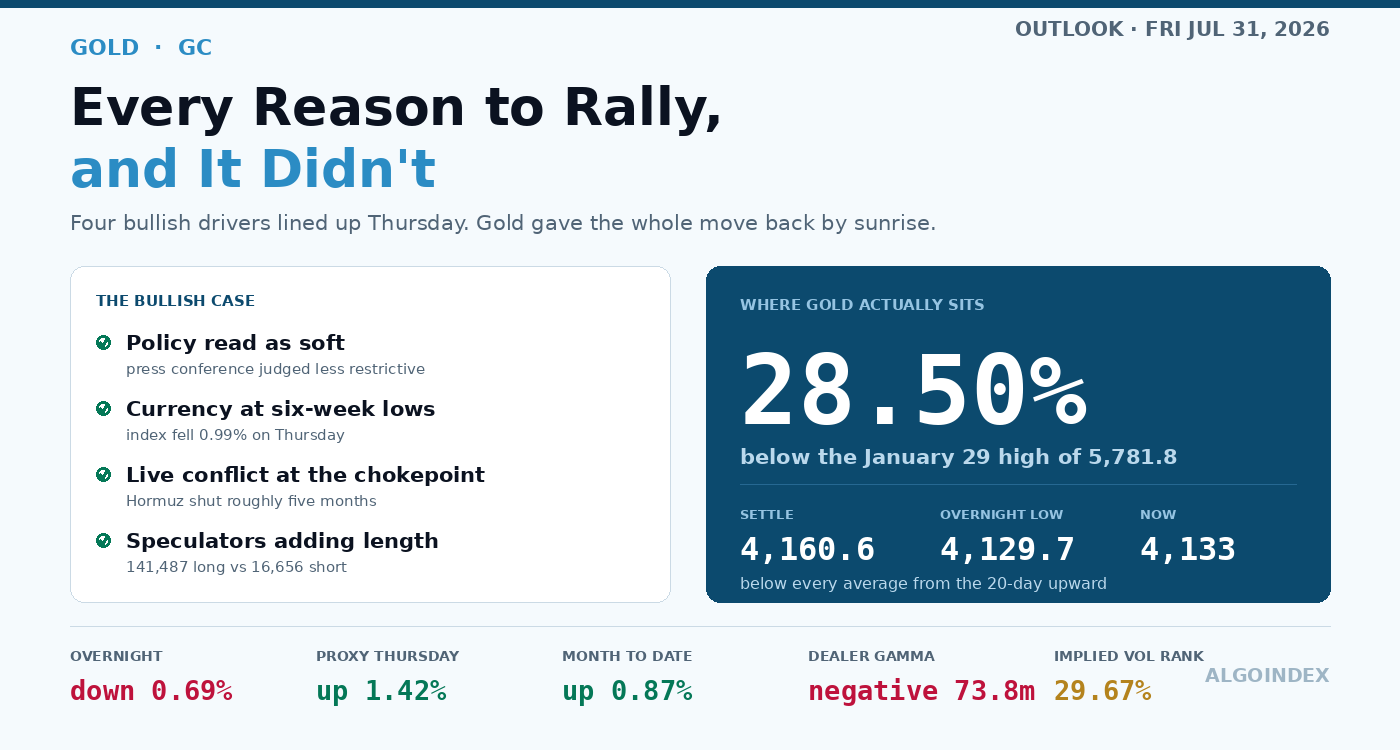
Thursday handed gold everything it is supposed to want. Policy read as soft. Growth came in short of what was forecast, income and spending were both light, and the currency finished at its weakest level in six weeks. The metal took 1.42 percent on its exchange traded proxy and put the December contract out at 4,160.6. Then it returned every point before sunrise.
Seven hours, and the whole move was gone
Globex reopened on 4,163.9, a shade over the settlement. Early buyers managed 4,170.7 and that was the whole of the ambition. Price has ground down since, marking 4,129.7 before settling into a tight corridor of roughly 4,132 up to 4,136. It changes hands near 4,133 as this is written, which is 28.6 points and 0.69 percent under Thursday's close. Volume across the reversal: 13,339 contracts.
Look at the last half-hour bar. It covers 4.8 points, a range of 4,131.0 up to 4,135.8. Even overnight that is unusually tight, and it says the selling has gone orderly. Total travel since the reopen comes to 41.0 points against a normal daily distribution of 81.3 on the fourteen-day setting. Barely half a session used.
None of it was random. The currency index has clawed back 0.32 percent to 100.180. Its cross against the yen has bounced 0.70 percent to 160.617, undoing part of the appreciation that came after what traders took for official Japanese buying during American hours. Silver is off 0.66 percent at 58.630. The whole metals sector is moving as one, so this is not something specific to gold.
Where it stopped is the detail that counts. This is the bottom edge of the overnight range, not its middle, and it has come to rest on a thick stack of technical support running 4,123 up to 4,134. The gains are gone. The open question is whether the base takes the weight.
A complete bullish case, and no response to it
This is the part that should trouble anyone carrying length. Assemble the argument and it looks close to airtight. A policy chief whose remarks landed softer than the market wanted. A currency at its lowest in six weeks. A live shooting war wrapped around the most consequential energy chokepoint on earth. Speculators building rather than shedding. Any one of those normally counts for something. Four at once should have this metal pressing higher with real conviction.
Instead: 28.50 percent under the 5,781.8 peak of January 29, under every average starting at the twenty-day, and freshly rejected at a session high with price returned to the base of its own range.
Eventual de-escalation is what this market is pricing, and it has decided the soft policy read was known and paid for some time ago. Strength here gets distributed into, at least until inflation-adjusted yields make a decisive move down or the diplomatic effort falls apart.
The geopolitical file sharpens the point. Roughly five months of a mostly shut Hormuz. Strikes on Iranian sites, which reporting says came without advance notice to Baghdad. A public threat that shipping attacks in the passage bring infrastructure targets in reply. A Houthi navigation ban aimed at Saudi Arabia. Drone hits on two vessels at Damietta, with Cairo rejecting in public a report that laid it at Iran's door. Gulf exports still impaired even as transit traffic rises. Against all of it, gold has bled roughly a quarter of its value.
Set against it is the negotiating effort, and that is being worked hard. Mediators have floated a pause in strikes lasting ten days, aimed at reviving an interim arrangement. Beijing has started a separate push that draws in Pakistan, and statements keep arriving that an agreement can be reached. Every increment of progress removes another slice of premium. That, and nothing more exotic, is how a metal manages to lose ground straight through a live regional war.
There is an asymmetry in that worth respecting. Talks collapsing would put the premium back quickly and violently. Talks progressing just extends the grind. The same de-escalation trade that has been draining gold is visible one market over in crude, where we walked through the crack-spread contradiction in our July 31 crude review. Sizing should account for a right tail heavier than the daily distribution implies.
What the policy meeting actually delivered
Wednesday's hold arrived on a 9 to 3 vote, with all three of the dissents wanting 25 basis points more. Voting that way against a hold does not happen often. Bank commentary put the run-up at the most uncertainty over a possible increase in something like thirty years, and judged the tone at the podium softer than the market's own baseline. Yields at the two-year point fell, the curve steepened, and the questions about credibility on inflation followed.
Thursday's data backed that read. Core consumption prices for June eased as forecast. Output in the second quarter came in light. Income printed 0.2 percent against an expected 0.3, spending 0.3 against 0.4, and May spending revised upward, 0.7 becoming 0.9. Claims added 9,000 to reach 197,000, which beat the 200,000 penciled in and says the labour market is holding. From here the path is characterised as a long hold.
Both directions cut here. An authority read as relaxed on inflation lifts expectations, which helps the metal. Three votes for tightening, though, means the hawkish bloc is organised and audible, and a correction toward firmer language would lift inflation-adjusted yields and push gold the other way. The tension has not resolved and it is the main medium-term uncertainty.
The structure underneath
The average configuration is bearish everywhere past the very short term. Fifty-day at 4,280.6, a hundred and forty-eight points overhead. Then 4,558.9 on the hundred-day, four hundred and twenty-six above, and 4,620.7 on the two-hundred, four hundred and eighty-eight above. The year's average sits higher still at 4,718.5. Their ordering is fully developed bearish alignment, and price beneath all three confirms both the intermediate and the long trend still point down. Only the five-day at 4,125.3 and the eighteen-day near 4,123.0 sit below, with the twenty-day at 4,133.6 sitting right on the market. First real hurdle above is the forty-day, at 4,202.7.
Momentum splits by horizon. Raw stochastics on the nine, fourteen and twenty-day settings print 45.49, 54.50 and 44.71 percent, every one of them neutral. Push out to fifty days and the reading is 17.48; at a hundred it drops to 8.57. Neutral across days, washed out across months. That pairing describes a fall that paused, not one that ended.
Relative strength on the fourteen-day window prints 46.62, under neutral, and 4,177.1 is the price that would carry it back to 50. Sitting almost on top of that is a 4,177.9 retracement, and together they build a well-defined shelf. Direction leans lower on every period from nine days out to a hundred without a single exception, though nine-day strength has slipped down to 19.37 and its two lines now sit close to level. Consolidation within a downtrend, not fresh selling.
Volatility is compressing, and the options are cheap
Every window is contracting. True range prints 85.9 points at nine days, 92.5 at fourteen, 98.3 at twenty and 113.3 at fifty. Daily range repeats the pattern: 81.1, then 81.3, then 84.2, then 101.9. Historic volatility of 19.21 percent on the fourteen-day setting sits against 26.93 out at a hundred days, better than a quarter of compression.
Options on the proxy fund are priced accordingly. Implied volatility over one month prints 22.38 percent; realised prints 21.18, so the premium is 1.2 points and no more. Rank sits down at 29.67 percent, the lower third of its own year, with a variance-model reading of 13.72 and skew at 22.13. What is priced in is a 5.24-dollar move on the fund, near enough 1.39 percent, which converts out to some 57 futures points. Well under the 81.3 that this contract actually travels.
Dealer hedging exposure is net negative. On the call side it reads negative 132.16 million; on the put side, positive 58.37 million. Net, roughly negative 73.8 million. When that measure is negative, hedging travels alongside price instead of leaning on it, so rallies get chased and declines get pressed. However this compressed range breaks, the opening leg gets amplified instead of absorbed. Structurally, nothing about Friday matters more.
Participants are positioned for upside. Calls traded 168.43 thousand against 57.28 thousand in puts, a ratio of 2.94, and open interest between the two runs 0.51. Inexpensive options that price a below-average day into a negatively hedged book make an asymmetric setup, and the answer is to own defined risk rather than sell it. Both hedging concentrations sit out at the September 17 expiry, far enough away that nothing near-dated can pin price into the bell.
Where Friday gets decided
Nine points overhead sits the pivot, and it is what divides a bearish day from a neutral one. The four-week midpoint follows immediately. Then the band that decides things, where a computed target and Thursday's close arrive together just under 4,161. Take that back and hold it and the overnight reversal is undone, with the soft-policy repricing back in charge.
Above that the ceiling thickens quickly: a short-term threshold, then the overnight high that sellers actually defended, then a crossover stall, and then the shelf near 4,177 where a momentum midpoint and a retracement land together. Trading sustainably through that pairing would be the first honest evidence of a change in character. Beyond it the deviations stack up and the forty-day average waits at 4,202.7.
Beneath is denser and much closer. A first deviation and the nine-day average both sit essentially at the market. Under them, the overnight low, then a stochastic midpoint, the eighteen-day average and a second deviation stack up into a grouping that runs 4,122 through 4,134. That grouping is what keeps the session contained. Give it up and a retracement, a third deviation and a stall level lead down to the first proper support, 4,103.7.
Lose 4,103.7 and the distribution widens materially, first toward 4,082.3 where a threshold meets the convergence stall, then through two minor shelves to second support. Under those come the July structural lows, and 4,015.6 is the one that counts. Break it decisively and the primary decline restarts. Nothing else on the board carries that weight.
A liquidation angle sits underneath all of it. As of July 21 managed money carried 141,487 contracts long against 16,656 short, and it added to that length while price was falling. A growing long book under every major average is precisely the arrangement that turns a slow Friday into a fast one the moment the base fails.
The trade
Short, and on a failed retest rather than chasing a break. The zone runs 4,152 up to 4,162, and it wants rejection instead of first touch: a completed half-hour bar that cannot hold over the settlement. Stop goes at 4,178, above both pieces of the shelf, which puts it out of reach of noise and leaves only a genuine reclaim able to trigger it.
Objectives step down through the structure: the overnight low first, about 27 points from the middle of the zone, then first support at roughly 53 points, then the stall band at some 75. Risk from a 4,157 midpoint is 21 points, so the three pay near enough 1.3, 2.5 and 3.6 to one. Close a half hour above the stop, or accept anywhere over 4,187.8, and it is finished.
The conditional alternative runs long. A flush down into the 4,105 to 4,120 pocket that holds, then reclaim the eighteen-day average inside two half-hour candles, and mean reversion is live. Behind that: intermediate stochastics deeply washed out, cheap optionality, calls outnumbering puts close to three to one, and the five-day average sitting inside the zone itself. Stop 4,095, under the stall. Objectives are the pivot and then the settlement, paying roughly 1.6 and 2.6 to one against 18 points of risk taken from 4,113.
Three reasons to skip it. An American open already under 4,110 means the move happened without you, and chasing into first support against negative hedging is bad risk. An open over 4,175 puts price above the shelf and kills the premise before the bell. And a span of under 25 points across the first ninety minutes says the day has no tradeable distribution in it, which an empty calendar can easily produce. Nothing before 09:45, nothing after 16:00, and in this contract the settlement at 13:30 is the real close.
Two windows, and a month ending
Not one American economic release lands on Friday. That absence defines the whole session and changes how it has to be handled. With nothing scheduled to anchor direction, the cue comes off the currency complex, off headlines, and off whatever month-end flow shows up.
First order is a Japanese central bank briefing, scheduled 01:00 ET and marked tentative. The yen has driven most of this week's dollar movement since the suspected official buying, and the dollar is what prices this metal. Firm language, or language that backs the intervention, strengthens the yen, leans on the dollar and carries gold back over 4,150. Passive language lets the currency's recovery run and puts the lower support band under direct pressure. Reporting earlier in July said the bank is open to moving quicker than its recent twice-yearly rhythm. Separately, Switzerland has signalled it expects zero to hold through 2027.
Second is a cabinet meeting at 10:00, also tentative, calendared in form while being genuinely unscheduled in substance. A remark on Iran, on the passage, on where the talks stand, and the risk premium reprices on the spot. With hedging exposure negative, anything headline-driven moves fast. Take the position beforehand with defined risk, or wait it out. Sitting on hands is entirely defensible.
The European pre-dawn is filled with second-order material that reaches gold only through the euro. Japanese housing starts arrive alongside the press conference, forecast 12.7 percent annually against a prior 33.9. German import prices follow, 6.0 percent expected where 6.8 came last, with the monthly figure at negative 0.7 against 0.7. Then Swiss retail sales against a prior 3.5 percent, and a French preliminary inflation read forecast at 1.8 percent domestically and 2.0 on the harmonised measure.
Note the shape of the day. This pit opens at 08:20 and closes at 13:30, well ahead of equities, and depth thins noticeably once it does. Direction usually confirms in the ninety minutes before that settlement, and that is also where month-end flow lands. Gold is up only 0.87 percent across July, so those flows should stay small, though they can still distort the last half hour. Treat the run into the settlement as a weaker signal than usual.
Past Friday the calendar refills. August 3 brings manufacturing surveys and prices paid. August 4 carries job openings, factory orders and the trade balance, plus an auction of thirty-year inflation-protected paper. Mark that auction now. It prints an inflation-adjusted yield directly, and that is the exact mechanism by which this market is being valued at the moment.
Base case is a contained two-sided day drifting modestly lower. Nothing on the schedule forces a repricing, month-end muddies whatever signal there is, and movement is compressing on every window. Call it 45 percent that gold oscillates roughly 4,110 to 4,165, rejects the upper band and keeps the base, finishing 4,120 to 4,145. Another 32 percent that the currency bounce extends, the overnight low and the eighteen-day average both give way, negative hedging amplifies the slide, long liquidation adds to it and price reaches for 4,082.3, finishing 4,085 to 4,105. The last 23 percent is the squeeze: supportive language at the press conference or a headline that the talks are deteriorating, a reclaim of the settlement, a clean break of the shelf, and an extension into 4,198 and possibly the forty-day average on a call-heavy book, finishing 4,175 to 4,200.
The complete data picture
Every number behind Friday’s plan, charted first; the full numeric reference follows underneath.
Full numeric reference , every remaining figure from the review
| December settlement | 4,160.6 |
| Exchange traded proxy | 371.00 to 376.25, a gain of 1.42 percent |
| Globex reopen | opened 4,163.9, high 4,170.7, low 4,129.7, near 4,133 at roughly 22:10 ET |
| Change against settle | down 28.6 points, or 0.69 percent |
| Overnight volume | 13,339 contracts |
| Overnight range | 41.0 points against a 14-day average daily range of 81.3 |
| Last half-hour candle | 4,131.0 to 4,135.8, a span of 4.8 points |
| Stabilisation band | 4,132 to 4,136 |
| Futures-to-fund conversion | approximately 10.98 to 1 |
| All-time high | 5,781.8 on January 29, 2026; price 28.50 percent below |
| Drawdown to June 30 | 5,781.8 down to 4,015.6, or 30.5 percent across five months |
| July range | 4,019.0 on July 17 to 4,276.2 on July 6, a 257-point band |
| Month to date | up 35.5 points, or 0.87 percent since June 30 |
| Five sessions | up 4.3 points, or 0.10 percent |
| Twenty sessions | down 52.6 points, or 1.26 percent |
| Three months | down 597.8 points, or 12.63 percent |
| Fifty-two weeks | up 638.4 points, or 18.26 percent |
| Above the July 2025 low | 19.11 percent above 3,470.7 |
| 52-week relative strength | 46.62, having fallen 2.03 |
| Weighted alpha | positive 5.30 |
| Open interest | 285,246 contracts |
| Swing pivots that would change the read | 4,276.2 above, 4,015.6 below |
| 5-day | 4,125.3 |
| 9-day | approximately 4,134.5 |
| 18-day | approximately 4,123.0 |
| 20-day | 4,133.6 |
| 40-day | approximately 4,202.7 |
| 50-day | 4,280.6, some 148 points above |
| 100-day | 4,558.9, some 426 points above |
| 200-day | 4,620.7, some 488 points above |
| Year-to-date average | 4,718.5 |
| Raw stochastic | 9-day 45.49 percent, 14-day 54.50 percent, 20-day 44.71 percent, 50-day 17.48 percent, 100-day 8.57 percent |
| Stochastic %K | 9-day 48.38, 14-day 52.86, 50-day 16.97, 100-day 8.32 |
| Stochastic %D | 9-day 45.87, 14-day 47.86 |
| 14-day relative strength | 46.62, returning to 50 at 4,177.1 |
| Directional index, 9-day | 19.37, lines at 17.02 and 18.49 |
| Directional index, 14-day | 28.52, negative 21.30 against positive 16.04 |
| Directional index, 20-day | 30.74, negative 23.21 against positive 15.37 |
| Multi-indicator composite | 24 percent sell; 56 percent a week ago, 16 percent yesterday |
| Composite internals | long term 67 percent sell, medium term 25 percent sell, short term 20 percent buy |
| Component signals | 7-day direction and 20-day versus price both buy; 20-to-50, 20-to-100 and 50-to-100 crossovers all sell |
| Average true range | 9-day 85.9 (2.10 percent), 14-day 92.5 (2.20 percent), 20-day 98.3 (2.40 percent), 50-day 113.3 (2.70 percent), 100-day 111.0 (2.70 percent) |
| Average daily range | 9-day 81.1, 14-day 81.3, 20-day 84.2, 50-day 101.9 |
| Historic volatility | 14-day 19.21 percent against 26.93 percent on the 100-day |
| One range band from 4,160.6 | roughly 4,068 to 4,253 |
| One range band from 4,133 | roughly 4,041 to 4,226 |
| 4,141.9 | the pivot |
| 4,147.6 | 50 percent of the four-week range |
| 4,158.9 / 4,160.6 | computed target price; Thursday's settlement |
| 4,166.7 | a short-term stochastic threshold |
| 4,170.7 | the overnight high |
| 4,171.9 | short-average crossover stall |
| 4,177.1 / 4,177.9 | where 14-day momentum returns to 50; 38.2 percent off the four-week high |
| 4,187.8 | one deviation and an 80 percent threshold |
| 4,198.9 / 4,199.1 | first resistance; two deviations |
| 4,202.7 / 4,207.7 | the 40-day average; three deviations |
| 4,218.3 | where the 18-day average stalls |
| 4,237.1 / 4,276.2 / 4,294.1 | second resistance; the one-month high; third resistance |
| 4,133.4 / 4,134.5 | one deviation support; the 9-day average |
| 4,129.7 | the overnight low |
| 4,124.5 / 4,123.0 / 4,122.1 | stochastic midpoint; 18-day average; two deviations |
| 4,117.3 / 4,113.5 / 4,109.9 | 38.2 percent off the four-week low; three deviations; a stochastic stall |
| 4,103.7 | first support |
| 4,082.3 | a 30 percent threshold and the convergence stall together |
| 4,073.0 / 4,061.2 / 4,046.7 | minor shelves; second support |
| 4,019.0 / 4,015.6 / 4,008.5 | the one-month low; the 13-week low; third support |
| Fund marks | 371.00 prior close, 376.25 now, up 1.42 percent |
| Call gamma | negative 132.16 million |
| Put gamma | positive 58.37 million |
| Net | approximately negative 73.8 million |
| Call volume | 168.43 thousand |
| Put volume | 57.28 thousand, a ratio of 2.94 |
| Put to call open interest | 0.51 |
| Implied volatility, one month | 22.38 percent against realised 21.18 percent |
| Implied volatility rank | 29.67 percent |
| Variance-model rank / skew rank | 13.72 percent / 22.13 percent |
| Implied move | 5.24 dollars on the fund, about 1.39 percent, roughly 57 futures points |
| Concentration | gamma and delta both at the September 17 expiry |
| Volatility inflection labels | 371 and 335 on the fund, roughly 4,074 and 3,678 on futures; low confidence, unused |
| Managed money | 141,487 long against 16,656 short; longs up 4,582, shorts up 530 |
| Managed money net | approximately 124,831 and growing |
| Non-commercial | 224,785 long against 40,875 short; longs cut 2,525, shorts up 247 |
| Commercial | 80,457 long against 293,656 short |
| Swap dealers | 24,959 long against 218,837 short; shorts reduced by 1,979 |
| Other reportable | 83,298 long against 24,219 short; longs cut by 7,107 |
| Dollar index | 100.180, up 0.32 percent overnight after falling 0.99 percent Thursday |
| Dollar-yen | 160.617, up 0.70 percent |
| Euro-dollar | 1.15129, down 0.14 percent |
| Broad equity index | 7,471.95, up 0.38 percent |
| Technology index | 28,368.40, up 0.92 percent |
| Equity volatility | 17.08, down 1.44 percent |
| Silver | 58.630, down 0.66 percent |
| Brent | 89.03, down 1.71 or 1.88 percent |
| West Texas Intermediate, September | 83.59, down 87 cents or 1.03 percent |
| Natural gas / gasoline / diesel | 2.7580 / 3.2847 / 4.2094 |
| Vote timing | the hold was announced Wednesday, July 29, ahead of the July 31 session |
| Committee decision | held on a 9 to 3 vote, all three dissents favouring a 25 basis point increase |
| Personal income | 0.2 percent against 0.3 percent expected |
| Personal spending | 0.3 percent against 0.4 percent expected; May revised to 0.9 from 0.7 |
| Initial claims | up 9,000 to 197,000 against 200,000 expected |
| Swiss National Bank | expects to hold at zero through the end of 2027 |
| Strait closure | approximately five months |
| Mediator proposal | a ten-day cessation of strikes |
| United States data | none scheduled |
| 01:00 ET | Bank of Japan press conference, tentative, first-order via the yen |
| 01:00 ET | Japanese housing starts, forecast 12.7 percent against a prior 33.9 percent |
| 02:00 ET | German import prices, 6.0 percent forecast against 6.8 percent; monthly negative 0.7 against 0.7 |
| 02:30 ET | Swiss retail sales, prior 3.5 percent |
| 02:45 ET | French preliminary inflation, 1.8 percent domestic against 1.8 percent prior; harmonised 2.0 against 2.0; monthly 0.3 against negative 0.3 |
| 08:20 ET / 13:30 ET | gold pit open / settlement |
| 10:00 ET | Cabinet meeting, tentative, headline risk on Iran |
| Following week | manufacturing surveys and prices paid August 3; trade balance, factory orders, job openings and a thirty-year inflation-protected auction August 4 |
| Entry | 4,152 to 4,162 on rejection, not first touch; no hold above 4,160.6 on a thirty-minute basis |
| Stop | 4,178, above the 4,177.1 momentum midpoint and the 4,177.9 retracement |
| Target 1 | 4,129.7, approximately 27 points from mid-entry, roughly 1 to 1.3 |
| Target 2 | 4,103.7, approximately 53 points, roughly 1 to 2.5 |
| Target 3 | 4,082.3, approximately 75 points, roughly 1 to 3.6 |
| Risk | 21 points from a 4,157 midpoint |
| Invalidation | a thirty-minute close above 4,178, or any acceptance above 4,187.8 |
| Trigger | a flush into 4,105 to 4,120 that holds and reclaims 4,123 within two thirty-minute candles |
| Stop | 4,095, beneath the 4,109.9 stall |
| Target 1 / Target 2 | 4,141.9 / 4,160.6 |
| Risk | 18 points from 4,113, paying roughly 1 to 1.6 and 1 to 2.6 |
| Path A, 45 percent | 4,110 to 4,165, rejects 4,155 to 4,171, holds the base; settles 4,120 to 4,145 |
| Path B, 32 percent | 4,129.7 and 4,123.0 both fail, extends toward 4,082.3; settles 4,085 to 4,105 |
| Path C, 23 percent | reclaims 4,160.6, clears the 4,177 shelf, extends toward 4,198 and possibly 4,202.7; settles 4,175 to 4,200 |
| Low band | 4,085 to 4,105 |
| Most likely | 4,120 to 4,155 |
| High band | 4,170 to 4,190 |
| Working range | 4,090 to 4,185, a 95-point span centred near 4,135 |
| Most probable close | somewhere between 4,115 and 4,145 |
| Overnight containment | 4,110 to 4,165 absent a currency surprise; a sustained break of 4,129.7 in European hours sets a negative tone |
| Four-week midpoint | 4,147.6, just overhead of the market |
| Morning recovery band | 4,147 to 4,162, where the midpoint, the computed target and the settlement converge |
| Lower support band under a passive tone | 4,122 to 4,129 |
| Skip conditions | an open below 4,110 or above 4,175; a range under 25 points between 09:45 and 11:00 ET |
| Session rules | no entries before 09:45 ET or after 16:00 ET; treat 13:30 ET as the practical close |