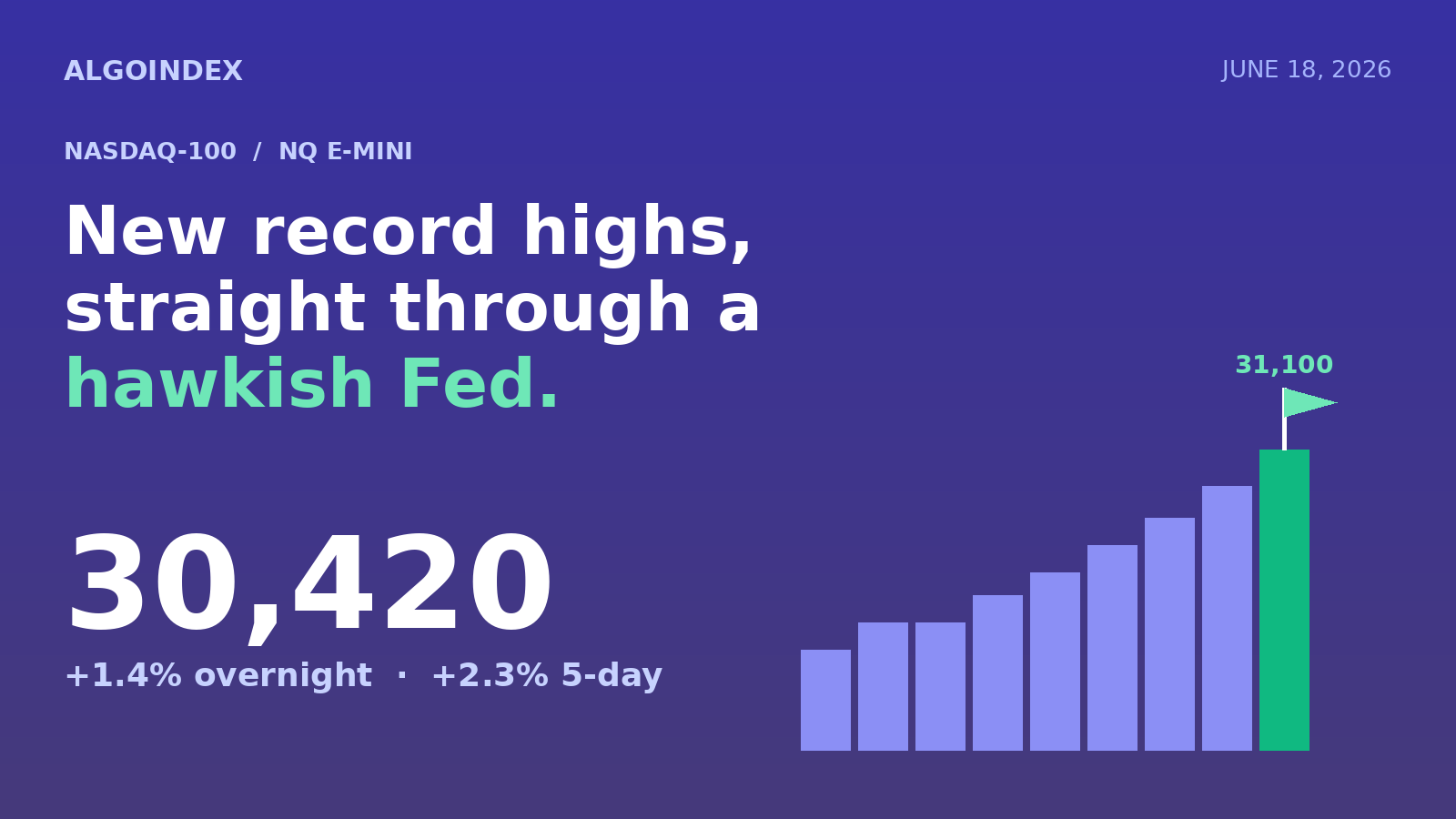
Yesterday the Federal Reserve told markets that nine of its eighteen members now see a rate hike before year-end. This morning the Nasdaq-100 is making new record highs anyway. That single fact, an index rallying straight through a genuinely hawkish policy shift, is the story of the session.
The E-mini enters Thursday near 30,420 on the continuous contract, with front-month NQU26 around 30,437, after an overnight advance of roughly 424 to 438 points, about plus 1.4% versus the prior settle of 29,998.75. Price gapped up to a 30,142.50 open and extended to an overnight high near 30,500, pushing back into fresh record territory after a five-day gain of about plus 2.3%. The overnight low printed at 30,096, holding well above the prior settle, an indication that the gap has so far been defended as support.
The dominant driver is the market's read of the policy decision, which on closer inspection was hawkish. The new leadership under Chair Warsh delivered a much shorter statement that removed the prior easing-bias language and committed the committee to deliver price stability. The updated projections shifted decisively: nine participants now expect a hike by year-end, the growth projection was cut to 2.2% from 2.4%, the core inflation projection was raised sharply to 3.3% from 2.7%, and the unemployment projection eased to 4.3%. That index futures rallied through that print is a meaningful signal of risk appetite, helped by optimism around artificial-intelligence productivity, relief that policy uncertainty has resolved, and continued geopolitical de-escalation.
A fully stacked, rising average set
The moving-average stack is fully bullish, with price above every major average and each average rising: the 5-day at 30,312.80, the 20-day at 30,185.63, the 50-day at 28,845.31, the 100-day at 27,001.18, the 200-day at 26,435.77, and the year-to-date average at 26,878.22. Price above all averages with the short averages above the long averages is the characteristic signature of an established uptrend. The 50-day sits roughly 1,500 points below spot, underscoring how extended the advance is on a longer horizon.
Momentum is firm but not yet at an extreme. The 14-day relative-strength reading is about 56.7, with the 9-day near 55.7. Stochastics are elevated but below the saturation zone, with the 9-day percent-K around 70.5 and the 14-day percent-K at 67.1. The directional trend measure is developing, reading about 25.9 on the 9-day and 24.4 on the 14-day, with positive directional movement above negative on both, confirming the bullish tilt. The multi-indicator composite reads 72% buy overall, strengthening sharply from 48% a session ago, while the standalone trend signal is neutral, a small note of caution amid the otherwise bullish set.
Where the magnets sit
The first overhead marker is the computed first-level resistance near 30,414, essentially at spot, then the overnight high and scalp resistance band around 30,495 to 30,500, reinforced by the two-standard-deviation band at 30,521. The next shelf is the three-standard-deviation band at 30,638, then the second-level resistance at 30,830 and the supply marker near 30,972. The major overhead objective is the third-level resistance at 31,076, sitting right at the recent high of 31,100. Immediate support is the one-standard-deviation marker near 30,368, then the computed pivot at 30,168.75 and the overnight low at 30,096, with deeper supports at 29,753, 29,507, and the one-month low at 28,508 that would mark a meaningful trend change if revisited.
The dealer-positioning context favors a controlled grind. Index-level markers sit at 29,200, 30,000, 30,400, and 30,500, with the 30,400 to 30,500 zone the nearest overhead positioning magnet, aligning with the overnight high. On the Nasdaq-100 fund proxy, last near 729.78, key strikes sit at 700, 720, 730, and 740, with high-agreement concentration around 740 to 755. The prior desk note framed the index at the upper end of its positioning range with subdued implied volatility, an environment that favors a controlled grind higher and pinning behavior near the large overhead strikes rather than a violent expansion. Translated to the futures, that supports buying dips while respecting that 30,500 may cap the first test.
The conditional path is a momentum-continuation long: if the cash open holds above 30,500 after the opening range, a continuation targets 30,830 and the 31,076 to 31,100 confluence, with a stop back below 30,400. The base case across the day breaks down as a roughly even split between a pullback-and-go-higher path near 50% and a direct momentum continuation near 30%, with a failed-gap rotation toward 29,750 the 20% tail. The principal threat is the hawkish policy backdrop itself: with the core inflation projection raised to 3.3% and the new leadership emphasizing price stability, any upside inflation surprise or hawkish remark can trigger a sharp unwind given how extended the index is near record highs.
The macro calendar today is secondary to digesting the policy decision. The Bank of England held its rate at 3.75% with a vote split of no members for a cut, seven for unchanged, and two for a hike, and the Canadian Business Barometer printed 49.6. With no single-name technology earnings event dominating, leadership is a function of broad demand for the largest growth names and continued enthusiasm around the artificial-intelligence capital-spending theme, which is why the Nasdaq-100 outpaced the S&P 500 yesterday by 1.4% to 0.7%.
AlgoIndex publishes computed levels and dealer-positioning context for every session. Review the performance statement, compare strategies on the pricing page, and track every entry against the levels with the free AI Trading Journal.
Latest session: The Day the AI Trade Cracked: Nasdaq-100 After a 7% Chip Rout →
Foundational guides
New to Nasdaq 100 futures? Start with What Are NQ Futures, the ES, NQ, MES & MNQ point value and contract specs, QQQ gamma exposure (GEX), and market internals: TICK, ADD, VOLD and VIX.