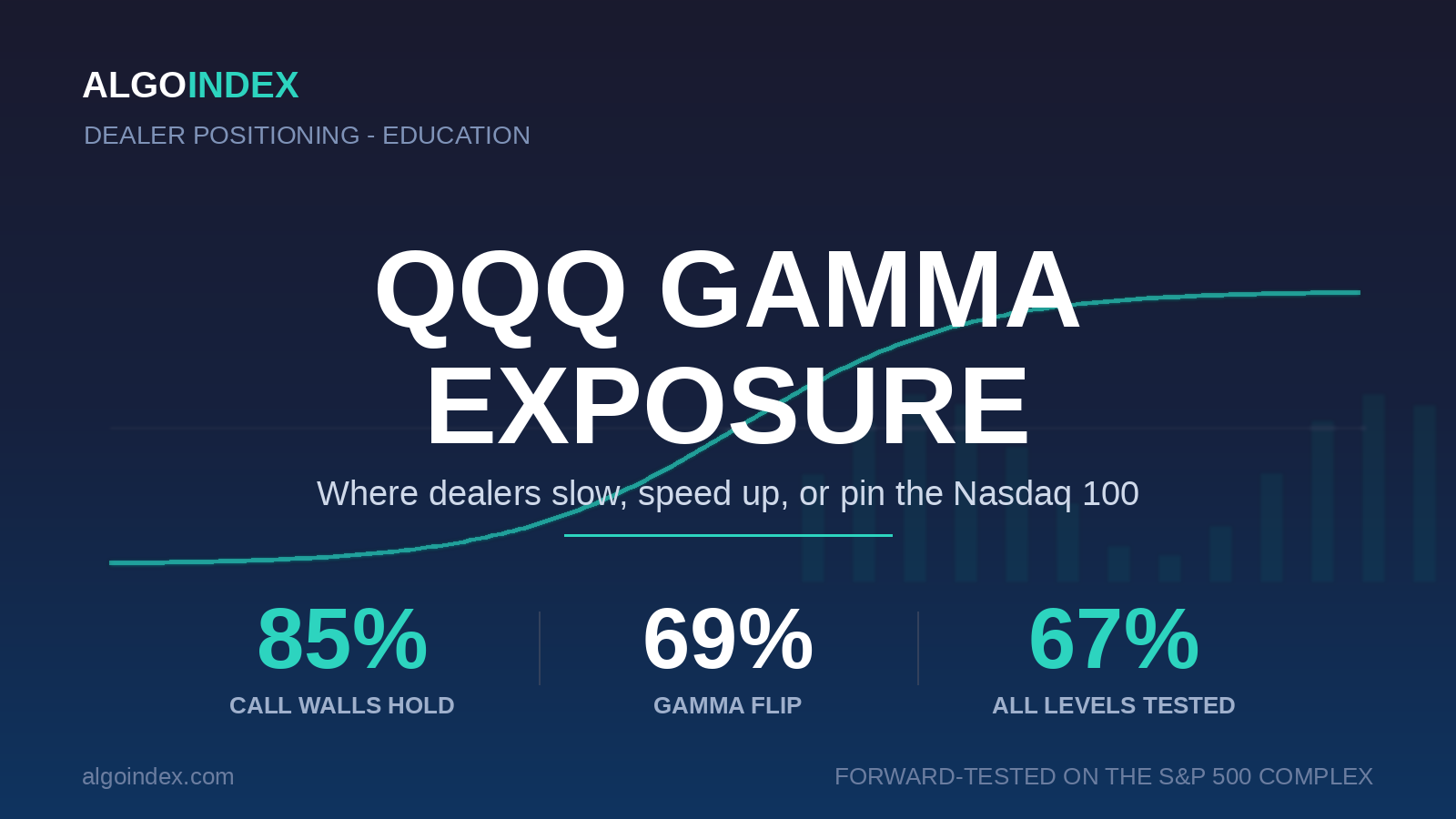
QQQ gamma exposure measures the total options gamma that dealers, the market makers, hold across all strikes on the QQQ ETF, which tracks the Nasdaq 100. It maps where dealer hedging is likely to slow the index down, speed it up, or pull it toward a strike. In positive gamma, dealers buy dips and sell rallies, so QQQ tends to compress and mean-revert. In negative gamma, dealers chase the move, so ranges expand. Reading QQQ gamma tells Nasdaq and NQ futures traders where price is most likely to stall or accelerate.
What QQQ gamma exposure really measures
Every options contract a dealer sells leaves that dealer with a hedging job. To stay neutral as the Nasdaq 100 moves, dealers buy and sell the underlying, and the size of that hedging depends on gamma. QQQ gamma exposure adds up that hedging pressure across every strike and expiration on the most heavily traded Nasdaq ETF. The number tells you which side of the market dealers are on and how hard they will lean.
The Nasdaq 100 is more concentrated than the S&P 500, with a heavier weight in a handful of large technology names. That concentration makes QQQ options flow especially worth watching, because a single mega-cap earnings move can swing the whole index gamma profile in a session.
Positive gamma versus negative gamma
When dealers are long gamma, they are a stabilizing force. They sell into strength and buy into weakness, which dampens volatility and tends to pin QQQ inside a range. Quiet, two-sided sessions that fade their own extremes are the signature of positive gamma.
When dealers are short gamma, the opposite happens. They buy strength and sell weakness, which removes liquidity and amplifies the move. Trend days and sharp afternoon extensions on the Nasdaq usually stem from negative gamma. The level where the index crosses from one state to the other is the gamma flip, and it is the single most important line on the map.
The three QQQ levels that matter
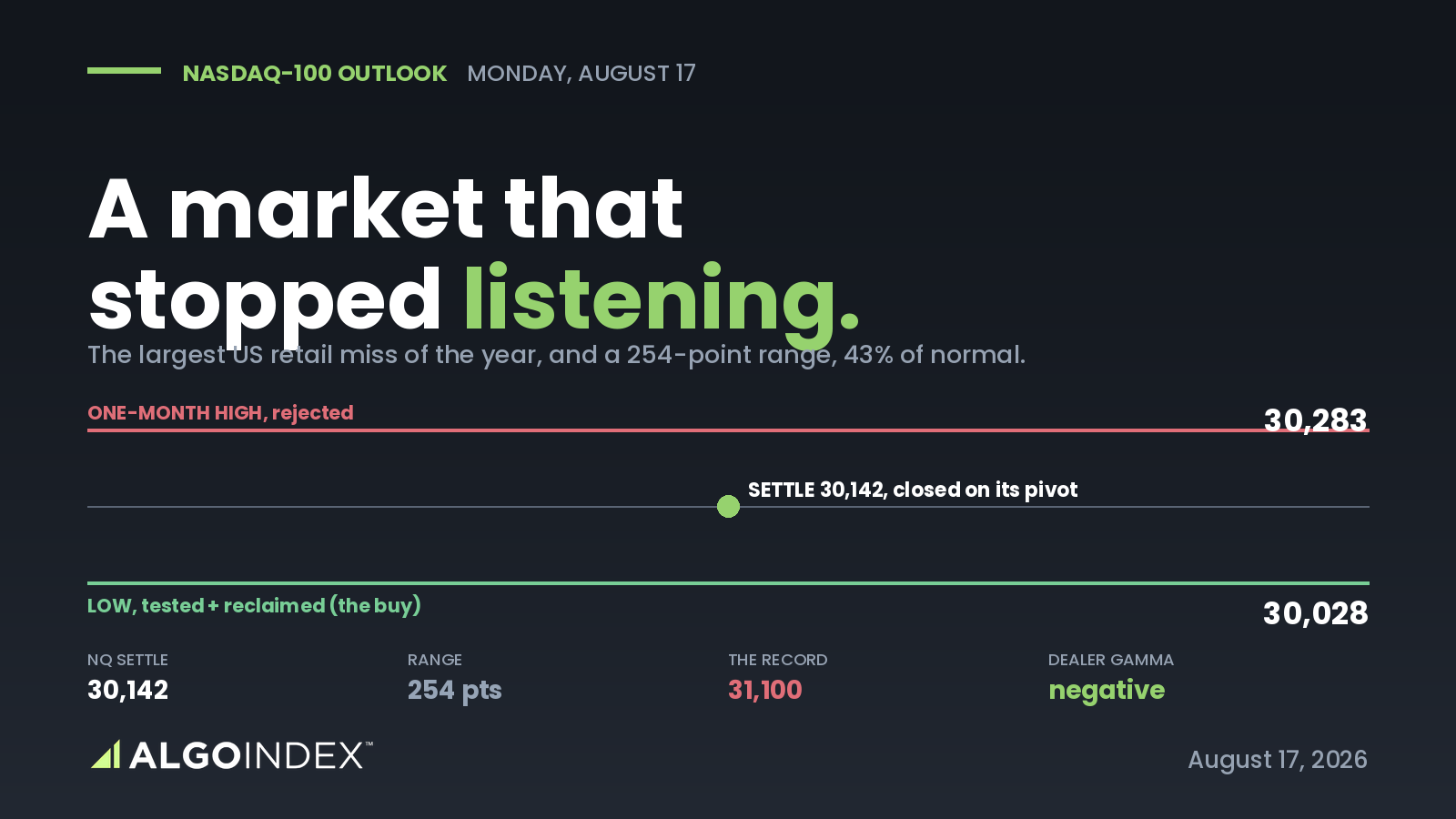
Three dealer-positioning levels do most of the work intraday. The call wall is the strike with the heaviest call gamma above price; it tends to act as resistance and a magnet, because dealer hedging there caps upside. The put wall is the heaviest put gamma below price; it tends to act as support, the level where downside hedging slows a sell-off. The gamma flip is the line between positive and negative gamma: above it, expect calmer, mean-reverting trade; below it, expect faster, more volatile trade.
Do these levels actually hold? We measure it
Most QQQ gamma pages show you the numbers and stop there. The harder question is whether the levels do anything when price arrives. We forward-test that, publicly, on the S&P 500 complex, and the early data is clear: across 295 tested levels over the first weeks of tracking, dealer-positioning levels held about two times in three when price reached them, with call walls holding roughly 85 percent of the time and the core gamma-flip area near 69 percent. The dealer-hedging mechanics that produce those results on the S&P are the same forces that set QQQ levels, because the same dealers are hedging both. You can see the live S&P numbers on our Gamma Level Accuracy Tracker.
How to trade QQQ gamma, and the NQ link
Start every session by locating QQQ relative to its gamma flip. Above the flip in positive gamma, favor fading the extremes toward the call wall and put wall and expect a contained range. Below the flip in negative gamma, respect momentum, because dealers are amplifying the move rather than fighting it.
For futures traders, QQQ gamma is a direct read on NQ. QQQ and NQ both track the Nasdaq 100, so the call wall, put wall and gamma flip you read on QQQ options map onto NQ price. We trade the Nasdaq through NQ futures using exactly this dealer-positioning map, which is why we publish the levels and then score whether they held. For the contract itself, see our guide to NQ futures, and for the mechanics, our dealer gamma positioning guide.
Frequently asked questions
Both measure dealer hedging pressure, but QQQ reflects the Nasdaq 100, which is more technology-concentrated and often more volatile, while SPX reflects the broader S&P 500. QQQ gamma can shift quickly around large technology earnings.
Above the gamma flip, dealers dampen moves, so QQQ tends to mean-revert and you can fade the extremes. Below it, dealers amplify moves, so you respect momentum instead of fading it.
Yes. QQQ and NQ both track the Nasdaq 100, so QQQ's call wall, put wall and gamma flip line up with NQ price levels, making QQQ options gamma a practical map for trading NQ.
They are probabilistic, not guarantees. We forward-test S&P levels publicly and they hold roughly two times in three, with some level types far more reliable than others, which is why we publish the hit rates instead of asking you to take them on faith.
Related guides
- Call Walls and Put Walls: Do They Hold?. The two strikes where dealer gamma concentrates, forward-tested.
- What Is Gamma Exposure (GEX)? for ES Futures. How dealer gamma sets the call wall, put wall and gamma flip.
- What Is Dealer Gamma Positioning?. Why dealers buy weakness and sell strength.
- ES, NQ, MES & MNQ Contract Specs & Point Value. Point value, tick value and margin for every contract.
- What Are NQ Futures?. The Nasdaq 100 futures contract explained.
Related tools
- QQQ gamma exposure tool: the live version of this guide, with QQQ's call wall, put wall, gamma flip and max pain recomputed from the option chain each session and graded forward-only.
- SPY gamma exposure tool: the same live levels for the S&P 500 fund, useful for checking whether Nasdaq positioning is leading or lagging the broad market.