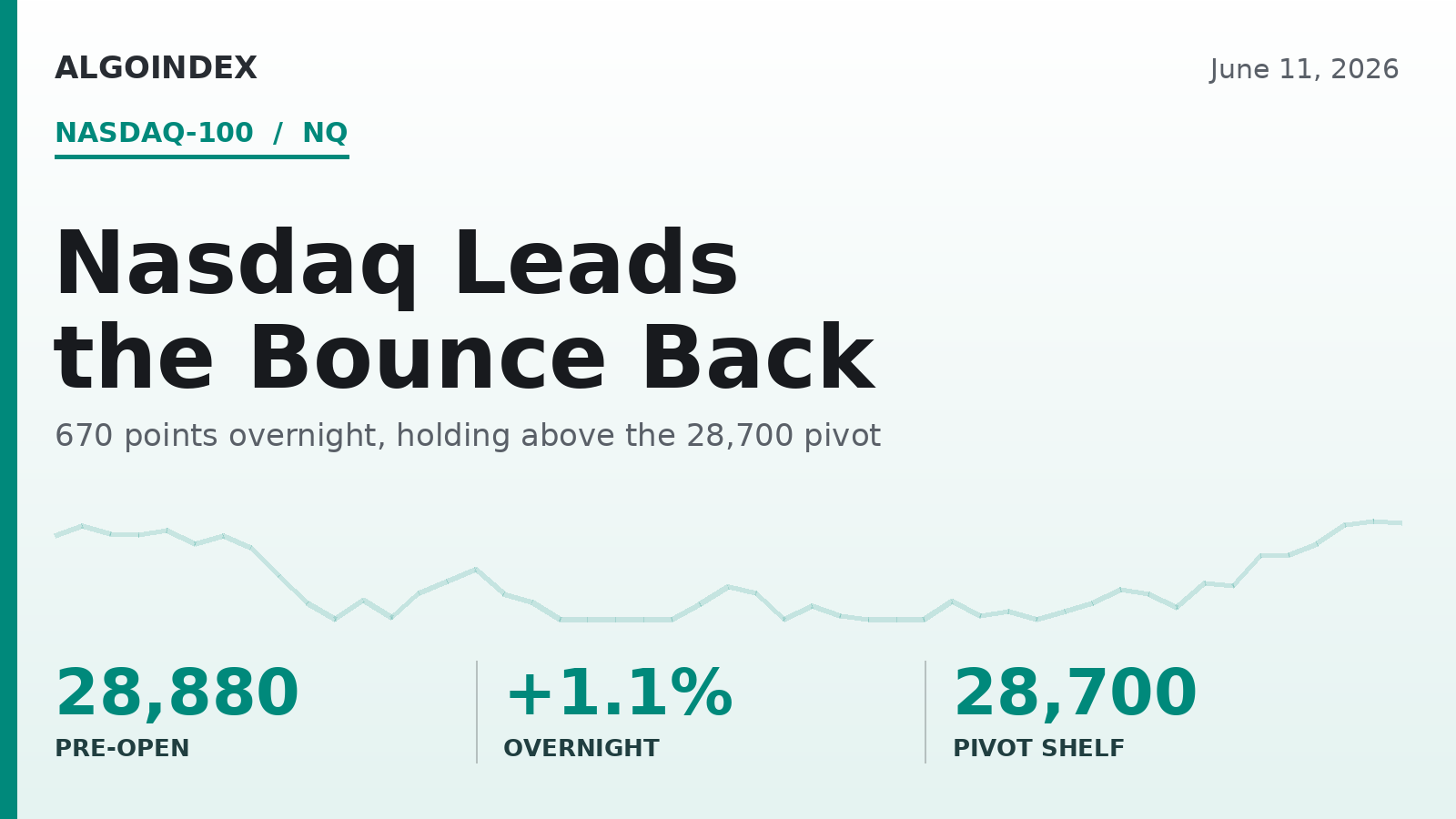
Overnight, the Nasdaq-100 traveled more than 670 points before most of America had finished its coffee.
The contract printed a low of 28,265.75, then buyers stepped in and drove it back to an overnight high near 28,936, a span that already approaches a full average day's range before the opening bell. NQ settled the prior session at 28,554 and now trades near 28,880 in the pre-open, an advance of roughly 1.1 percent that reverses a meaningful chunk of the previous day's broad selloff. Just as telling, the technology-heavy index is outperforming the broad market futures into the open.
That relative strength is the read worth holding onto. The prior session's weakness was driven by geopolitics rather than by prices, and this morning the volatility gauge is easing back toward 21, the dollar is flat, and yields are steady, the supportive mix that has let high-beta technology lead the rebound. NQ sits below its short-term averages after pulling back from the early-June high near 30,807, yet it remains comfortably above its 50-day, 100-day, and 200-day averages. The primary uptrend is intact. The bounce is real but unconfirmed.
A pullback inside a primary uptrend
The trend layers frame the situation cleanly. Against a reference near 28,880, the 5-day average sits at 29,008 and the 20-day at 29,681, both overhead resistance, while the 50-day at 28,010, the 100-day at 26,549, and the 200-day at 26,055 sit far below as distant support. Short-term averages are caps, longer-term averages are a cushion. The 28,700 to 28,742 area, where the daily pivot overlaps a 40-day average crossover, is the session's center of gravity.
The intermediate swing structure still shows a sequence of lower highs and lower lows off the 30,807 peak, the signature of a controlled pullback. The overnight rally carved the first higher low and a higher reaction high, an early change of character that needs a push through 28,936 and the 29,066 pivot to confirm. Until then, this remains a counter-trend bounce that has to prove itself, the same test we walked through when the chips carried it back earlier this week and during last week's shelf test into payrolls.
Momentum is climbing back toward neutral
The oscillator picture supports the bounce without yet signaling overheating. The relative-strength readings stair-step higher across timeframes, from 40.6 on the short window to 47.1 in the middle to 51.7 on the longer one, a steady recovery back toward and just past the neutral mark. The raw stochastic sits low and turning up, with room to run before exhaustion. The prevailing short-term momentum vector is still the downside leg the overnight rally is fighting, which is exactly why confirmation through 28,936 matters.
Buy the shelf, not the chase
The 28,700 to 28,742 pivot confluence is a high-quality structural support shelf for a long entry. A hold there favors a grind toward the 28,936 overnight high, then the 29,066 first pivot, with a stretch toward 29,300 to 29,400 if the broad market cooperates and chip and AI-infrastructure leadership shows up. A sustained loss of the 28,640 to 28,700 area shifts the structure back to the corrective leg and negates the long.
Two cautions belong on the desk. With more than 670 points of range already spent overnight, the base case skews toward a contained cash session that rotates around the pivot rather than a clean trend day. And the broad-market gatekeepers remain on a knife's edge, the read at the center of today's S&P session, so Nasdaq strength is best treated as a relative-strength trade within a fragile structure. That conditional framing is the backbone of our published performance methodology.
The index that fell hardest is now leading the way back, and the market is about to find out whether that means strength or just the loudest spring in the consolidation.
See how AlgoIndex turns this kind of level-gated read into systematic signals.
View pricing →Foundational guides
New to Nasdaq 100 futures? Start with What Are NQ Futures, the ES, NQ, MES & MNQ point value and contract specs, QQQ gamma exposure (GEX), and market internals: TICK, ADD, VOLD and VIX.