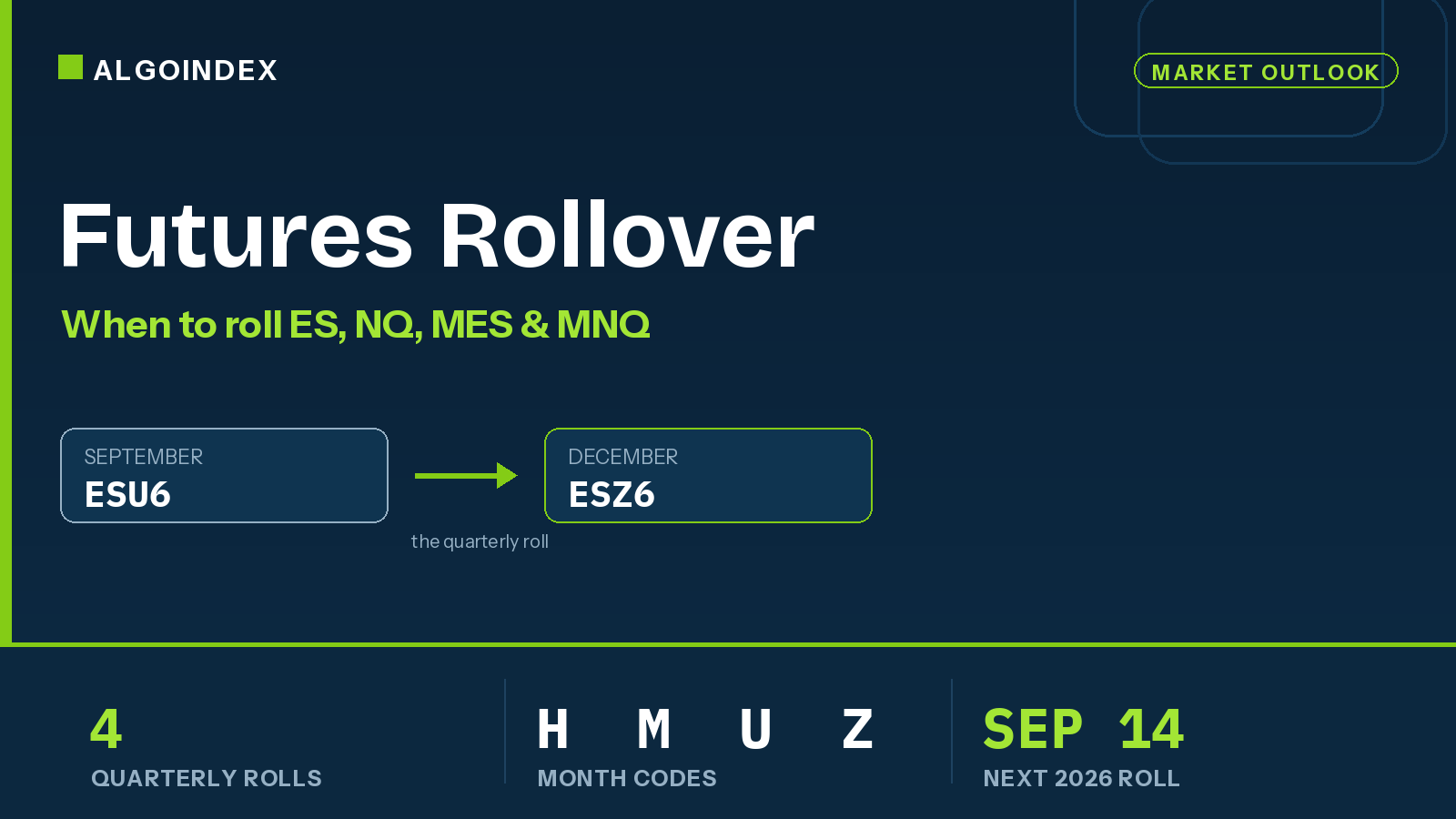
On Sunday evening, August 16, 2026, two E-mini S&P 500 contracts were trading on the same exchange screen. September ES, symbol ESU6, had recorded 17,167 contracts of delayed volume. December ES, symbol ESZ6, had recorded 430. September last traded at 7,809.25. December last traded at 7,875.75.
Both contracts were valid. Only one carried the active market. That gap is the whole subject.
The 66.50-point difference between them did not mean the S&P 500 had suddenly jumped 66.50 points. It was the price relationship between two separate expirations. The volume difference told the more useful story: the market had not rolled to December yet. Not close, in fact. The exchange quote page was showing September as the liquid contract, even though December was already available.
That's the central lesson of futures rollover. The calendar tells traders when to start paying attention. Volume and execution quality tell them when the move has actually happened.
For ES, NQ, MES and MNQ, the customary roll date is the Monday preceding quarterly expiration. In practice, many active traders switch when the next contract overtakes the expiring contract in volume and offers the better market. A trader with an open position can close it, carry it into settlement, or roll it by closing the current contract and opening the next one. A trader without a position still needs to switch symbols, charts, alerts and working orders at the right time.
This guide explains the full process, from contract codes to continuous charts, without treating the published roll date as a magic switch.
What futures rollover means
A futures contract has a defined expiration. ES, NQ, MES and MNQ do not remain the same instrument forever. Each quarterly contract is a separate agreement with its own symbol, price, order book, volume and open interest.
Rollover is the transfer of market activity, or an individual position, from the contract nearing expiration to a later contract.
The phrase is used in two related ways:
- The market rolls. Trading volume and liquidity migrate from the expiring contract to the next quarterly contract.
- A trader rolls a position. The trader closes the expiring contract and establishes an equivalent position in the next contract.
These events often happen during the same week, but they are not identical. The market can begin migrating while a trader remains in the old contract. A trader can also move early, before the later contract has become the liquidity leader.
The exchange introduction to contract roll describes three choices before expiration: offset the position, roll it into a later month, or proceed to settlement. ES, NQ, MES and MNQ are financially settled, so there is no delivery of shares. That doesn't make an accidental expiration harmless. Settlement can produce a result that differs from the last price seen on an ordinary intraday chart.
ES, NQ, MES and MNQ contract months
All four contracts follow the same quarterly month cycle:
The exchange publishes the full list of futures month codes. The year is added after the month code. In 2026, the main symbols are:
Some data systems display a four-digit year, such as ESU2026. Others use a one-digit year, such as ESU6. The instrument is the same if the exchange, product, month and year match.
The letters are easy to confuse when the screen is busy. M means June, not March. H means March. U means September. Z means December. Checking the full contract description before sending an order takes seconds and can prevent a position in the wrong month.
Readers who need the point value, tick value and contract-size differences can use the AlgoIndex guide to ES, NQ, MES and MNQ contract specifications.
The 2026 ES and NQ rollover calendar
The exchange lists a customary roll date and an expiration date for U.S. equity index futures. The roll date is generally the Monday immediately before quarterly expiration. The 2026 schedule is:
Source: 2026 equity index roll dates.
The June row is a useful warning against memorizing the usual Friday pattern and stopping there. In 2026, the listed June expiration is Thursday, June 18. The exchange calendar is the authority, especially when a holiday changes the usual sequence.
The published roll date is a planning date, not an order instruction. It tells a trader when the second-nearest expiration customarily becomes the lead month. It doesn't guarantee that every contract, every session and every broker display will switch at the same minute.
When should a trader roll ES or NQ?
For most active traders, the clean answer is:
Prepare on the published roll date, then trade the contract with the stronger volume, tighter bid and ask, and more reliable fills.
The exchange’s lesson on futures volume gives a practical test. Watch both the expiring contract and the next contract during roll week. When the later contract’s volume exceeds the old contract’s volume, activity has shifted.
That volume crossover is more useful than a fixed clock because liquidity migration can develop across sessions. It can also differ slightly among ES, NQ, MES and MNQ.
Use this order of evidence:
1. Check the official calendar
Know the customary roll date and the final trading date before the week begins. Add them to the trading calendar. A reminder set several sessions early leaves time to update symbols and review open orders.
2. Compare same-day volume
Place the expiring and next contracts beside each other. Compare actual contract volume, not a continuous symbol. The next contract becoming the volume leader is the clearest sign that the active market has moved.
Volume is not a direction signal. It does not say whether buyers or sellers are in control. Here it answers a narrower question: where are participants transacting?
3. Inspect the bid and ask
A liquid contract usually has a tighter spread and more dependable execution. The later contract may be tradable before it becomes the volume leader, but an active trader should ask whether the available price and displayed depth fit the order size.
4. Compare fill quality
The best contract is not simply the one with a large headline number. It is the one in which the intended order can be entered and exited without avoidable slippage. For small orders, both months may appear workable for a period. For larger orders, the difference can matter earlier.
5. Verify the chart and order ticket
The chart label, quote panel and order ticket should all show the same contract month. A correct chart paired with an old order ticket is a common roll-week error. So is a new order ticket paired with indicators calculated on the old contract.
Why the next contract trades at a different price
Two expirations on the same index can trade at different prices because they cover different periods of time. Financing costs and expected dividends are part of that relationship. The difference between the two contract prices is the calendar spread.
On the August 16 snapshot, ESU6 traded at 7,809.25 and ESZ6 at 7,875.75. The December contract was 66.50 points above September. That difference wasn't an instant market gain. It was the spread between September and December at that moment.
This matters when rolling a position. Suppose a trader is long two September ES contracts and wants to remain long through December. The roll consists of two linked actions:
- Sell two September ES contracts to close the existing long position.
- Buy two December ES contracts to open the replacement long position.
The new position starts at the December contract’s price. It is a fresh entry, not a continuation of the old one. The numerical gap between the two months shouldn't be recorded as an immediate trading loss. The old contract’s realized result and the new contract’s entry price remain separate. Commissions, fees and slippage are real roll costs; the full price difference between months isn't the same thing.
The exchange overview of futures spreads defines a calendar spread as buying one delivery month and selling another month of the same futures product. Traders and hedgers use that structure to move exposure from one expiration to another.
How to roll an open futures position
There are two common execution methods.
Method 1: Use a calendar-spread order
A spread order links the closing leg and opening leg. For a long position being rolled forward, the trade sells the old month and buys the new month. For a short position, it buys back the old month and sells the new month.
The advantage is control over the price relationship between the two contracts. It also reduces the time in which only one leg is filled. The quoted spread may use a sign convention that varies by order-entry system, so confirm the leg definitions before submitting it.
For a long September ES position rolling to December:
For a short September ES position rolling to December:
Before sending the spread, confirm quantity, ratio, order type and which leg is being bought. ES to ES, NQ to NQ, MES to MES and MNQ to MNQ are one-to-one rolls when the desired contract count stays the same.
Method 2: Execute the legs separately
A trader can close the expiring position and then open the later contract as a separate order. This can be simple for a small position in a liquid session. It also introduces leg risk. The market can move between the two fills, leaving the trader temporarily flat or exposed at a different price than intended.
If separate legs are used, the sequence should be decided before the first order. Confirm that the old position is closed, then verify the new symbol and quantity. Don't assume the first order filled completely because the price traded on screen.
A practical roll checklist for an open position
- Identify the exact current contract and quantity.
- Confirm the official roll and expiration dates.
- Compare volume and spread quality in the old and new months.
- Cancel working orders attached to the old contract if they will no longer be valid.
- Choose a calendar-spread order or separate-leg process.
- Check whether the position direction and quantity in the new month match the intended exposure.
- Rebuild protective orders on the new contract where needed.
- Save both fills and the spread price in the trading journal.
- Confirm the old contract position is zero.
- Confirm alerts and charts now reference the intended month.
What if there is no open position?
Rollover still matters to day traders who finish every session flat.
The main task is moving the trading workspace from the old month to the new one. That includes:
- Charts and watchlists
- Order-entry symbols
- Price alerts
- Saved bracket templates
- Volume profiles
- Session statistics
- Market-internals comparisons
- Automated rules that reference a contract symbol
- Journal tags and screenshots
An old contract can keep printing trades after the main volume has moved. The chart may look normal at first glance, yet its spread can widen and its movement can become less representative of the active market. A trader may then wonder why levels are not reacting as expected while the real answer is sitting in the symbol field.
If contract selection is part of a broader session routine, pair this guide with the AlgoIndex explanation of futures market hours.
Rollover and continuous futures charts
Continuous futures symbols solve one problem and create another. They join a sequence of expiring contracts into one long historical series. That makes it easier to view months or years of price action without loading each contract separately.
But a continuous chart is constructed. It is not one contract that traded forever.
There are several ways to join the series:
Front-contract series
A front-contract series follows the nearest expiration and switches according to a preset rule. The exchange’s continuous price series describes a front-contract method that changes two business days before expiration.
Active-contract series
An active-contract series follows the expiration with the strongest liquidity and switches based on historical roll behavior. This method can change earlier than a simple nearest-expiration rule.
Back-adjusted series
A back-adjusted chart modifies prior prices to remove the visible jump between contracts. It produces a smoother historical line, which can help with trend research. The tradeoff is that old displayed prices may no longer equal the prices that actually traded at the time.
Unadjusted series
An unadjusted chart joins the raw contracts without changing history. The gap between the old and new contract remains visible. That gap may reflect the calendar spread rather than a sudden move in the index.
No single construction is best for every task. Use the actual contract for execution and short-term order placement. Use a continuous series for longer historical context, then learn how that series selects and adjusts its contracts.
Why indicators can change on roll day
Moving from one contract to another can alter any calculation built from price or volume. That includes moving averages, volume profiles, average true range, anchored levels and prior-session references.
Three effects cause most of the confusion:
- The new contract has a different absolute price. A moving average on December ES will not necessarily match one on September ES.
- The contracts have different volume histories. A profile built on the new month may initially look sparse because less activity occurred there before the roll.
- A continuous chart may adjust old data. A level remembered from yesterday can appear at a different price after the series rolls and recalculates.
Before changing a trading decision because an indicator moved, check whether the underlying symbol or adjustment method changed. Keep screenshots labeled with the exact contract. If a level came from ESU6, record ESU6, not just “ES.”
This is especially important when comparing price with breadth measures. The AlgoIndex guide to TICK, ADD, VOLD and VIX explains what those measures represent. During roll week, make sure the futures side of that comparison is the active contract.
Does MES roll at the same time as ES?
MES follows the same March, June, September and December expiration cycle as ES. MNQ follows the same cycle as NQ. The ES contract specifications, NQ specifications, MES specifications and MNQ specifications all list quarterly months and financial settlement.
That shared calendar does not remove the need to check each order book. The volume crossover in MES can occur near the ES crossover, and MNQ often moves near NQ, but “near” is not a substitute for current volume. A trader executing MES should compare MES contracts. A trader executing MNQ should compare MNQ contracts.
The larger E-mini can still provide context because it is closely related to the Micro product. Execution, however, happens in the contract shown on the ticket. A liquid ES book does not guarantee the same spread or depth in a specific MES expiration at the same moment.
What happens if a position reaches expiration?
ES, NQ, MES and MNQ are cash settled. Trading in each quarterly contract normally ends at 9:30 a.m. Eastern Time on its listed expiration date, subject to the official holiday calendar and contract rules.
Final settlement uses a Special Opening Quotation, often called the SOQ. In the S&P 500 contract, the calculation uses the opening prices of the index components. Because individual stocks do not all open at the same instant, the SOQ need not match the index reading displayed at the opening bell.
The exchange’s final settlement procedures state that open expiring futures contracts are cash settled to the final SOQ. Nasdaq-100 futures use an opening-price process based on Nasdaq-100 components.
The expiration process is one reason an index futures contract is not interchangeable with an ETF share. AlgoIndex covers the wider structural differences in ES futures versus SPY.
This creates a specific risk: a trader who expected settlement near the last futures quote may receive a result tied to a later published opening calculation. Holding through expiration should be a deliberate choice supported by the contract rules, account permissions and a clear understanding of the settlement method.
For most short-term traders, the simpler choice is to close or roll well before termination.
Nine rollover mistakes that are easy to prevent
1. Switching only because the calendar says Monday
Monday is the customary date, but liquidity is the test. Compare both contracts before moving.
2. Waiting until expiration morning
By then, the old contract may have much less activity. There is also little room to correct a symbol or settlement misunderstanding.
3. Treating the roll gap as a market move
The new contract can trade above or below the old one. The difference is the calendar spread, not automatically a gain, loss, breakout or gap in the underlying index.
4. Updating the chart but not the order ticket
The chart can show the new month while a saved ticket still points to the old one. Read the full symbol before submitting.
5. Leaving working orders in the old contract
Stops, targets and resting limit orders do not necessarily move with the chart. Cancel or replace them intentionally.
6. Using a continuous symbol for execution
A continuous series is useful for analysis. Orders require a real, listed contract month.
7. Mixing E-mini and Micro quantities
One ES contract is not the same exposure as one MES contract. The same is true for NQ and MNQ. Recheck size if changing product as well as month.
8. Comparing volume from different sessions
Compare old and new contracts over the same session and at the same point in the day. Yesterday’s final volume in one month is not comparable with today’s partial volume in another.
9. Forgetting that data vendors can use different roll rules
Two continuous charts can switch on different dates or use different adjustments. A disagreement between charts may come from construction, not bad market data.
A simple roll-week routine
The following routine keeps contract selection separate from market direction:
Before roll week
Record the official roll and expiration dates. Add the old and new contracts to the same watchlist. Note the exact month codes. Review any open swing position and decide whether it will be closed, rolled or intentionally settled.
At the start of each session
Compare volume in both expirations. Check the bid and ask. Verify which contract the primary chart uses. Make sure alerts and working orders match it.
When the new contract becomes the volume leader
Move active trading to the new month if its execution quality is suitable. Save the old chart if it contains useful levels. Recreate only the alerts and orders that still make sense on the new contract’s price scale.
After the switch
Keep the old contract visible for a session if needed, but label it clearly. Confirm that no unwanted position or working order remains there. In the journal, record the contract code on every roll-week trade.
The routine is short because the decision does not need a prediction. The question is not whether ES or NQ will rise. The question is which listed contract now carries the market.
Futures rollover FAQ
What is the futures rollover date?
It's the customary date when trading activity begins moving from the expiring contract to the next expiration. For U.S. equity index futures, the exchange generally lists the Monday immediately before quarterly expiration. The actual liquidity shift should still be confirmed with volume and spread quality.
Is the rollover date the same as the expiration date?
No. The roll date normally occurs before expiration. That separation gives traders time to move positions and allows the next contract to become the active market.
When do ES and NQ futures expire?
The expiration cycle runs four times per year: March, June, September and December. Trading in the expiring contract ends at 9:30 a.m. Eastern Time on the listed expiration date, subject to exchange rules and holiday adjustments.
Can a trader hold ES or NQ through expiration?
An eligible account can hold a cash-settled position into expiration, but the result is based on the final settlement procedure, not simply the last price on an intraday chart. Account rules can be stricter than the exchange schedule, so confirm the broker’s cutoff.
Which contract should a day trader use during roll week?
Usually the contract with the higher same-session volume, tighter bid and ask, and better fills. Compare the exact products being traded. For MES, compare MES months. For MNQ, compare MNQ months.
Does rolling a futures position create a loss equal to the price gap?
No. The difference between expirations is the calendar spread. Closing the old contract realizes that contract’s result. Opening the new contract establishes a new entry price. Fees and slippage are costs, but the full gap between contract prices is not automatically a loss.
What does front month mean?
Front month usually means the nearest listed expiration. During roll week, the most active contract can become the second-nearest expiration before the front month actually expires. That is why “nearest” and “most liquid” can point to different contracts.
Should historical analysis use a continuous contract?
A continuous contract is useful for long-range analysis, but its roll and adjustment method must be known. Use the actual contract month for execution and for reviewing short-term fills.
Do MES and MNQ use different month codes?
No. They use the same quarterly month letters as ES and NQ: H for March, M for June, U for September and Z for December.
The decision in one sentence
Know the official date, watch the old and new contracts together, and move when liquidity moves.
The calendar gets the trader to the screen. Volume identifies the active market. The final check is the symbol on the order ticket.
That Sunday in August, December ES was open and moving, but September still had about forty times its volume. The later contract existed. The market had not moved there yet. Rollover is the discipline of knowing the difference.
AlgoIndex publishes institutional-grade reviews on ES, NQ, GC and CL, and runs an automated SPY options strategy on the same data. See the performance statement for how the strategy is tracked, then view pricing.