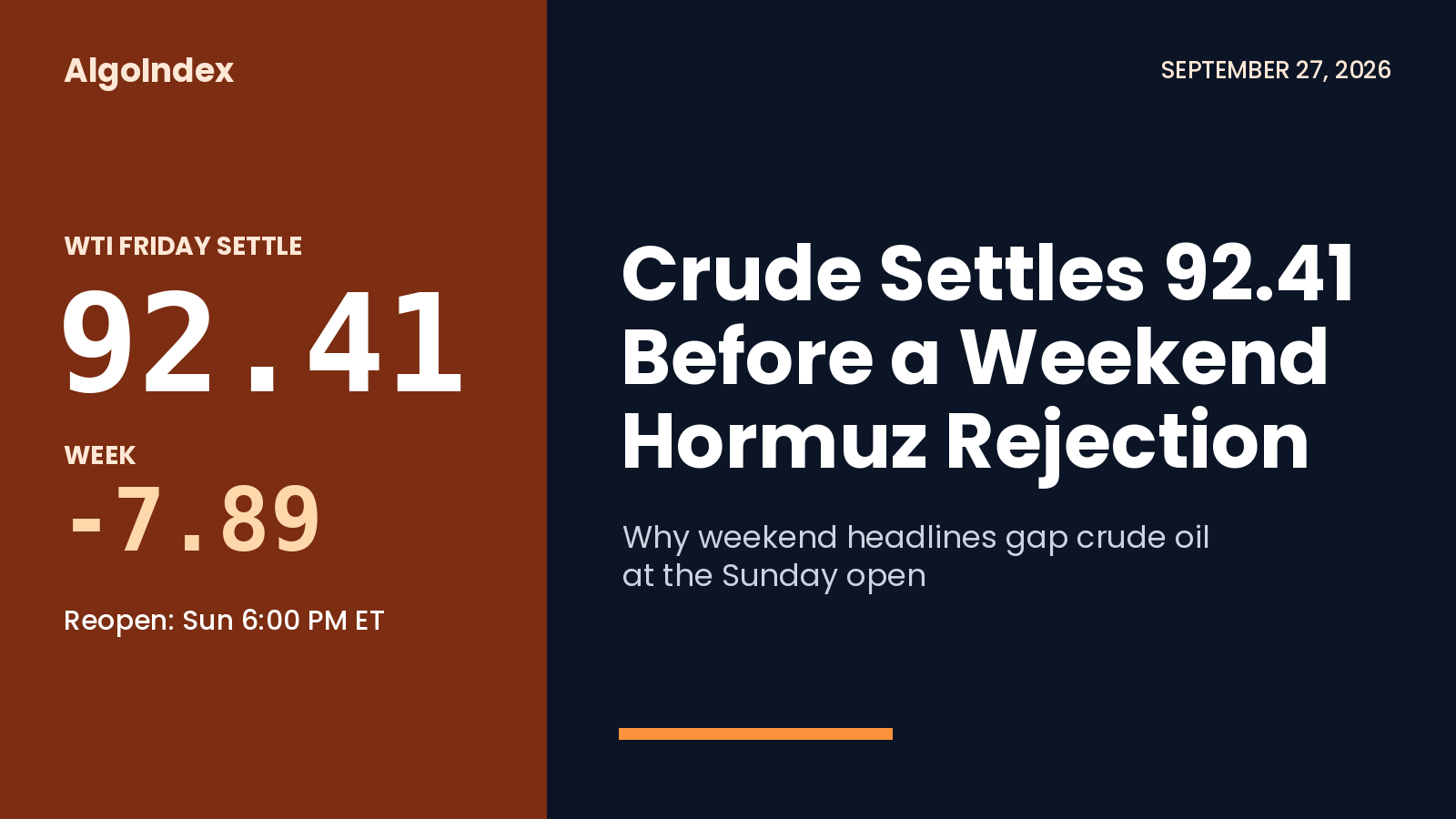
On Friday afternoon, crude traders sold the idea of peace. November WTI settled at 92.41 dollars a barrel, down 2.20 on the day. Against the prior Friday's front-month settle of 100.30, the benchmark showed a 7.89-dollar weekly drop, but that comparison spans the roll from the October to the November contract, and the incoming November contract traded well below the expiring October, so it overstates the same-contract decline. The trigger was hope. At the United Nations General Assembly, Iran's foreign minister, Abbas Araghchi, laid out a seven-day roadmap. The United States would release frozen Iranian funds, lift oil sanctions and end the naval blockade of Iranian ports. The Strait of Hormuz would reopen, with final talks starting by day seven.
A day later, the plan was dead. Speaking to reporters at the White House on Saturday, September 26, President Trump said the proposal "would not be acceptable" and argued Iran wanted a deal only "because they are losing so badly." Araghchi answered on social media that Iran "will not back down" and that Tehran would await the mediators' formal reply.
No futures market was open to price any of it.
A weekend gap happens when news lands while the exchange is shut, so the first trade on Sunday evening prints away from Friday's settle instead of walking there tick by tick. Crude futures reopen at 6:00 PM ET on Sunday. This weekend, the market carries a Friday price built partly on truce hopes into a Saturday headline that rejected the plan behind those hopes. The Friday settle at 92.41 and the Thursday settle at 94.61 are the two reference prices that frame the reopen.
Friday’s long from 93.80, measured against a 92.41 settle
The crude outlook we published for Friday leaned long from a 93.80 to 94.20 band around the 94.21 pivot, after Thursday's 94.61 settle. It named two lines. Acceptance beneath 93.06, defined as two consecutive 30-minute closes there with the 92.85 retracement also lost, removed the edge, and a settle beneath Thursday's 91.23 low negated the thesis outright. Friday settled at 92.41, 65 cents beneath 93.06 and 1.18 above 91.23. The settle alone does not show whether the two-close condition printed during the session, so this article records where price finished against the published lines and does not grade the plan. The full level map is in the Friday crude outlook.
Going into the reopen, the settle sits between those two lines, beneath the edge level and above the negation level.
A 2.33 percent Friday drop and an 11.91 dollar spread
Crude is a headline commodity with a physical choke point. Flows through Hormuz made up more than a quarter of global seaborne oil trade in 2024 and early 2025, according to the Energy Information Administration, so any change in the odds of the strait reopening feeds straight into the price of the next barrel. Stocks digest weekend politics through earnings expectations, a slow channel. Oil digests them through supply, a fast one.
The week just ended showed how much of the price was sitting on diplomacy. WTI dropped 2.33 percent on Friday alone. Brent, the international benchmark, fell 2.28 to 104.32 on the day yet still finished the week up 45 cents, because attacks on Saudi Arabia kept the seaborne market tight. That split widened the Brent to WTI spread to about 11.91 dollars. One barrel priced a deal. The other priced a war.
So the Friday settle was a bet on a phased agreement, placed with about two days of risk hanging over it. On Saturday that bet lost its main support.
The May precedent: 107.77 Brent by the May 12 settle
This has happened before. On Sunday, May 10, the President rejected Iran's response to a United States peace proposal and called it "unacceptable." When trading resumed, crude rallied. In Monday's session on May 11, Brent was up about 3 percent and WTI about 3.2 percent, with WTI briefly trading above 100 dollars. By the May 12 settle, Brent stood at 107.77 and WTI at 102.18, according to same-day settlement reports.
Two details from May are useful now. First, the move did not end at the open. It carried into a second session, because the rejection changed the path of the negotiations. Second, the back channels stayed open. Energy-trade commentary at the time noted that the two sides were still talking, and said the gap between them was as wide as when the ceasefire began. Prices can climb while talks continue. They did in May.
The setup this weekend rhymes. In the week before the May rejection, both benchmarks had fallen about 6 percent on hopes for an end to the conflict. This week the picture is split: front-month WTI finished lower, a comparison inflated by the contract roll, while Brent finished slightly higher.
Rates and trade: the week behind the gap
The weekend is only the first test. Rates run through the same pipe. The Federal Reserve raised its target range to 3.75 to 4 percent on September 16, and the 10-year Treasury yield ended Friday at 5.18 percent, near a two-decade high. Oil is a large part of the inflation story the Fed is fighting. That is why the August PCE report on Wednesday, September 30, at 8:30 AM ET, and September payrolls on Friday, October 2, at 8:30 AM ET, sit on the same page as the Strait. The S&P 500 futures outlook from Friday carries that rate side of the story.
Trade news landed across the week. Washington announced a two-month extension of the trade truce on Wednesday, a White House statement on Friday set out tariff cuts on about 30 billion dollars of goods in each direction, and Beijing confirmed the package on Saturday. That is a growth headline for stocks. It does little for the supply of oil through a closed strait.
The reopen map for Sunday
A gap is information, not an instruction. The size of the opening move says how far the first wave of orders had to travel to find the other side. It says little about where the session settles.
Three things usually matter more than the first print.
The first is whether the reopen holds its side of Friday's settle through the thin Sunday evening hours. Liquidity on a Sunday night is a fraction of the Monday morning book, and early prints can overshoot in both directions.
The second is how Brent and WTI move against each other. If the rejection revives supply fear, the spread tends to stay wide because the seaborne barrel carries the risk. A narrowing spread would say the market sees the rejection as noise.
The third is the follow-up headline. Iran said it was waiting for the mediators, and the White House offered no counterproposal, according to wire reports. A new statement from either side during Asian hours can move crude more than the Saturday news did.
Planning around a gap means writing those checks down before 6:00 PM ET. Chasing the first print means buying or selling the widest part of the move on the thinnest liquidity of the week. Experienced desks treat the Sunday open as a measurement first.
A gap that opens in crude on Sunday evening will be measured against two prices: 92.41, where the peace trade left it, and 94.61, where Thursday's supply fear had it. Whichever of those the market chooses to defend will say more about the week than the size of the first print.
The complete data picture
Every number cited above, charted in one place: the Friday settles and spread, the headline timeline with the May precedent, and the week’s calendar.
Sources and methodology
Event dates and times come from the official schedules: the Bureau of Labor Statistics September and October release calendars for JOLTS, payrolls and the consumer price index, the Bureau of Economic Analysis schedule for PCE and GDP, and the Institute for Supply Management, which posts its manufacturing report after 10:00 AM ET on the first business day of each month. The Micron entry is the earnings-call time from the company announcement, which gives 2:30 PM Mountain time for the call and does not state a release time for the results.
Friday's settlements, the Brent to WTI spread and the contract-roll note come from a same-day energy report. The weekly WTI comparison spans the October to November roll and is not a same-contract change. The Iranian plan, the Saturday rejection and the Iranian response come from a news report on the White House remarks. The trade timeline comes from a wire report on the Beijing confirmation.
The May precedent uses a same-day report of the May 11 session for the intraday moves and the prior week's decline, and two same-day settlement reports, a market news report and a wire report, for the May 12 settles of the July Brent and June WTI contracts. The Hormuz share comes from the Energy Information Administration, which measures it against global seaborne oil trade for 2024 and the first quarter of 2025. The first-hand section quotes the lines published in our September 25 crude outlook. References to earlier AlgoIndex outlooks describe what those outlooks published before the session. This article does not grade any trade outcome.
Friday’s crude outlook is here, and Friday’s S&P 500 futures outlook is here. Outlooks for the equity index, technology index, gold and crude contracts are collected on the market outlook page, and our forward trading record is on the performance statement.