Minutes after Wednesday's close, a major semiconductor name gave a soft forward outlook and dropped roughly fourteen percent in after-hours trade. A leading cybersecurity name followed it down nine percent on its own report. By Thursday's pre-open, ES had slipped to roughly 7,530 from a 7,571.75 settle, extending a two-day pullback off Tuesday's record, and the question every desk is asking out loud is whether the artificial-intelligence rally has finally run ahead of its fundamentals.
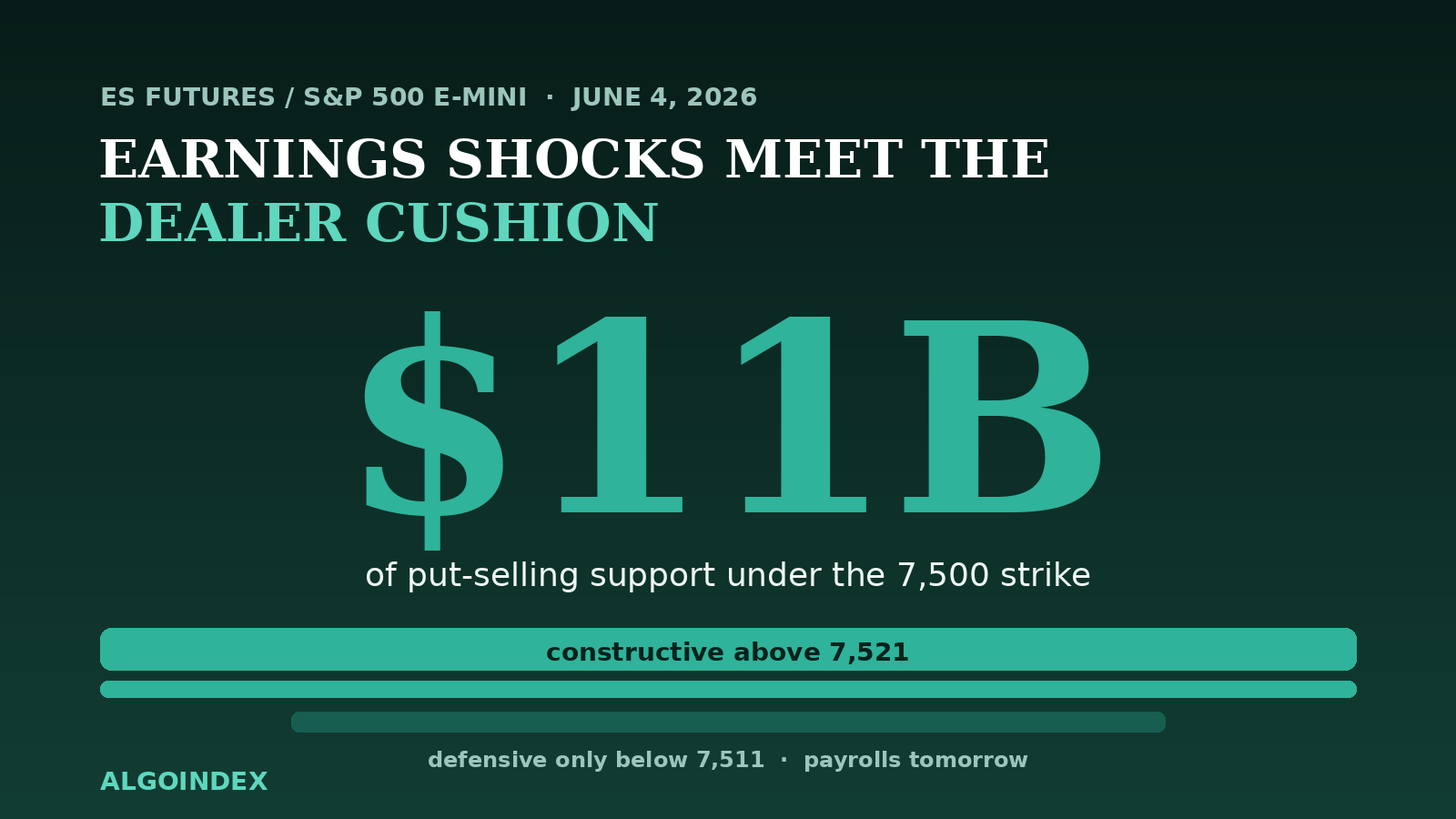
Here is what makes Thursday interesting: the answer underneath the price is calmer than the headlines. While the earnings shocks were landing, institutional options flow was doing the opposite of panicking. Participants met the softness by selling puts in and around the cash 7,500 strike, with a second grouping near 7,400, and that activity has built roughly eleven billion dollars of positive hedging-flow cushion onto market-maker books. Positioning like that mechanically dampens ranges and pulls price back toward magnets instead of letting it trend. The trend is bruised at the surface and supported underneath, and the line where those two stories meet is 7,521 on the E-mini.
The Eleven-Billion-Dollar Net Under the Market
Start with the morning's defining feature, because everything else hangs from it. The put-selling around cash 7,500 and 7,400 supplies a large positive gamma cushion to dealer books. When dealers carry that posture, their hedging works against movement: they buy as price dips toward the heavy strikes and sell as it rallies away, compressing realized ranges and biasing the session toward mean reversion. The practical translation is specific. Expect contained, reverting trade as long as the cash index holds above 7,500, which maps to roughly 7,521 on the E-mini. The defensive shift only arrives on a sustained break beneath the cash 7,490 risk inflection, about 7,511 on the contract, where the hedging mechanics flip and a path toward the cash 7,400 grouping near 7,421 opens. Flow data currently treats that outcome as low-probability given the sheer size of the supportive positioning.
A New High on a Thinning Base
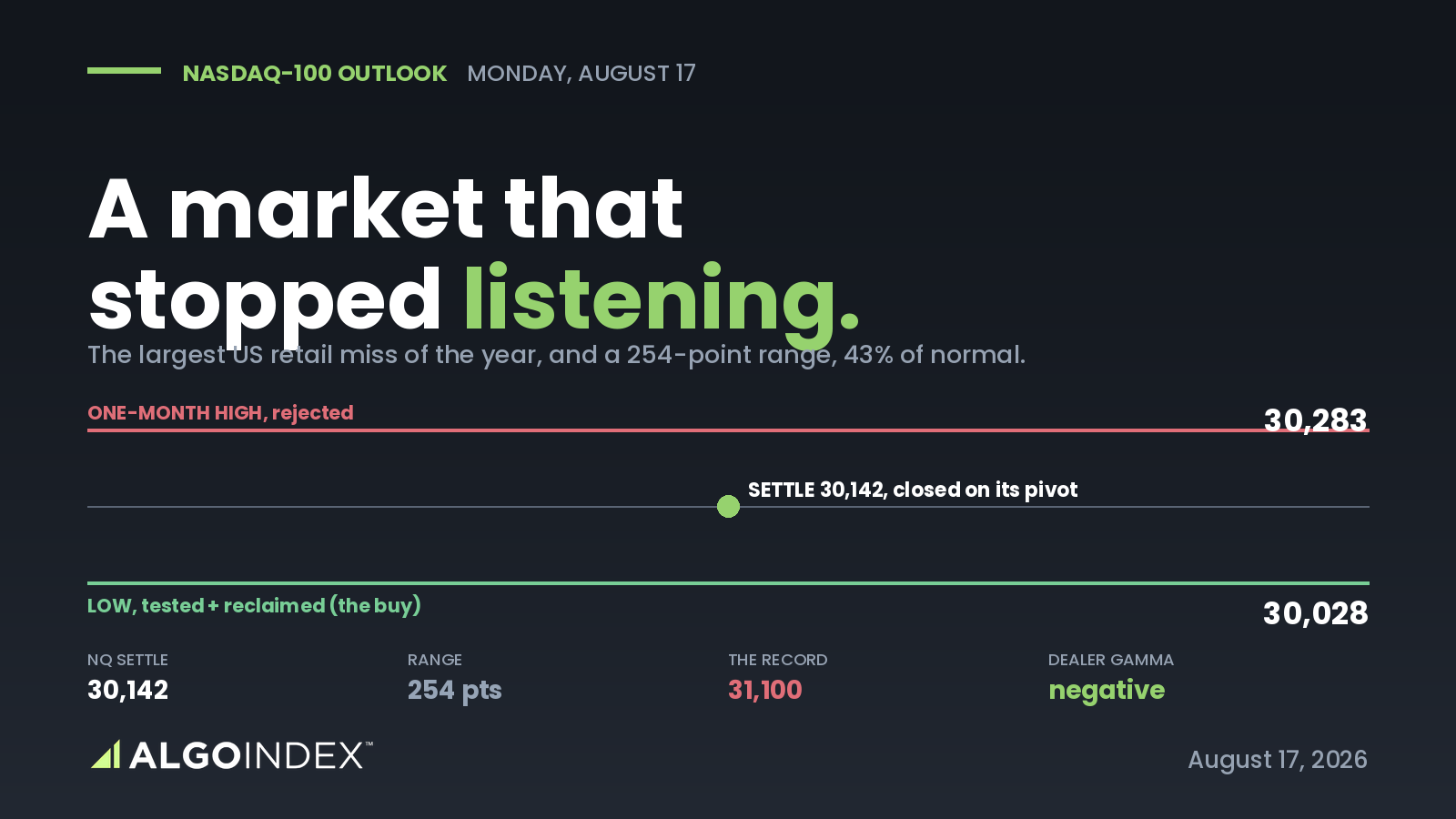
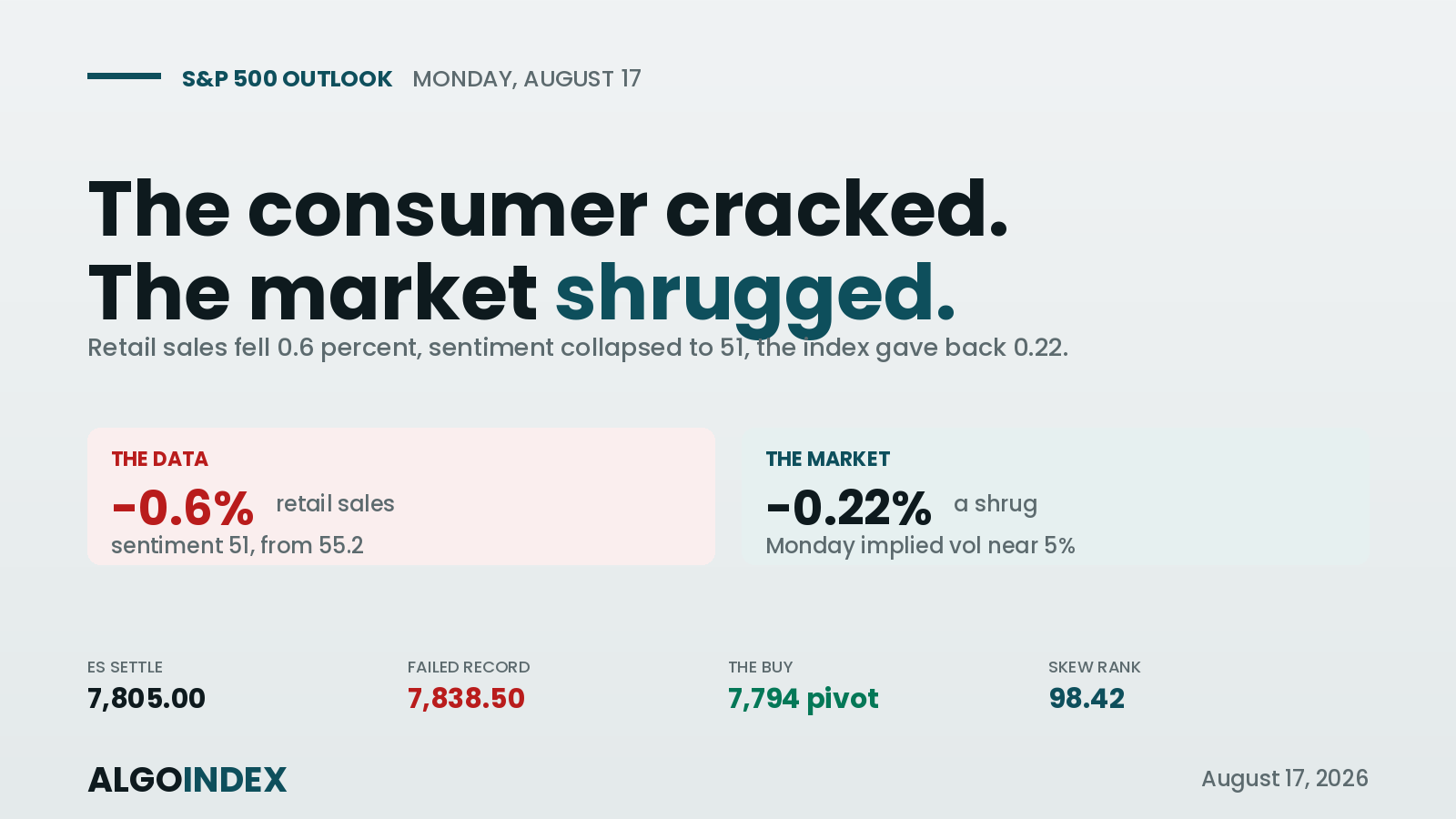
The reason the cushion matters so much is that the leadership underneath the index has narrowed to an uncomfortable degree. Wednesday's session was broad risk-off: the cash index fell 0.74 percent, the Dow dropped 1.21 percent, and the Nasdaq 100 slipped from a fresh record to close down 0.29 percent. Only technology has carried the recent gains while cyclicals and small caps lagged, which means Tuesday's record rested on fewer and fewer winners. A market that makes highs on a thinning base can keep climbing, but it is more exposed to exactly the kind of single-name shock that landed after Wednesday's bell, and today's open is the test of whether dip buyers step in front of the semiconductor weakness or stand aside into payrolls.
The funnel narrows from index to single name: a record built on fewer leaders met its first single-name shock after the bell.
Structure: Bruised Short Term, Intact Everywhere Else
The technical ledger reads the same way at every horizon except the shortest. Price holds well above the rising 20-day average at 7,494, the 50-day at 7,169, the 100-day at 7,036, and the 200-day at 6,949, and the multi-indicator composite still reads 72 percent buy with the 14-day directional index at 31.79 and positive direction dominant at 24.47 over 14.04. What has cracked is the front of the curve: spot near 7,530 sits below the 5-day average at 7,589, the 9-day raw stochastic has dropped to 44.86 with a bearish short-cycle crossover, and the composite's short-term direction is weakening. The 14-day relative-strength reading at 63 describes a market that is firm but no longer accelerating. This is a strong trend taking a breather, with the first sustained two-day giveback since the breakout and a 52-week high at 7,632.25 sitting 0.8 percent overhead.
One red box out of five: a normal short-term mean reversion inside a bullishly ordered average stack.
The Macro Backdrop Around It
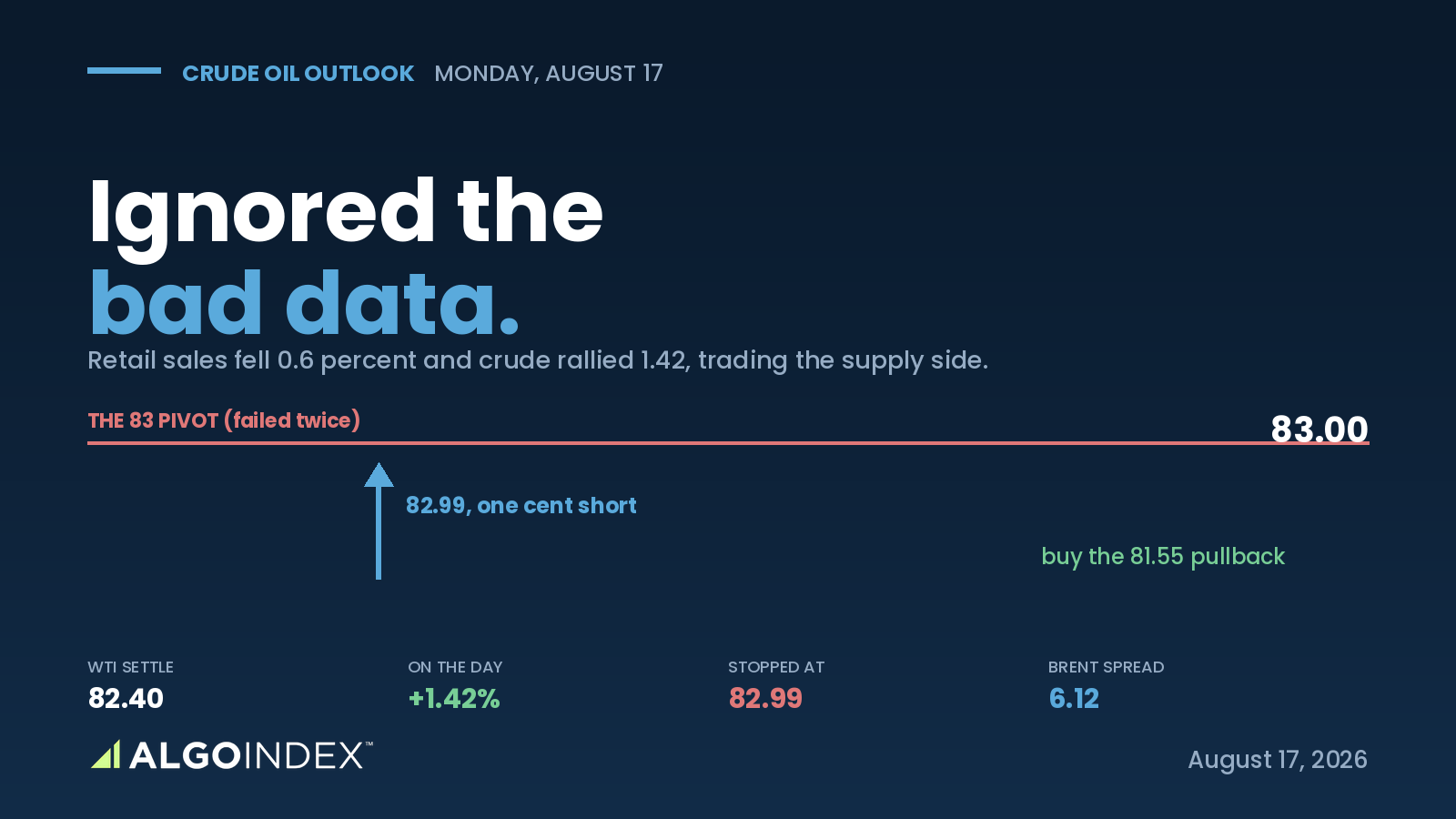
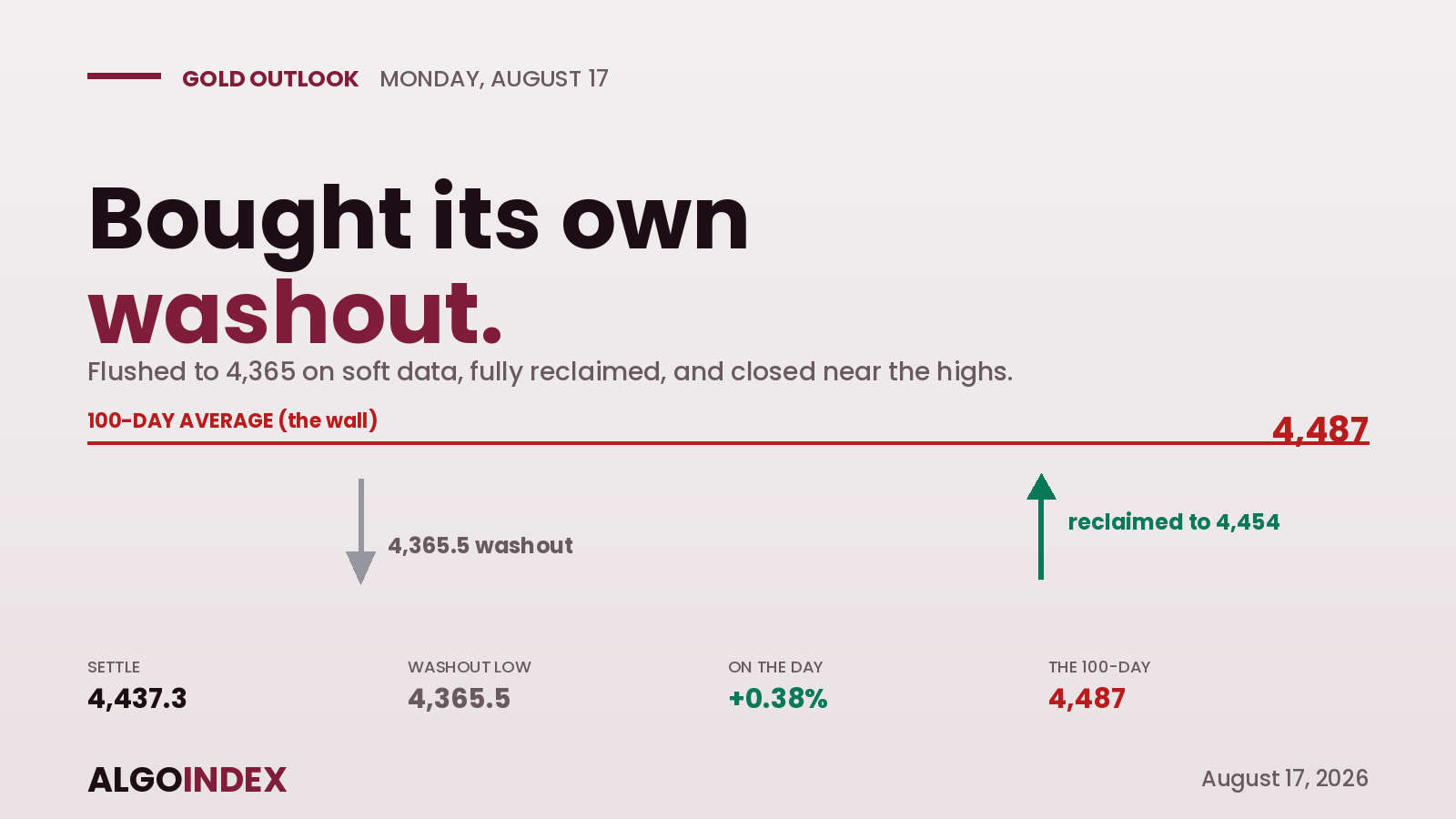
The geopolitical pressure that helped sink Wednesday reversed by Thursday morning. After a Middle East flare briefly drove crude up more than two percent, headlines now point to the United States in final negotiations to end the Iran conflict, and crude has given back roughly three percent to trade near 95. Gold is up about one percent near 4,493 on a safe-haven and inflation-hedge bid, the volatility index at 16.69 is firm but not stressed, and bitcoin is down two percent on the day and roughly fifteen percent over three sessions as speculative risk gets trimmed across asset groups. The cross-asset picture describes a market de-risking selectively rather than panicking. Meanwhile the calendar is a waiting room: today's 8:30 ET jobless claims and productivity data are second-tier, a voting Fed official speaks at 10:00 ET, and everything defers to tomorrow's payrolls. Desks are also paying up for insurance, layering longer-dated put spreads and volatility calls after a correlation risk gauge crossed a caution threshold, the posture of investors who are constructively long the core and hedged at the tail.
A positioning day, mapped: second-tier data, one voter, an afternoon of compression, and the real event tomorrow.
Levels and the Three Paths
Overhead, the first supply shelf is dense: the daily pivot at 7,580.67 sits just above the 7,571.75 prior settle and the 7,567.53 statistical target, all anchored by the 5-day average near 7,589. Beyond it wait 7,605 at the first standard deviation, the 7,619 computed shelf, dealer ceilings near 7,621 and 7,646, and the 7,632.25 record. Below, the overnight low at 7,527.50 is reinforced by standard-deviation support at 7,524.62, then the dealer shelf at 7,521 and the 7,511 inflection, with the 20-day at 7,494 as the deeper structural base of the constructive case. The 14-day true range of 75.30 points frames a likely envelope of roughly 7,460 to 7,600, and the positioning argues for the lower half of it absent a catalyst.
Three paths for a cushioned, pre-payrolls Thursday. Mean reversion is the favorite while the shelf holds.
The Trade: Buy the Net, Not the Story
The primary setup is a constructive, patient long from the dealer-supported shelf: entries in the 7,521 to 7,530 zone on a hold or shallow pullback, or on a confirmed reclaim above 7,545 once the 8:30 data settles, with a stop below 7,511 where the thesis structurally dies. Targets ladder up the reversion path: 7,557 to 7,567 first, the 7,571 to 7,580 settle-and-pivot shelf second, and the 7,590 to 7,605 zone third, roughly one-to-one-point-six out to one-to-four on the full ladder. The mirror trade is a tactical short only on a clear rejection at the 7,567 to 7,580 shelf, targeting a return to the 7,520s, the sell-the-rally posture positive gamma rewards. And the skip list matters more than usual: nothing before 9:45 ET, nothing through a whipsaw data reaction, no net-new risk into the 10:00 speaker, half size everywhere, because the dominant catalyst prints tomorrow morning.
We publish our performance methodology openly so every read can be measured against what it claimed. For the rest of today's complex, see the companion reads on the Nasdaq's tech-specific de-risking, gold's fight at its 200-day line, and crude's fast-deflating war premium, and for how we grade the dealer levels themselves, the live gamma level accuracy tracker.
Headlines broke the surface this week. Eleven billion dollars of positioning is betting the shelf under it holds one more day.
See how AlgoIndex turns this kind of read into a disciplined daily signal.
View pricing →Foundational guides
New to S&P 500 futures? Start with What Are ES Futures, the ES, NQ, MES & MNQ point value and contract specs, gamma exposure (GEX) explained, and market internals: TICK, ADD, VOLD and VIX.