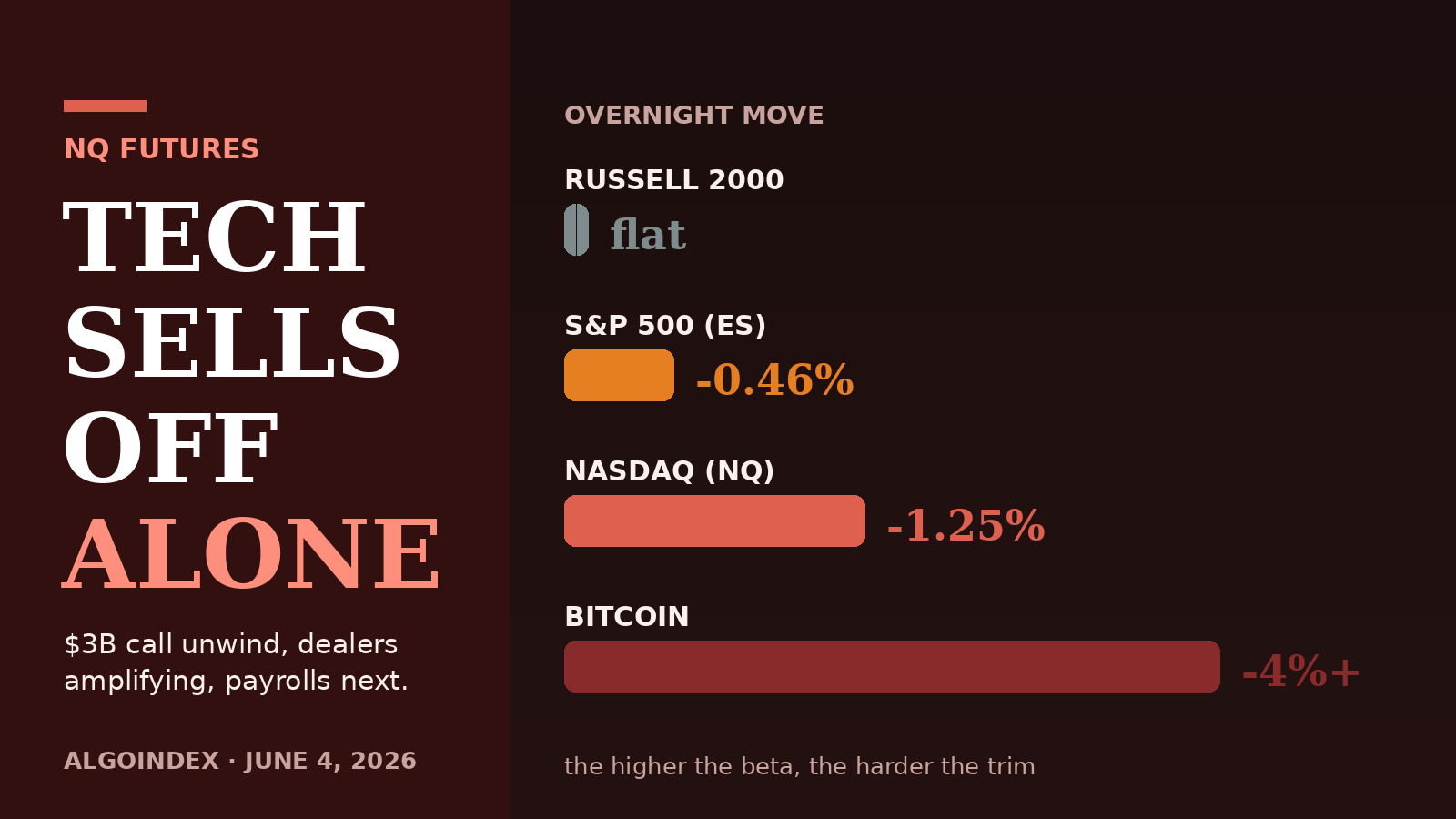
Overnight, while the broad market drifted half a percent lower, the Nasdaq-100 E-mini fell three times as far. NQ enters Thursday's cash session near 30,250, down roughly 380 points or 1.25 percent from Wednesday's 30,633.25 settle, after a slow, persistent bleed through the entire globex session that never once reclaimed the prior close. Small caps, meanwhile, are essentially flat. When the highest-beta index falls alone, the message is not about the economy. It is about positioning.
That is exactly what the options data says. Wednesday afternoon's desk commentary flagged roughly three billion dollars of index-level upside-call unwinding and described extreme call positioning in the largest technology names and in the Nasdaq tracking fund. A crowded long-call posture is being trimmed, and the trim is hitting the most crowded index first. Worse for the intraday trader, dealer positioning in the tracking fund has tilted net short, which means hedging flows now amplify moves in both directions instead of damping them. A de-risking market with an amplifier under it, one day before payrolls, deserves respect in both directions.
The Spread That Tells the Story
The single most useful read this morning is relative. NQ is off about 1.25 percent while the S&P 500 E-mini is down only 0.46 percent and the Russell 2000 E-mini is flat. A broad risk-off event drags everything; a positioning unwind drags the crowded trade. The fact that the de-risking concentrates precisely where the call froth was flagged, the megacaps and the tracking fund, identifies this as a technology-specific trim rather than a flight from equities. Bitcoin, down more than four percent and the highest-beta asset on the board, confirms the pattern from the other end of the risk curve.
Three Billion Dollars of Calls Coming Off
Wednesday was a distribution day for technology in the most literal sense. The Nasdaq-100 cash index closed near 30,191, down 1.27 percent, on roughly three billion dollars of upside-call selling at the index level, the early unwind of a posture the options desk had been calling extreme. The catalyst cited was a crude-oil pop that re-sensitized markets to inflation, but the mechanism was positioning: when everyone owns the same upside, the first sellers move price disproportionately. With no first-tier megacap earnings today, leadership trades on flows and headlines rather than fundamentals, and the only constructive single-name item on the wire is a partnership between a large enterprise-software name and a major cloud provider. Behind it all sits a recurring policy undertone: fresh objections regarding actions on the global semiconductor supply chain, a standing reason crowded chip positions take profits quickly.
The tracking-fund dealer book has flipped to the mode where whichever side breaks first tends to keep going.
The broad-market desk note gives a live example of what amplifier mode does. Wednesday mid-morning, the index broke a key dealer-hedging shelf near 7,595 and fell 44 basis points in roughly ten minutes. Same-day put selling at the day's heaviest strike provided support that, by design, evaporated at expiration. Net real-time hedging flow ran about negative three billion dollars, driven principally by call selling, while fixed-strike implied volatility stayed flat, the signature of a market drifting lower without panic-grade hedging demand. The desk's stance is the template for the whole complex right now: core long maintained, two-to-three-month downside protection added, and the broad-market risk pivot raised to 7,490.
An Uptrend With a Broken Front End
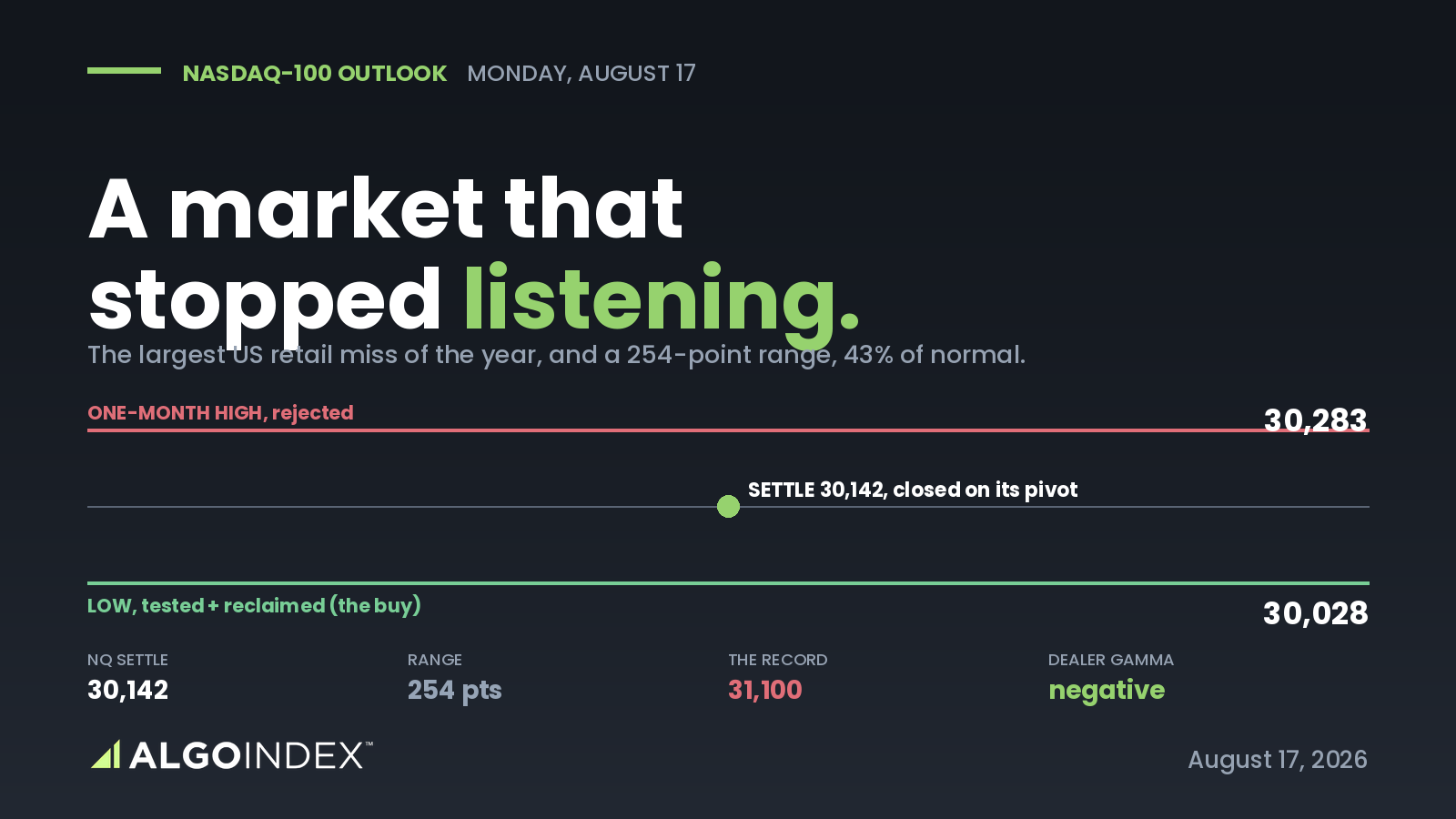
None of this has damaged the structural trend. NQ is up 18.7 percent year-to-date, 20.9 percent over three months, and 39.5 percent over the past year, sits in the top few percent of its 52-week range of 21,471 to 30,807.75, and trades roughly 1.8 percent above its rising 20-day average at 29,721, with the 50-day a full ten percent below price. The 14-day directional index at 37.71 with positive direction at 29.25 over 14.40 describes a strong, intact bullish trend. What has broken is the front of the structure: price slipped beneath the 5-day average at 30,514 and the 9-day reclaim shelf near 30,288, the hourly sequence rolled into lower highs and lower lows, and the 14-day stochastic is crossing down from a stretched 87.88 reading. Repairing the swing requires reclaiming 30,360 and then 30,471 on a closing basis. Until then, this is a pullback inside an uptrend with its short-term momentum lost.
→ 30,142 computed support
→ 30,000 round number
deeper: 29,633 retrace · 29,721 20-day
→ 30,448 - 30,471 shelf
→ 30,544 overnight high
then: 30,639 pivot · 30,807.75 record
With dealers in amplifier mode, the first clean break tends to extend rather than fade. Both branches are mapped before the bell.
The Macro Wrapper
The macro inputs make the positioning read cleaner, not muddier. The dollar is soft at 99.27 and the 10-year yield is easing toward 4.49 percent, conditions that ordinarily support long-duration technology valuations. NQ selling off despite that tailwind reinforces that the pressure is flow-driven, not rate-driven. The Middle East backdrop improved at the margin overnight, with a lifted naval blockade, troops turned back, and renewed diplomatic contact pushing crude down 1.35 percent near 94.70 and removing Wednesday's inflation-sensitivity input. The volatility complex is firming, with the broad-market gauge up 3.6 percent to the mid-16s. And the calendar is a waiting room: this morning's layoff-announcement survey already printed 97,006 against 83,387 prior, a softening labor signal that feeds straight into tomorrow's employment report, while today's 8:30 ET claims and productivity data are second-tier curtain-raisers.
Paths and the Trade
The day resolves three ways. The base case, about 45 percent, is drift and chop between 30,142 and 30,471 with no clean break, the market compressing into the labor data. The downside continuation, about 35 percent, loses 30,204 and 30,142 with the amplifier extending the move toward the 30,000 round number. The bullish reclaim, about 20 percent, retakes 30,310 and 30,471 and lets the same amplification work upward toward the 30,639 pivot. Afternoons before an employment report compress; if the morning breaks down, the familiar pattern is a partial bounce back toward the broken level as shorts cover into the close. A close above 30,471 is the constructive tell into the print; a close at or below 30,142 signals continuation risk.
We publish our performance methodology openly so every read can be measured against what it claimed. Today's companion reads cover the eleven-billion-dollar cushion under ES, gold's stand at its 200-day average, and crude's deflating war premium, and the mechanics behind dealer amplification live in our dealer gamma positioning guide.
When the most crowded index falls alone on a calm macro day, the market is not repricing the future. It is repricing its own consensus.
See how AlgoIndex turns this kind of read into a disciplined daily signal.
View pricing →Foundational guides
New to Nasdaq 100 futures? Start with What Are NQ Futures, the ES, NQ, MES & MNQ point value and contract specs, QQQ gamma exposure (GEX), and market internals: TICK, ADD, VOLD and VIX.