Short answer
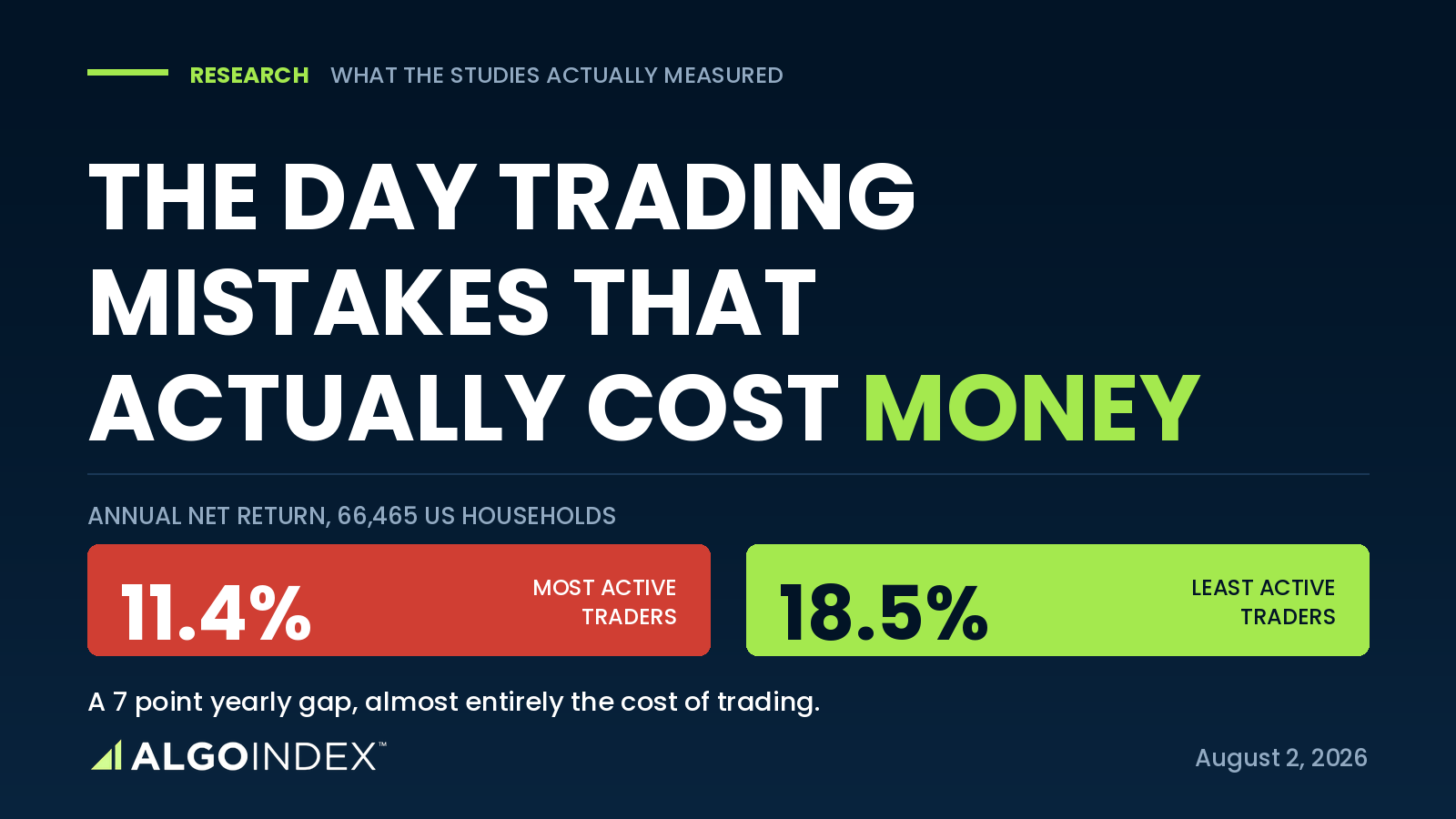
The mistakes that drain retail day trading accounts are not exotic. Overtrading is the most expensive by a wide margin, because trading costs compound faster than any edge most retail traders have. A study of 66,465 households found the most active traders netted 11.4% a year while the least active netted 18.5%. Add the disposition effect, position sizing by feel, and no pre-set exit, and you have most of the distribution of losses. Each one is a decision made under pressure, which is why rules that remove the decision tend to work better than resolutions to decide better.
Before the opening bell on March 13, 2026, I bought 0DTE puts.
The setup looked right. Overnight price action had rolled over, the levels lined up, and waiting felt like leaving money on the table. Then a $25 squeeze ran through thin pre-market liquidity and the position was underwater before the market officially opened. Nothing about my read was wrong. The direction eventually came. I just wasn't there for it, because I'd sized and entered into a book with no depth, at an hour where a handful of orders can move price further than any thesis can survive.
That trade is now a rule in our system: no entries before 9:45 AM ET, ever, for any reason. Not a guideline. A hard gate in code that refuses the order.
The gap between knowing and doing
Ask any losing trader what they did wrong and they'll usually tell you correctly. They traded too much. They held the loser. They sized up after two wins. They know. The knowledge was never the missing piece.
What the research shows, consistently, across four decades and multiple countries, is that retail trading losses concentrate into a small number of repeated decisions, each made in the same emotionally loaded moment. The fix that works is rarely more information. It's removing the moment.
This piece ranks those mistakes by what they actually cost, using the primary studies rather than the numbers that get recycled on trading forums. Then it gets into what rules-based execution genuinely solves, and where it fails, because anyone selling you automation without that second half is selling you something.
Mistake one: overtrading, and it isn't close
If you fix one thing, fix this.
Brad Barber and Terrance Odean studied 66,465 households at a large US discount broker between 1991 and 1996. They sorted by portfolio turnover. The top 20% by trading activity earned an annual net return of 11.4%. The bottom 20%, the near buy-and-hold group, earned 18.5%. Same market. Same period. A gap of roughly seven percentage points a year, and it was almost entirely trading costs, not worse stock selection. The paper's title says it plainly: Trading Is Hazardous to Your Wealth.
Seven points a year, compounded, is the difference between a retirement and a hobby.
The same team went to Taiwan and got a harder version of the answer. Across the full Taiwan Stock Exchange dataset, more than eight out of ten day traders lost money in a typical six-month window. Heavy day traders generated real gross profits, roughly NT$36.4 million in mean daily terms, and still finished with net daily losses of NT$68.9 million once transaction costs were applied. The edge existed. The costs ate it and kept going. Over a fifteen-year sample, day traders lost an average of 23.9 basis points per day net of fees, and aggregate performance was negative in fourteen of fifteen years. Roughly 5% of active traders were consistently profitable.
Then Brazil, which is the study I'd hand to anyone who thinks persistence is the answer. Chague, De-Losso and Giovannetti tracked 19,646 individuals who began day trading Brazilian mini-index futures between 2013 and 2017. Of the 1,551 who stuck with it past 300 trading days, 97% lost money. Just 1.1% earned more than the Brazilian minimum wage. Half a percent earned more than a bank teller's starting salary. The authors looked specifically for evidence of learning over time and did not find it.
Now put options on top. A 2022 study by de Silva, Smith and So examined contract-level retail options data from 2010 through early 2021, a window in which retail options volume grew from around $20 billion to roughly $240 billion. Retail traders paid bid-ask half-spreads averaging about 8% and lost 5% to 9% on average, worsening to 10% to 14% around high-volatility earnings events. Aggregate retail options losses across the sample ran to about $3 billion. A 2023 Journal of Finance paper by Bryzgalova, Pavlova and Sikorskaya found the aggregate retail options portfolio lost $2.1 billion between November 2019 and June 2021, with the losses driven mainly by the cost of trading rather than by bad directional calls.
The directional bets weren't the problem. The act of placing them was.
Why traders overtrade
Overconfidence, mostly, and it's measurable. Barber and Odean's 2001 paper studied 35,000 households and found men traded 45% more than women and earned annual risk-adjusted net returns 1.4 percentage points lower. Among single account holders the effect widened: single men traded 67% more than single women and gave up 2.3 points a year for the privilege. The trading itself was the entire cost. Confidence produced turnover, turnover produced fees, fees produced the shortfall.
There's a second driver nobody wants to name. Boredom. A flat morning with no setup feels like failure, and the account is right there. The trade you take at 11:40 because nothing has happened since 10:00 is not in your strategy document. It's in your P&L.
Mistake two: selling winners, riding losers
Odean's 1998 study of 10,000 discount brokerage accounts found investors were 1.5 to 2 times more likely to sell a winning position than a losing one. Not explained by tax-loss harvesting. Not explained by rebalancing. Not justified by what the stocks did afterward. It reduced after-tax returns.
This is the disposition effect, and prospect theory explains the mechanics. Kahneman and Tversky's 1979 paper established that losses register more intensely than equivalent gains, later quantified at roughly a 2.25 to 1 ratio. So closing a green trade delivers a clean small pleasure, while closing a red one requires accepting a disproportionately painful fact. Holding the loser defers the pain. The position stays open, the loss stays unrealized, and the trader stays technically undefeated.
Every trader who has ever moved a stop knows exactly what this feels like from the inside. Mine included.
Mistake three: the mechanical ones
These are less interesting and just as fatal.
Sizing by feel. Position size after two wins is not position size after two losses, and neither is the size your written plan specified. Inconsistent bet sizing is the single fastest amplifier of ruin risk, because it guarantees your largest positions arrive precisely when your judgment is most distorted.
No pre-set exit. If the exit is decided while the position is open, it's being decided by someone with money on the line. That person is not your best analyst.
Averaging down into a loser. This converts a small planned loss into an unplanned large one, and it feels like conviction while you're doing it.
Ignoring the cost of trading. The options research above is the clearest indictment: an 8% average half-spread means the position needs to move 8% just to reach breakeven, before commissions, before slippage.
Holding overnight. Gap risk is the one exposure a day trader is explicitly not being paid to take.
The industry's own numbers corroborate the aggregate result. Under rules the European Securities and Markets Authority introduced in 2018, brokers offering contracts-for-difference must publish the percentage of their own retail clients who lose money. The regulator's analysis across EU jurisdictions found 74% to 89% of retail CFD accounts lost money, with average per-client losses between €1,600 and €29,000. Those disclosures are still live: a major UK broker's current homepage banner states that 69% of retail investor accounts lose money trading spread bets and CFDs with that provider. These are not critics' figures. They are the brokers' own, published under legal compulsion.
One piece of current context worth knowing, because it changes the friction: FINRA eliminated the pattern day trader rule effective June 4, 2026, replacing the old four-trades-in-five-days count and the $25,000 minimum equity requirement with an intraday risk-based margin approach. For years the PDT rule functioned as an accidental brake on undercapitalized overtrading. That brake is gone. Whatever you think of the rule, its removal means the discipline now has to come from somewhere else.
A number you should stop repeating
"90% of day traders lose money" appears everywhere and traces to no single study. It's a compression of the Taiwan finding (more than 80% losing in a typical six-month period) and the Brazil finding (97% of those who persisted past 300 days). Both are real, both are worse than the folklore in their own way, and both are more useful because you can check them. Cite those instead.
Why knowing all this doesn't fix it
Here's the turn, and it's the part that took me longest to accept.
I assumed for years that the answer to undisciplined trading was better discipline. Study harder, journal more honestly, want it more. That model is wrong, and there's a well-established body of research explaining why.
In 1954 Paul Meehl published a comparison of clinical judgment against simple statistical rules across a range of prediction tasks, and found the rules generally won. The finding held up. Grove and colleagues published a meta-analysis in 2000 covering 136 studies: mechanical prediction was about 10% more accurate on average, outperformed expert judgment in 33% to 47% of studies, and was outperformed by expert judgment in under 5%. Robyn Dawes showed in 1979 that even crude linear models with arbitrary equal weights beat the human experts whose judgments they were built to imitate.
That literature is clinical rather than financial, so treat the bridge to trading as an argument by analogy, not proof. But there is direct evidence too. Locke and Mann's 2005 study in the Journal of Financial Economics found that among professional futures traders, the discipline to realize losses quickly predicted trading success. And a 2022 study by Liaudinskas comparing algorithmic and human traders found that algorithmic traders showed no disposition effect while human traders did, with the human bias correlating with mood-linked variables such as weather.
Same market. Same instruments. One group holds losers because it's holding losers, and the other doesn't, because it can't.
The mechanism has a name in behavioral economics: the commitment device, or Ulysses contract. Ulysses didn't resist the sirens through willpower. He had himself tied to the mast in advance, while calm, and removed his own ability to act on the impulse he knew was coming. Every hard trading rule is a rope.
What automation actually removes, and what it doesn't
Let me be direct about the limits first, because this is where most content on this subject goes quiet.
Backtest overfitting is the dominant failure mode of systematic trading. Bailey, Borwein, López de Prado and Zhu showed in 2014 that with enough trials, a strategy with no real edge can be tuned to produce an impressive backtest, and they introduced the Deflated Sharpe Ratio specifically to correct for the number of attempts. Harvey, Liu and Zhu documented roughly 300 published factors purporting to explain returns and argued that conventional significance thresholds are far too lenient given how much testing has occurred. If a system's only evidence is a beautiful historical curve, the beautiful historical curve is the warning.
Automation fails technically. Knight Capital lost approximately $440 million in 45 minutes in August 2012 through a deployment error. The May 2010 Flash Crash, documented in the joint SEC and CFTC report, showed how automated execution interacts with thin liquidity in ways nobody modeled. FINRA's Regulatory Notice 15-09 exists because supervision of automated systems is a real and ongoing obligation, not a solved problem.
Automation removes the human from the good judgment calls too. A system fires every qualifying entry, including on days when an experienced discretionary trader would have looked at the conditions and stayed flat. That is a genuine cost, and it's paid on real days.
With all of that on the table, here is what a rules-based system does structurally, which no amount of resolve does reliably.
It removes the decision point. Not the decision quality, the decision moment. There is no instant at which a person with money at risk chooses whether to honor the plan, because by then the order is placed. Sizing becomes arithmetic instead of mood, and the formula has no idea you're on a losing streak. The exit stops being a judgment call made under pressure and becomes a property of the trade itself, set before entry, indifferent to how the position feels an hour in. The record gets complete, too. Systems log the trades a human would rather forget.
How we built AlgoIndex around these specific failures
We built our platform against this list, one control per failure. That's the honest description of the design process.
That 9:45 gate, as noted at the top, is my March 2026 loss written into code so nobody else has to buy it.
One more control, and it points at us rather than at the trader. We publish the graded accuracy record of our market-structure calls, and we released the underlying dataset, 1,652 scored rows, under an open Creative Commons license so anyone can audit the methodology instead of trusting a marketing number. We deliberately do not publish a headline win rate. Any service quoting you a precise win-rate percentage is either mistaken or about to be. Our performance methodology is public for the same reason.
Two things we are not. We are not a broker and we never hold your money; execution happens at your own brokerage account, and if we disappeared tomorrow your funds would be unaffected. And we are not a registered investment advisor. This is research and software tooling, not personalized advice, and options carry real risk of substantial loss including total loss on short-dated contracts.
The part that's still on you
None of this makes anyone a good trader. A rule that stops you from overtrading a bad strategy just gets you to the same destination more slowly and with better records.
What it does is close the specific gap the research keeps finding, between the trader who knows what to do and the trader who does it at 11:40 on a slow Tuesday with a red position on screen and a strong opinion about what happens next.
Ulysses still heard the sirens. He just couldn't reach the wheel.
Start with the free AI trading journal. It grades every trade you log against your own statistics, including the ones you would rather forget.
View pricing