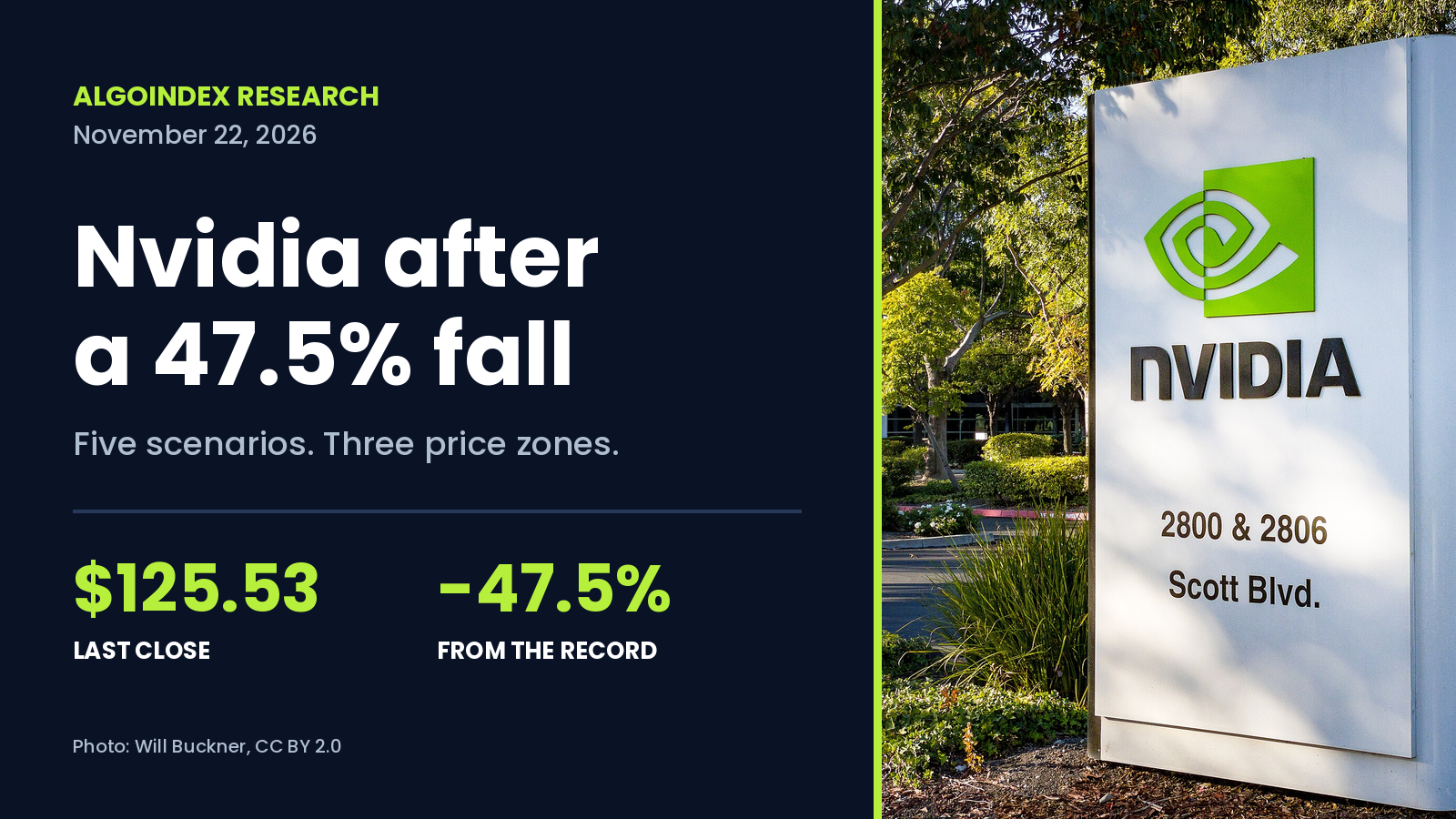
The short answer. Nvidia closed at $125.53 on November 20, 2026, 47.5% below its October 6 record, days after reporting the largest quarter in its history. The decline follows a leadership change, a reported regulatory inquiry into its accounting and a quarterly report that is not yet filed. Our base case, which we estimate at 35%, is that earnings hold and the discount fades slowly. Three price zones stand out as places where support could form: $118 to $126, $96 to $108 and $81 to $90. These are our estimates, not forecasts or guarantees.
On November 17, Nvidia reported the largest quarter in its history. Revenue reached $115.8 billion, up 103% from a year earlier, and the company told investors to expect about $130 billion in the current quarter, almost $5 billion more than analysts had pencilled in. Three sessions later the stock closed at $125.53, down 14.0% on the day. It was the worst session since January 2025.
Both facts are true at once. On its reported results the business has rarely been stronger, and the shares have lost 47.5% in 45 days. In our reading, the decline reflects a loss of trust more than a loss of demand. A founder who ran the company for 33 years resigned effective November 11, regulators are reported to be examining the accounting, the quarterly report is not yet filed and the company has disclosed guarantees with a maximum gross exposure of $118 billion, mostly tied to a data center campus built for a customer.
We had been watching the group weaken. In our October 30 research note we wrote that chip stocks had entered a bear market while the broad market held, and Nvidia sat 14.5% below its high that day. It has since fallen much further than the group. At about 8 times next year's expected earnings, the stock is priced as though those earnings may not arrive. This article sets out what happened, what the company is dealing with, what analysts are saying, five ways the story could develop and where the price could find support.
How a record quarter became a seven-week decline
The reported numbers were strong. Data center revenue came in at $107.6 billion, up 110%. Gross margin held near 75%. Free cash flow was $43.8 billion in a single quarter. Management raised its fiscal 2028 growth guidance to about 75% from 70%.
The stock rose after hours on the report, then fell 2.9%, 3.3% and 14.0% over the next three sessions. When a result beats estimates and the stock still sells off this hard, our reading is that investors are weighing whether the reported figures can be relied on, and who leads the company next. Other factors, including a weak week for the wider market, may also have contributed.
CNBC reported on November 20 that seven straight weekly declines is the longest such run for the stock since 2008, and that Nvidia is now the fourth-largest US company by market value, behind Apple, Microsoft and Alphabet. It remains one of the largest weights in the major indexes. The Nasdaq-100 tracking fund fell about 9% in the week of November 16. Our latest Nasdaq-100 futures outlook and S&P futures outlook cover that spillover.
The problems on the table
Leadership and legal. Finance chief Colette Kress is interim chief executive while a search runs, and chair Harvey Jones said on November 17 that the company is not considering reinstating Mr. Huang. Reuters reported on November 20, citing two people briefed on the matter, that securities regulators are looking into the company's accounting practices; the specific questions are not public. Three separate government tracks are also open, and they are not the same thing. First, California's attorney general announced on November 19 an investigative subpoena to Nvidia, asking whether advanced chips or confidential information reached China and whether investors were misled. Second, House lawmakers said on November 17 that Mr. Huang agreed to voluntary transcribed interviews with three House committees on December 1, with Nvidia's general counsel the following day. Third, on November 12 the senior Democrats on the House Ways and Means Committee and the Senate Finance Committee, Richard Neal and Ron Wyden, opened an inquiry directed at the Commerce Department over how the administration approved and taxed Nvidia chip exports to China. Reuters reported in October that Justice Department antitrust officials are asking about the $12.9 billion purchase of Hugging Face, and the New York Times reported that the department has taken over the federal investigation of Megaspeed. None of this establishes wrongdoing. The single most important near-term event is the quarterly report, due by December 4. Filed on time with no restatement, it could reduce the accounting risk. A missed deadline or revised figures could deepen it.
China. The current-quarter outlook assumes no data center chip revenue from China. In November the Commerce Department adopted a rule restricting remote access to advanced AI chips by companies based in China, which reaches overseas data centers that rent computing power to them. The cost to Nvidia has not been disclosed.
Financing its own customers. This is the issue analysts pressed hardest on the earnings call. Nvidia bought $58.1 billion of equity stakes in nine months, close to the $61.2 billion it spent on buybacks. It has also guaranteed up to $118 billion of obligations if partners default. About $105 billion relates to an Ohio data center campus being built by SB Energy to host Nvidia systems under 20-year leases to OpenAI, and those guarantees take effect in phases, the first expected in fiscal 2029. Nvidia said it has made no payments on its guarantees. Total commitments and guarantees are about $668 billion, mostly supply contracts. The customer group that includes smaller AI cloud providers grew 195% and produced more than half of the yearly increase in data center revenue. Those are the buyers that rely most on outside credit. Ms. Kress said the company would be "disciplined and selective" from here.
The spending gap. The largest cloud companies kept their spending plans high in their October reports. Amazon guided to about $220 billion of capital spending for 2026, Alphabet to $195 billion to $205 billion and Meta to $135 billion to $145 billion. Microsoft guided to about $170 billion, slightly below its earlier figure of about $175 billion, citing capacity delays. But one analyst expects the largest buyers to raise spending 25% to 50% in 2027. Nvidia is guiding to 75% growth. Closing that gap takes share gains or faster growth from everyone else.
Competition. Outside estimates put Nvidia at about 75% to 81% of AI accelerator revenue this year, down from a peak near 87% in 2024. Custom chips designed by the cloud companies hold 12% to 18%. Anthropic's computing footprint is about 42% Nvidia. OpenAI has signed for 6 gigawatts of a rival's accelerators and 10 gigawatts of custom chips alongside its Nvidia plans. Gross margin is guided down to 71% to 72% this quarter, which management called the low point.
What analysts are saying
Most analysts still rate the stock a buy: 47 of 61, according to StockAnalysis data cited by Moneywise on November 16, with hold ratings up to 14 from two in October. Six firms downgraded around the resignation: Evercore ISI, Bernstein, Baird, HSBC, Truist and Oppenheimer, which dropped its target altogether. The average target in that data was about $268, about double the last close.
The numbers underneath those targets kept rising. The analyst consensus for fiscal 2028 earnings compiled by TIKR stood at $15.93 a share on November 10, up from $12.84 three months earlier. That is an adjusted, analyst-estimate figure, not a reported result under accounting rules. On that evidence estimates were still rising into the selloff. The discount is for governance and for the chance that those estimates prove too high.
The split is over how long that discount lasts. Morgan Stanley kept an overweight rating while cutting its target to $267 from $300 after the resignation and again to $260 on November 18, after results, and called its own reduced data center estimates overly conservative. Citi kept a buy rating with a target of $225, down from $285. Bernstein moved to market perform and halved its target to $200 from $400, writing that it had "had enough."
The earnings estimates kept rising in November. The price paid for them was cut nearly in half.
Five ways this could develop
No one knows which path the company takes. The five scenarios below cover the range we consider plausible over roughly twelve months, with our own probability estimates. They are judgments, not forecasts, and no outcome is assured. They add up to an even split: about 50% for the base case or better, about 50% for slower growth or worse.
Several events could shift those odds quickly. A reopening of China would add revenue that is not in any estimate, though the November rule makes that unlikely soon. A large customer moving a full generation of systems to custom chips could take 5 to 10 points off long-run share. A default at a financed customer would hit revenue, guarantees and equity stakes together. A disruption in Taiwan could interrupt supply for much of the industry.
Over three years, our base case assumes Nvidia keeps about 65% to 75% of accelerator spending as custom chips grow, and that earnings compound from about $16 a share in fiscal 2028 toward a range of $21 to $25. If that happened, 12 times $21 is about $250 and 14 times $25 is $350 a share. That is arithmetic on an assumption, not a price forecast. The current price implies a much weaker outcome. The main five-year risk is that AI capital spending has never been through a downturn.
Where the stock could find support
Start with valuation. At $125.53 the stock trades at about 7.9 times the $15.93 consensus for fiscal 2028 earnings compiled by TIKR on November 10. In its past selloffs the low came at far higher multiples: about 17 times trailing earnings in December 2018, about 23 times forward earnings in April 2025 and 19.9 times in March 2026. The multiple is already less than half of every prior low.
That is why cheapness alone may not mark the low. In earlier declines the multiple compressed while the earnings estimate stayed credible. This time the estimate itself is in doubt.
History gives two reference points. Repeating the 56% decline of 2018 from the record close would mean about $105. Repeating the 66% decline of 2022 would mean about $81. Both of those came with earnings that actually fell, which has not happened here.
Zone 1, $118 to $126. The stock is here now. The November 20 low was $124.50, and the closing price on the day of the January 2025 selloff was $118.42. Options activity that day ran at twice its usual volume, a reading often seen near lows but not proof of one. In our view this zone has a reasonable chance of holding if the filing arrives cleanly in December.
Zone 2, $96 to $108. This becomes the more likely area if the quarterly report misses its December 4 deadline or the inquiry widens while estimates are cut only moderately.
Zone 3, $81 to $90. This zone would likely require an actual hit to earnings: a restatement, or a financing or spending shock. We estimate the chance of prices below $80 at about 5% to 7%. None of these zones is a guarantee that buyers will appear.
| Earnings basis | 7x | 8x | 10x | 12x |
|---|---|---|---|---|
| Consensus fiscal 2028, $15.93 (TIKR, November 10) | $112 | $127 | $159 | $191 |
| Slower growth, about $12 to $14 | $84 to $98 | $96 to $112 | $120 to $140 | $144 to $168 |
| Severe downside, about $9.70 | $68 | $77 | $97 | $116 |
A durable low would likely show four things: a filed quarterly report with unchanged revenue recognition, evidence that the buyback is running at about $45 billion a quarter, a monthly close back above roughly $146, and 2027 spending plans from the cloud companies that keep the consensus above $1 trillion.
What investors can watch
The reported balance sheet shows ample liquidity. Nvidia held $53.5 billion of cash and debt securities against $32.4 billion of long-term debt on October 25. The buyback authorization of $227.3 billion equals about 7.5% of market value. One open question is whether the company holds back on repurchases while the quarterly report is pending.
Each quarter, the figures that matter most are the split between the largest cloud buyers and everyone else, gross margin against the 71% to 72% guide, receivables, which have risen to $81.0 billion from $38.5 billion in January, and any change in guarantees.
The next move may be decided by a quarterly report that is due by December 4.
Sources and methodology. Prices are closing prices as of November 20, 2026. Company figures come from Nvidia's fiscal third-quarter 2027 release and call of November 17, 2026. The resignation date and interim appointment come from Nvidia's Form 8-K dated November 11, 2026. Regulatory and legal developments are as reported by Reuters, the Wall Street Journal, the New York Times, the Associated Press, CNBC, The Hill and TechCrunch between October 28 and November 20, 2026. The fiscal 2028 consensus earnings estimate of $15.93 a share and its three-month comparison of $12.84 are analyst consensus figures compiled by TIKR, as published on November 10, 2026, on an adjusted basis. Morgan Stanley's $260 target is as reported on November 18, 2026; other targets in the chart are as of November 12 to November 16. Analyst targets and ratings are as reported by Moneywise on Yahoo Finance and 24/7 Wall St. on November 12 and November 16, 2026. Guarantee details are from Nvidia's third-quarter disclosures as reported by The Motley Fool on November 17, 2026. Scenario probabilities, price zones and the earnings grid are AlgoIndex estimates, not forecasts or guarantees, and nothing here is investment advice. Header photo of the Nvidia sign: Will Buckner, CC BY 2.0, via Wikimedia Commons, cropped, with text and graphics added by AlgoIndex.
AlgoIndex publishes daily levels and research for S&P 500, Nasdaq-100, gold and crude oil futures.
View plans